Remember the children of Palestine/ War effects on children/09/ 08 /2009 /Part1:
Related News
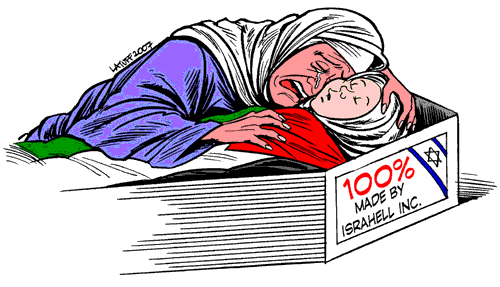
Palestinian child dies due the siege on Gaza, death toll 352
Source: IMEMC
Date: September 09, 2009
A Palestinian child was announced dead on Wednesday after she was prevented from leaving the Gaza Strip for medical care she needed.
Dinna Al Zakzok, seven years old, had Lymphatic gland tumor, he family had completed all needed documents to leave Gaza but still the Israeli military did not allow he to leave.
The Palestinian Ministry of Health in Gaza announced that the number of patients who died in Gaza due to the Israeli siege have now reached 352.
Israel placed the Gaza Strip under total siege in June of 2006 leaving the 1.5 million Palestinians living there lacking medial, food, and fuel supplies.
Part 1
Health conditions are worse in Gaza
Part 2
The same as above goes for education in Gaza
OPT: Gaza schoolchildren lack basic equipment
Source: IRINNEWS.ORG
GAZA CITY, 9 September 2009 (IRIN) - Some 1,200 students at al-Karmel High School for boys in Gaza City returned to class on 25 August without history and English textbooks, or notebooks and pens - all unavailable on the local market.
Severe damage to the school - caused during the 23-day Israeli offensive on the Gaza Strip which ended on 18 January - has yet to be repaired. Al-Karmel’s principal, Majed Yasin, has had to cover scores of broken windows with plastic sheeting.
“The entire west side of the school was damaged adjacent to Abbas police station which was targeted on 27 December,” said Yasin. “We have yet to repair the US$65,000-worth of damage, since glass and other building materials are still unavailable.”
Educational institutions across Gaza are still reeling from the effects of the Israeli offensive, compounded by the more than two-year Israeli blockade (tightened after Hamas seized power in June 2007), according to the UN Office for the Coordination of Humanitarian Affairs (OCHA).
At least 280 schools out of 641 in Gaza were damaged and 18 destroyed during the military operation. None have been rebuilt or repaired to date due to continued restrictions on the entry of construction materials, OCHA reported.
At the start of the new school year, all 387 government-run primary and secondary schools serving 240,000 students - and 33 private sector schools serving 17,000 students - lack essential education materials, according to the education ministry in Gaza.
Half of all students lack at least one textbook for their coursework this term, the ministry said.
“The war had, and continues to have, a severely negative impact on the entire education system,” Yousef Ibrahim, deputy education minister in Gaza, said. “About 15,000 students from government schools have been transferred to other schools for second shifts, significantly shortening class time.”
He said the damaged schools lacked toilets and water and electricity networks; their classrooms were overcrowded, and they also suffered from shortages of basic items such as desks, doors, chairs and ink for printing.
UNRWA schools affected
More than 80 percent of government-run schools and those run by the UN agency for Palestinian refugees (UNRWA) now have a second shift, according to Ibrahim.
The 221 primary and secondary schools run by UNRWA (in addition to government and privately run schools) are also struggling to accommodate 200,000 students this school year.
“We have only provided the minimum amount of stationery and textbooks to our students, since it is very difficult to bring in these materials and they are unavailable on the local market,” said UNRWA spokesperson Milina Shahin in Gaza.
UNRWA schools are also missing items such as lab equipment, calculators, desks, tables, chairs, and even crayons, said Shahin.
UNRWA planned to build 100 new schools this year, but has had to give up the idea due to a lack of building materials. Thirty-five UNRWA schools are still without windows as a result of the offensive, due to a lack of glass, Shahin said.
“There is no generator at al-Karmel High. The lack of electricity, often all day, is a real challenge for our teachers,” said al-Karmel principal Yasin.
Truckloads of stationery await clearance
Since the beginning of 2009, Israel has allowed 174 truckloads of educational materials to enter Gaza. Of these, only two were carrying stationery, in July and August, OCHA said.
According to the Palestine Trade Centre (PalTrade) and local suppliers, there are nearly 120 truckloads of stationery awaiting clearance to enter.
Ghazi Hamad, head of borders and crossings under the Hamas-led government in Gaza, said some educational materials, such as notebooks and clothing, had entered Gaza via underground tunnels from Egypt, but this was only a token amount.
Teaching has also been affected by the Fatah-Hamas rift: Of the 11,000 teachers in Gaza, 7,000 are employed by the Palestinian Authority in Ramallah (West Bank). Half of these did not return to teach this school year, according to deputy education minister Ibrahim.
“We had to replace them with less qualified teachers, while they chose to stay at home,” he said.
es/ed/cb
Palestine Video - A Palestine Vlog
Showing posts with label Education. Show all posts
Showing posts with label Education. Show all posts
Thursday, September 10, 2009


Friday, September 4, 2009
Education gap divides Jerusalem - 03 Sep 09
Education gap divides Jerusalem - 03 Sep 09:
"A recent report by an Israeli non-governmental organisation says 5,000 Palestinian children in East Jerusalem will not be able to attend classes this year because there are not enough classrooms.
The Arab neighbourhoods of East Jerusalem lack more than 1,000 classrooms needed to accommodate schoolchildren, according to the report issued by the Association for Civil Rights in Israel (ACRI) and Ir Amim, an Israeli nonprofit that promotes coexistence in the city.
The widening gap in education between the Arab East and the predominantly Jewish West Jerusalem is all too obvious.
Al Jazeera's Sherine Tadros visited Shaafat Elementary, a school, and found that it was a converted animal barn.
The ACRI report estimates that more than 5,000 would-be students in East Jerusalem are not enrolled in any school.
According to the report, there is a huge discrepancy in the number of schools and quality of education in the Arab East part of Jerusalem, compared to the predominantly Jewish West of the City.
In fact, while the number of public schools in the West is going up. 30,000 Palestinian students in East Jerusalem this year have been forced to attend private schools due to a shortage of at least 1,000 classrooms.
Over 5,000 will not be going to school at all this year.
"There has been a huge increase in the population in East Jerusalem, and that has not been followed by a huge increase in classroom construction," Sarah Kreimer, associate director of Ir Amim, said.
The Jerusalem municipality rejected the report, saying the numbers were "distorted."
Of the nearly 90,000 children between 5 and 18 years old living in East Jerusalem, fewer than half were enrolled in municipal public schools last year, the report said.
Students who do not make it into public school because of the classroom shortage are forced to consider private schools, often at a steep cost, Kreimer said. Some families get priced out, and many students end up at home.
The report also said many existing classrooms were "small, crowded, unventilated and lacking support classes or playgrounds."
Nisreen Elyan, a lawyer for ACRI, told Al Jazeera that the shortage of schools and poor facilities will likely have a long-term social effect on Palestinian children.
"If they're not in school it means they're usually on the streets and they can get into gangs etc which is dangerous," she said.
"Also, it has been shown that once these children are out of the education system it is difficult for them to come back in."
Israeli officials admit there is a huge gap between education systems in the East and West of Jerusalem. They put it down to bureaucratic reasons and the fact that within the municipality few are lobbying on behalf of Palestinian residents."
Palestine Video - A Palestine Vlog
"A recent report by an Israeli non-governmental organisation says 5,000 Palestinian children in East Jerusalem will not be able to attend classes this year because there are not enough classrooms.
The Arab neighbourhoods of East Jerusalem lack more than 1,000 classrooms needed to accommodate schoolchildren, according to the report issued by the Association for Civil Rights in Israel (ACRI) and Ir Amim, an Israeli nonprofit that promotes coexistence in the city.
The widening gap in education between the Arab East and the predominantly Jewish West Jerusalem is all too obvious.
Al Jazeera's Sherine Tadros visited Shaafat Elementary, a school, and found that it was a converted animal barn.
The ACRI report estimates that more than 5,000 would-be students in East Jerusalem are not enrolled in any school.
According to the report, there is a huge discrepancy in the number of schools and quality of education in the Arab East part of Jerusalem, compared to the predominantly Jewish West of the City.
In fact, while the number of public schools in the West is going up. 30,000 Palestinian students in East Jerusalem this year have been forced to attend private schools due to a shortage of at least 1,000 classrooms.
Over 5,000 will not be going to school at all this year.
"There has been a huge increase in the population in East Jerusalem, and that has not been followed by a huge increase in classroom construction," Sarah Kreimer, associate director of Ir Amim, said.
The Jerusalem municipality rejected the report, saying the numbers were "distorted."
Of the nearly 90,000 children between 5 and 18 years old living in East Jerusalem, fewer than half were enrolled in municipal public schools last year, the report said.
Students who do not make it into public school because of the classroom shortage are forced to consider private schools, often at a steep cost, Kreimer said. Some families get priced out, and many students end up at home.
The report also said many existing classrooms were "small, crowded, unventilated and lacking support classes or playgrounds."
Nisreen Elyan, a lawyer for ACRI, told Al Jazeera that the shortage of schools and poor facilities will likely have a long-term social effect on Palestinian children.
"If they're not in school it means they're usually on the streets and they can get into gangs etc which is dangerous," she said.
"Also, it has been shown that once these children are out of the education system it is difficult for them to come back in."
Israeli officials admit there is a huge gap between education systems in the East and West of Jerusalem. They put it down to bureaucratic reasons and the fact that within the municipality few are lobbying on behalf of Palestinian residents."
Palestine Video - A Palestine Vlog
Subscribe to:
Posts (Atom)


 Posts
Posts


