Press TV- Middle East Today -Israels Demographic Dilemma-04- 17- 2010( part1)
PressTVGlobalNews — April 18, 2010 — Israel is seeking a military decision to exile over 50,000 Palestinians living in the West bank
Guests:
Abdullah Abdullah, Palestinian Palestinian Ambassador to Lebanon
Khalil Shahin, Political Analyst, Ramallah
Michael Scott Carter, An Apologist for Israel, London
Part 1
Part 2
Part 3
Palestine Video - A Palestine Vlog
Showing posts with label Ethnic Cleansing. Show all posts
Showing posts with label Ethnic Cleansing. Show all posts
Sunday, April 18, 2010
Amjad Attallah on new IDF order to deport/imprison tens of thousands of Palestinians - Viewpoint with James Zogby
Viewpoint with James Zogby (April 15, 2010 Episode): Amjad Attallah
Amjad Attallah, Co-Director of the Middle East Task Force at the New America Foundation, spoke about a new IDF order which could facilitate the deportation and/or imprisonment of tens of thousands of Palestinians currently living in the West Bank.
Palestine Video - A Palestine Vlog
Amjad Attallah, Co-Director of the Middle East Task Force at the New America Foundation, spoke about a new IDF order which could facilitate the deportation and/or imprisonment of tens of thousands of Palestinians currently living in the West Bank.
Palestine Video - A Palestine Vlog


Tuesday, April 13, 2010
Israel Declares Palestinians Illegal in their own Country - Palestinians condemn Israeli order
Palestinians condemn Israeli order:
AlJazeeraEnglish — April 12, 2010 — A new Israeli military policy could result in the eviction of tens of thousands of Palestinians from the occupied West Bank. They even risk being jailed.
Amendments to the existing 1969 order on preventing infiltration could apply to Palestinians living in the West Bank without official ID cards issued by Israel.
The Israeli army says the order was designed to "facilitate a process of judicial review of the extradition of illegal residents in the region".
But Palestinian and Israeli human rights organisations have condemned the order.
Al Jazeera's Nour Odeh reports from Ramallah in the occupied West Bank. (13 April 2010)
Palestine Video - A Palestine Vlog
AlJazeeraEnglish — April 12, 2010 — A new Israeli military policy could result in the eviction of tens of thousands of Palestinians from the occupied West Bank. They even risk being jailed.
Amendments to the existing 1969 order on preventing infiltration could apply to Palestinians living in the West Bank without official ID cards issued by Israel.
The Israeli army says the order was designed to "facilitate a process of judicial review of the extradition of illegal residents in the region".
But Palestinian and Israeli human rights organisations have condemned the order.
Al Jazeera's Nour Odeh reports from Ramallah in the occupied West Bank. (13 April 2010)
Palestine Video - A Palestine Vlog
Further Ethnic Cleansing "According to Law" - 43 Sleepless in Gaza and Jerusalem
Israel issues a mass deportation order in West Bank
43 b Sleepless Gaza Jerusalem.divx:
SleeplessinGaza — April 12, 2010 — Day 43 b: Special Edition from Jerusalem & Ramallah: So what is this new Israeli military law about? Learn who can be affected and how from Palestine Radio journalist Mohammad Abed Rabbo who has studied the law and its possible consequences. The law gives the occupation forces illegal powers that people are now reminded of the 1948 catastrophe! Anyone without an Israeli permit to reside in the West Bank is deemed an "infiltrator" and Israel can either imprison them up to 7 years or deport them! The law allows Israel's occupation forces to arrest and deport foreigners including the American and European spouses of Palestinians living in the West Bank or even Israelis who may go to the West Bank to support Palestinians or protest against the Wall for example! In other words, the Palestinian Authority has lost what it gained through Oslo & Madrid in jurisdiction on the areas it controls! Ashira hears that PLO Leader Nabil Shaath is giving the foreign and Arab diplomats a "no media allowed" briefing, so she heads to Ramallah and crashes on it. Meet Father Manuel Musallam, the retired priest who was in charge of Gaza for 14 years. 72-year-old father Manuel is originally from Ramallah but holds a Gaza ID card. He lives with his sister at their family home and fears he will be deported back to Gaza and be separated from his sister and home! What is the South African top diplomat reminded of by the new law? Nabil Shaath describes the military law as a major act of terror and ethnic cleansing. So what will he do if the Israelis deport him to Gaza and his wife to Nablus? He accepts an Israeli prison before he would allow that to happen!
43 a Sleepless Gaza Jerusalem.divx:
SleeplessinGaza — April 12, 2010 — April 12, 2010: Day 43 a: Ashira goes to visit In'am to check on her and her family in light of a new military law that can make their life even more miserable than it already is. This family has a permit to sleep at their home in Jerusalem and drive on the road from their home to the checkpoint with the West Bank, ONLY! So they can't visit the store next door, they have to travel to the West Bank, buy their groceries, travel back into their Jerusalem home without getting out of the car! How long does it take In'am to visit her mother who lives 2 minutes away? Farah is shocked at how there are two separate protests for prisoners in Gaza. Fateh was holding a protest inside of the Red Cross Headquarters, their weekly sit-in for prisoners, and Hamas called for a rally outside the same place! Meet families of prisoners on both sides including Um Ahmad whose husband now has several grandchildren that he has never met! Families of Gazan Prisoners, around 11,000, have not been able to visit their loved ones for years."
Part a
Updated April 13, 2010 11:35 A.M. EST
Analysis: "Ethnic Cleansing By Any Other Name" by Yousef Munayyer
Tuesday, April 13, 2010
Palestine Center Brief No. 195 (13 April 2010)
By Yousef Munayyer
Background
The West Bank has been occupied by Israel since 1967. Israel maintains authoritative jurisdiction over the happenings in the West Bank via its military apparatus. Decisions governing the simplest aspects of Palestinian life, from traveling from one area to another to building a home, ultimately lie under the jurisdiction of the Israeli Military’s High Command in the West Bank. In October of 2009, amendments were made to military orders governing the legitimate presence of persons in Occupied Palestinian Territory. The changes, effective six months after the signing of the orders, are beginning to take effect. It is important to note that Palestinians are not in control of the Palestinian population registry. Israel maintains strict control over this database and continues to do so. It is because of this that Israeli authorities can determine the residencies of Palestinians and only through the Israelis can the Palestinian Authority issue identification documents.
Changes in Israeli Military Orders
The main changes come as amendments to the Israeli Military Order No. 329 titled “Order Regarding Prevention of Infiltration” which was signed into effect two years after the occupation began in 1969. This order defines so-called “infiltrators” as persons who “enter the Area knowingly and unlawfully having been present in the east bank of the Jordan, Syria, Egypt or Lebanon.” In 1969, prior to peace treaties with Egypt and Jordan, infiltrators as defined by this order were persons entering the West Bank from enemy states. The amendment to this order, order number 1650, signed in late 2009 changes this definition to “a person who entered the Area unlawfully following the effective date, or a person who is present in the Area and does not lawfully hold a permit.” [emphasis added]
The original order also defines a “resident of the Area” as a “person whose permanent residence is in the Area.” The new order eliminates this definition, apparently leaving determination of residency in the hands of military commanders.
Further, the original order states that a person that is present in the West Bank without documentation of their residency bears the burden of proving that he did not infiltrate the area. The amendment changes this language significantly and simply states that any person present in the West Bank without a document or permit is “presumed to be an infiltrator.” The amendment adds that a lawful document or permit is only one that is issued by the commander of the Israeli Military in the West bank or someone acting on his behalf.
Changes have also been made to the punishments levied against those considered so-called “infiltrators”. The amendments to the order now specify that deportation orders can be carried out as early as 72 hours from the issuance of the order and in some cases even sooner. Further, the Palestinians targeted for deportation will be held liable for the expenses of their deportation up to 7,500 NIS. Under the amendment, a military commander is permitted to seize monies held by the deportee to cover the expenses.
The section of the order on the sentencing of an alleged “infiltrator” was also modified. The old statute condemned an “infiltrator” to “imprisonment of fifteen years or a fine of 10,000 Israeli Lira or both”. The new order seems to condemn Palestinians to imprisonment regardless of their innocence. Read closely the section below:
A. “The infiltrator shall be sentenced to a term of imprisonment of seven years.
B. The provisions of Subsection (A) notwithstanding, where an infiltrator has proven his entry into the area was lawful – he shall be sentenced to a term of imprisonment of three years”
A second amendment issued at the same time, Order No. 1649, establishes a committee to review deportation orders. However, hearings before this committee are for those held in custody in the process of deportation and the order stipulates that they be allowed a hearing before the committee no later than eight days from the issuance of the deportation order. The obvious problem which arises is that when deportation orders are executable in 72 hours, a Palestinian may be deported before they have a chance to have a hearing.
The collective effects of the changes made by the new orders yields an increased ambiguity that can be dangerously exploited to target Palestinians and others in the West Bank.
Implications for Palestinians Residing in the West Bank
The changes made to these orders may lead to sweeping changes in the lives of Palestinians in the West Bank. Effectively, this order makes every resident of the West Bank subject to treatment as an alleged “infiltrator” and prosecution/deportation under this order for simply being unable to produce identification on the spot or not having the ambiguously defined and potentially unattainable identification mentioned in the amendments.
Two particular Palestinian communities will face increased difficulties because of these changes: Palestinians with Gaza Residencies and Palestinians with East Jerusalem Residencies.
Palestinians from Gaza - Palestinians which are either born in Gaza or maintain permanent residence in Gaza but reside in the West Bank are now subject to prosecution/deportation under this new order. This is a clear violation of the Oslo Accord agreements which stipulated that Palestinians from Gaza and the West Bank would be treated as one nation and also a violation of international law which treats the peoples of the West Bank and Gaza as one nation under a single occupation. While it is unclear exactly how many Palestinians from Gaza are currently living in the West Bank, it is certain that this number is in the tens of thousands and possibly higher. This number has also increased in recent years as the prosperity gap between the West Bank and Gaza widened due to an Israeli siege leading many Palestinians in the Gaza Strip who were able to come to the West Bank to do so. Aside from families which may have moved from Gaza to the West Bank, many married couples in which one spouse is a resident of Gaza will face forced separation because of the change to this order. Students who have residency in Gaza but study in the West Bank are also vulnerable to prosecution/deportation under this order. While cases like this are not new, this new order will certainly expedite separation and make legal objections far more difficult, placing an insurmountable burden of proof upon Palestinians for the “crime” of living on their land.
Palestinians with Jerusalem IDs - Another group that may face difficulties because of this order are Palestinians with Jerusalem IDs. Palestinians who reside in the territory that Israel refers to as East Jerusalem number approximately 270,000. These Palestinians have Israeli issued residency cards, which gives them a status between Palestinian Citizens of Israel and Palestinian residents of the West Bank. In an attempt to annex Jerusalem’s geography without its demography, Israel permits these Palestinians residency without citizenship. Should Palestinians with Jerusalem IDs be present in the West Bank where they may have numerous family members as well as commercial ties, they too may be treated as infiltrators under this ambiguous order. It is conceivable that Palestinians with Jerusalem IDs prosecuted under this category may eventually lose their residency rights as a result of prolonged incarceration preventing the renewal of their residency.
Implications for Foreign Born Residents in the West Bank
Another category which may be targeted under the changes to this order are foreign born residents of the West Bank. People in this category are most often the spouses of native born Palestinians who reside with their families in the West Bank. A Palestinian born in Jordan, for example, who married a West Bank Palestinian will not have an Israeli issued ID proving residency in the West Bank and will therefore be subject to prosecution/ deportation under these changes.
Implications for Foreign Born visitors in West Bank
The change in definition of “infiltrator” in the old order now seems to allow for the deportation of persons who are foreign born visitors in the West Bank as “infiltrators”. Citizens of foreign countries, like the United States or the United Kingdom for example, who enter into Israel without permission to be in the West Bank can be deported. While this is not expressly stated, it is the clear outcome of the sum of the policies in place. This may be part of an ongoing Israeli effort to silence dissent and crack down on international solidarity members and activists who travel to Palestinian areas to support protests and rallies often bringing with them the eyes of the outside world. The broad language in these orders basically allow the military regime that governs the occupied West Bank to arbitrarily deport or incarcerate nearly anyone present in the area.
In sum, the changes to these orders create a dangerous ambiguity with little protection for the most vulnerable under occupation: the Palestinians. Increasingly, Palestinians find themselves in the cross hairs of policies designed to force them off their land. It is important to keep in mind that in recent years, Israel’s altering of residency policy in Jerusalem has led to a dramatic spike in residency revocations. It happened in the mid-1990s and it culminated in 2008 with a record high 4,800 residency revocations of Palestinians in Jerusalem. There is little doubt that Israel has both the motive and the tendency to use these types of policies as tools for ethnic cleansing. With such ambiguity in these orders, a history of ethnic cleansing and the capacity to carry out such horrific acts, the world should be very wary of what is happening in the Israeli occupied West Bank where Israel is charged under international law with the protection of the native population and not its endangerment. At a time when the United States and the International community have asked Israel to do more to restart peace negotiations, this is a clear and significant step in the opposite direction.
Yousef Munayyer is Executive Director of the Palestine Center. This policy brief may be used without permission but with proper attribution to the Center.
Palestine Video - A Palestine Vlog
Sunday, 11 April 2010 10:35
Israel, April 11, (Pal Telegraph) A new military order aimed at preventing infiltration will come into force this week, enabling the deportation of tens of thousands of Palestinians from the West Bank, or their indictment on charges carrying prison terms of up to seven years.
When the order comes into effect, tens of thousands of Palestinians will automatically become criminal offenders liable to be severely punished.
Given the security authorities' actions over the past decade, the first Palestinians likely to be targeted under the new rules will be those whose ID cards bear home addresses in the Gaza Strip - people born in Gaza and their West Bank-born children - or those born in the West Bank or abroad who for various reasons lost their residency status. Also likely to be targeted are foreign-born spouses of Palestinians.
Until now, Israeli civil courts have occasionally prevented the expulsion of these three groups from the West Bank. The new order, however, puts them under the sole jurisdiction of Israeli military courts.
The new order defines anyone who enters the West Bank illegally as an infiltrator, as well as "a person who is present in the area and does not lawfully hold a permit." The order takes the original 1969 definition of infiltrator to the extreme, as the term originally applied only to those illegally staying in Israel after having passed through countries then classified as enemy states - Jordan, Egypt, Lebanon and Syria.
The order's language is both general and ambiguous, stipulating that the term infiltrator will also be applied to Palestinian residents of Jerusalem, citizens of countries with which Israel has friendly ties (such as the United States) and Israeli citizens, whether Arab or Jewish. All this depends on the judgment of Israel Defense Forces commanders in the field.
The new guidelines are expected to clamp down on protests in the West Bank.
The Hamoked Center for the Defense of the Individual was the first Israeli human rights to issue warnings against the order, signed six months ago by then-commander of IDF forces in Judea and Samaria Area Gadi Shamni.
Two weeks ago, Hamoked director Dalia Kerstein sent GOC Central Command Avi Mizrahi a request to delay the order, given "the dramatic change it causes in relation to the human rights of a tremendous number of people."
According to the provisions, "a person is presumed to be an infiltrator if he is present in the area without a document or permit which attest to his lawful presence in the area without reasonable justification." Such documentation, it says, must be "issued by the commander of IDF forces in the Judea and Samaria area or someone acting on his behalf."
The instructions, however, are unclear over whether the permits referred to are those currently in force, or also refer to new permits that military commanders might issue in the future. The provision are also unclear about the status of bearers of West Bank residency cards, and disregards the existence of the Palestinian Authority and the agreements Israel signed with it and the PLO.
The order stipulates that if a commander discovers that an infiltrator has recently entered a given area, he "may order his deportation before 72 hours elapse from the time he is served the written deportation order, provided the infiltrator is deported to the country or area from whence he infiltrated."
The order also allows for criminal proceedings against suspected infiltrators that could produce sentences of up to seven years. Individuals able to prove that they entered the West Bank legally but without permission to remain there will also be tried, on charges carrying a maximum sentence of three years. (According to current Israeli law, illegal residents typically receive one-year sentences.)
The new provision also allow the IDF commander in the area to require that the infiltrator pay for the cost of his own detention, custody and expulsion, up to a total of NIS 7,500.
Currently, Palestinians need special permits to enter areas near the separation fence, even if their homes are there, and Palestinians have long been barred from the Jordan Valley without special authorization. Until 2009, East Jerusalemites needed permission to enter Area A, territory under full PA control.
The fear that Palestinians with Gaza addresses will be the first to be targeted by this order is based on measures that Israel has taken in recent years to curtail their right to live, work, study or even visit the West Bank. These measures violated the Oslo Accords.
According to a decision by the West Bank commander that was not backed by military legislation, since 2007, Palestinians with Gaza addresses must request a permit to stay in the West Bank. Since 2000, they have been defined as illegal sojourners if they have Gaza addresses, as if they were citizens of a foreign state. Many of them have been deported to Gaza, including those born in the West Bank.
One group expected to be particularly harmed by the new rules are Palestinians who moved to the West Bank under family reunification provisions, which Israel stopped granting for several years.
In 2007, amid a number of Hamoked petitions and as a goodwill gesture to Palestinian President Mahmoud Abbas, tens of thousands of people received Palestinian residency cards. The PA distributed the cards, but Israel had exclusive control over who could receive them. Thousands of Palestinians, however, remained classified as "illegal sojourners," including many who are not citizens of any other country.
The new order is the latest step by the Israeli government in recent years to require permits that limit the freedom of movement and residency previously conferred by Palestinian ID cards. The new regulations are particularly sweeping, allowing for criminal measures and the mass expulsion of people from their homes.
The IDF Spokesman's Office said in response, "The amendments to the order on preventing infiltration, signed by GOC Central Command, were issued as part of a series of manifests, orders and appointments in Judea and Samaria, in Hebrew and Arabic as required, and will be posted in the offices of the Civil Administration and military courts' defense attorneys in Judea and Samaria. The IDF is ready to implement the order, which is not intended to apply to Israelis, but to illegal sojourners in Judea and Samaria."
By: Amira Hass
Source: Haaretz
Website: www.haaretz.com
43 b Sleepless Gaza Jerusalem.divx:
SleeplessinGaza — April 12, 2010 — Day 43 b: Special Edition from Jerusalem & Ramallah: So what is this new Israeli military law about? Learn who can be affected and how from Palestine Radio journalist Mohammad Abed Rabbo who has studied the law and its possible consequences. The law gives the occupation forces illegal powers that people are now reminded of the 1948 catastrophe! Anyone without an Israeli permit to reside in the West Bank is deemed an "infiltrator" and Israel can either imprison them up to 7 years or deport them! The law allows Israel's occupation forces to arrest and deport foreigners including the American and European spouses of Palestinians living in the West Bank or even Israelis who may go to the West Bank to support Palestinians or protest against the Wall for example! In other words, the Palestinian Authority has lost what it gained through Oslo & Madrid in jurisdiction on the areas it controls! Ashira hears that PLO Leader Nabil Shaath is giving the foreign and Arab diplomats a "no media allowed" briefing, so she heads to Ramallah and crashes on it. Meet Father Manuel Musallam, the retired priest who was in charge of Gaza for 14 years. 72-year-old father Manuel is originally from Ramallah but holds a Gaza ID card. He lives with his sister at their family home and fears he will be deported back to Gaza and be separated from his sister and home! What is the South African top diplomat reminded of by the new law? Nabil Shaath describes the military law as a major act of terror and ethnic cleansing. So what will he do if the Israelis deport him to Gaza and his wife to Nablus? He accepts an Israeli prison before he would allow that to happen!
43 a Sleepless Gaza Jerusalem.divx:
SleeplessinGaza — April 12, 2010 — April 12, 2010: Day 43 a: Ashira goes to visit In'am to check on her and her family in light of a new military law that can make their life even more miserable than it already is. This family has a permit to sleep at their home in Jerusalem and drive on the road from their home to the checkpoint with the West Bank, ONLY! So they can't visit the store next door, they have to travel to the West Bank, buy their groceries, travel back into their Jerusalem home without getting out of the car! How long does it take In'am to visit her mother who lives 2 minutes away? Farah is shocked at how there are two separate protests for prisoners in Gaza. Fateh was holding a protest inside of the Red Cross Headquarters, their weekly sit-in for prisoners, and Hamas called for a rally outside the same place! Meet families of prisoners on both sides including Um Ahmad whose husband now has several grandchildren that he has never met! Families of Gazan Prisoners, around 11,000, have not been able to visit their loved ones for years."
Part a
Updated April 13, 2010 11:35 A.M. EST
Analysis: "Ethnic Cleansing By Any Other Name" by Yousef Munayyer
Tuesday, April 13, 2010
Palestine Center Brief No. 195 (13 April 2010)
By Yousef Munayyer
Background
The West Bank has been occupied by Israel since 1967. Israel maintains authoritative jurisdiction over the happenings in the West Bank via its military apparatus. Decisions governing the simplest aspects of Palestinian life, from traveling from one area to another to building a home, ultimately lie under the jurisdiction of the Israeli Military’s High Command in the West Bank. In October of 2009, amendments were made to military orders governing the legitimate presence of persons in Occupied Palestinian Territory. The changes, effective six months after the signing of the orders, are beginning to take effect. It is important to note that Palestinians are not in control of the Palestinian population registry. Israel maintains strict control over this database and continues to do so. It is because of this that Israeli authorities can determine the residencies of Palestinians and only through the Israelis can the Palestinian Authority issue identification documents.
Changes in Israeli Military Orders
The main changes come as amendments to the Israeli Military Order No. 329 titled “Order Regarding Prevention of Infiltration” which was signed into effect two years after the occupation began in 1969. This order defines so-called “infiltrators” as persons who “enter the Area knowingly and unlawfully having been present in the east bank of the Jordan, Syria, Egypt or Lebanon.” In 1969, prior to peace treaties with Egypt and Jordan, infiltrators as defined by this order were persons entering the West Bank from enemy states. The amendment to this order, order number 1650, signed in late 2009 changes this definition to “a person who entered the Area unlawfully following the effective date, or a person who is present in the Area and does not lawfully hold a permit.” [emphasis added]
The original order also defines a “resident of the Area” as a “person whose permanent residence is in the Area.” The new order eliminates this definition, apparently leaving determination of residency in the hands of military commanders.
Further, the original order states that a person that is present in the West Bank without documentation of their residency bears the burden of proving that he did not infiltrate the area. The amendment changes this language significantly and simply states that any person present in the West Bank without a document or permit is “presumed to be an infiltrator.” The amendment adds that a lawful document or permit is only one that is issued by the commander of the Israeli Military in the West bank or someone acting on his behalf.
Changes have also been made to the punishments levied against those considered so-called “infiltrators”. The amendments to the order now specify that deportation orders can be carried out as early as 72 hours from the issuance of the order and in some cases even sooner. Further, the Palestinians targeted for deportation will be held liable for the expenses of their deportation up to 7,500 NIS. Under the amendment, a military commander is permitted to seize monies held by the deportee to cover the expenses.
The section of the order on the sentencing of an alleged “infiltrator” was also modified. The old statute condemned an “infiltrator” to “imprisonment of fifteen years or a fine of 10,000 Israeli Lira or both”. The new order seems to condemn Palestinians to imprisonment regardless of their innocence. Read closely the section below:
A. “The infiltrator shall be sentenced to a term of imprisonment of seven years.
B. The provisions of Subsection (A) notwithstanding, where an infiltrator has proven his entry into the area was lawful – he shall be sentenced to a term of imprisonment of three years”
A second amendment issued at the same time, Order No. 1649, establishes a committee to review deportation orders. However, hearings before this committee are for those held in custody in the process of deportation and the order stipulates that they be allowed a hearing before the committee no later than eight days from the issuance of the deportation order. The obvious problem which arises is that when deportation orders are executable in 72 hours, a Palestinian may be deported before they have a chance to have a hearing.
The collective effects of the changes made by the new orders yields an increased ambiguity that can be dangerously exploited to target Palestinians and others in the West Bank.
Implications for Palestinians Residing in the West Bank
The changes made to these orders may lead to sweeping changes in the lives of Palestinians in the West Bank. Effectively, this order makes every resident of the West Bank subject to treatment as an alleged “infiltrator” and prosecution/deportation under this order for simply being unable to produce identification on the spot or not having the ambiguously defined and potentially unattainable identification mentioned in the amendments.
Two particular Palestinian communities will face increased difficulties because of these changes: Palestinians with Gaza Residencies and Palestinians with East Jerusalem Residencies.
Palestinians from Gaza - Palestinians which are either born in Gaza or maintain permanent residence in Gaza but reside in the West Bank are now subject to prosecution/deportation under this new order. This is a clear violation of the Oslo Accord agreements which stipulated that Palestinians from Gaza and the West Bank would be treated as one nation and also a violation of international law which treats the peoples of the West Bank and Gaza as one nation under a single occupation. While it is unclear exactly how many Palestinians from Gaza are currently living in the West Bank, it is certain that this number is in the tens of thousands and possibly higher. This number has also increased in recent years as the prosperity gap between the West Bank and Gaza widened due to an Israeli siege leading many Palestinians in the Gaza Strip who were able to come to the West Bank to do so. Aside from families which may have moved from Gaza to the West Bank, many married couples in which one spouse is a resident of Gaza will face forced separation because of the change to this order. Students who have residency in Gaza but study in the West Bank are also vulnerable to prosecution/deportation under this order. While cases like this are not new, this new order will certainly expedite separation and make legal objections far more difficult, placing an insurmountable burden of proof upon Palestinians for the “crime” of living on their land.
Palestinians with Jerusalem IDs - Another group that may face difficulties because of this order are Palestinians with Jerusalem IDs. Palestinians who reside in the territory that Israel refers to as East Jerusalem number approximately 270,000. These Palestinians have Israeli issued residency cards, which gives them a status between Palestinian Citizens of Israel and Palestinian residents of the West Bank. In an attempt to annex Jerusalem’s geography without its demography, Israel permits these Palestinians residency without citizenship. Should Palestinians with Jerusalem IDs be present in the West Bank where they may have numerous family members as well as commercial ties, they too may be treated as infiltrators under this ambiguous order. It is conceivable that Palestinians with Jerusalem IDs prosecuted under this category may eventually lose their residency rights as a result of prolonged incarceration preventing the renewal of their residency.
Implications for Foreign Born Residents in the West Bank
Another category which may be targeted under the changes to this order are foreign born residents of the West Bank. People in this category are most often the spouses of native born Palestinians who reside with their families in the West Bank. A Palestinian born in Jordan, for example, who married a West Bank Palestinian will not have an Israeli issued ID proving residency in the West Bank and will therefore be subject to prosecution/ deportation under these changes.
Implications for Foreign Born visitors in West Bank
The change in definition of “infiltrator” in the old order now seems to allow for the deportation of persons who are foreign born visitors in the West Bank as “infiltrators”. Citizens of foreign countries, like the United States or the United Kingdom for example, who enter into Israel without permission to be in the West Bank can be deported. While this is not expressly stated, it is the clear outcome of the sum of the policies in place. This may be part of an ongoing Israeli effort to silence dissent and crack down on international solidarity members and activists who travel to Palestinian areas to support protests and rallies often bringing with them the eyes of the outside world. The broad language in these orders basically allow the military regime that governs the occupied West Bank to arbitrarily deport or incarcerate nearly anyone present in the area.
In sum, the changes to these orders create a dangerous ambiguity with little protection for the most vulnerable under occupation: the Palestinians. Increasingly, Palestinians find themselves in the cross hairs of policies designed to force them off their land. It is important to keep in mind that in recent years, Israel’s altering of residency policy in Jerusalem has led to a dramatic spike in residency revocations. It happened in the mid-1990s and it culminated in 2008 with a record high 4,800 residency revocations of Palestinians in Jerusalem. There is little doubt that Israel has both the motive and the tendency to use these types of policies as tools for ethnic cleansing. With such ambiguity in these orders, a history of ethnic cleansing and the capacity to carry out such horrific acts, the world should be very wary of what is happening in the Israeli occupied West Bank where Israel is charged under international law with the protection of the native population and not its endangerment. At a time when the United States and the International community have asked Israel to do more to restart peace negotiations, this is a clear and significant step in the opposite direction.
Yousef Munayyer is Executive Director of the Palestine Center. This policy brief may be used without permission but with proper attribution to the Center.
Palestine Video - A Palestine Vlog
Sunday, April 11, 2010
Protesters challenge eviction of Palestinian Families from Sheikh Jarah April 9, 2010
Israeli, Palestinian and International Protesters challenge eviction of Palestinian Families from their homes in Sheikh Jarrah, Jerusalem. Four activists were arrested.
Sheikh Jarah 09/04/2010:
"ActiveStills — April 10, 2010 — Video by: Petter Lahan, Nissim Musak, Keren Shayo and Daniel Argo Edited by: Activestills.org"
Palestine Video - A Palestine Vlog
Sheikh Jarah 09/04/2010:
"ActiveStills — April 10, 2010 — Video by: Petter Lahan, Nissim Musak, Keren Shayo and Daniel Argo Edited by: Activestills.org"
Palestine Video - A Palestine Vlog
Saturday, April 10, 2010
Deir Yassin Remembered
Deir Yassin Remembered:
"Deir Yassin Remembered
33:17 - Posted 3 years ago
Early in the morning of April 9, 1948, commandos of the Irgun (headed by Menachem Begin) and the Stern Gang attacked Deir Yassin, a village with about 750 Palestinian residents. The village lay outside of the area to be assigned by the United Nations to the Jewish State; it had a peaceful reputation. But it was located on high ground in the corridor between Tel Aviv and Jerusalem. Deir Yassin was slated for occupation under Plan Dalet and the mainstream Jewish defense force, the Haganah, authorized the irregular terrorist forces of the Irgun and the Stern Gang to perform the takeover. In all over 100 men, women, and children were systematically murdered. Fifty-three orphaned children were literally dumped along the wall of the Old City, where they were found by Miss Hind Husseini and brought behind the American Colony Hotel to her home, which was to become the Dar El-Tifl El-Arabi orphanage."
Palestine Video - A Palestine Vlog
"Deir Yassin Remembered
33:17 - Posted 3 years ago
Early in the morning of April 9, 1948, commandos of the Irgun (headed by Menachem Begin) and the Stern Gang attacked Deir Yassin, a village with about 750 Palestinian residents. The village lay outside of the area to be assigned by the United Nations to the Jewish State; it had a peaceful reputation. But it was located on high ground in the corridor between Tel Aviv and Jerusalem. Deir Yassin was slated for occupation under Plan Dalet and the mainstream Jewish defense force, the Haganah, authorized the irregular terrorist forces of the Irgun and the Stern Gang to perform the takeover. In all over 100 men, women, and children were systematically murdered. Fifty-three orphaned children were literally dumped along the wall of the Old City, where they were found by Miss Hind Husseini and brought behind the American Colony Hotel to her home, which was to become the Dar El-Tifl El-Arabi orphanage."
Palestine Video - A Palestine Vlog
Saturday, September 5, 2009
Where are all the villages? Ethnically cleansed & destroyed Khirbat Idmith
Tracing All That Rmains of the destroyede village of Kh Idmith:
Over 500 ethnically cleansed and destroyed Palestinian villages to empty the land for colonialist zionist settlers. Here are the remains of another such village with remains still evident to condemn the crime visited upon the Palestinians.
"Khirbat Idnmith is a Palestinian village which was ethnically cleansed and destroyed soon after the 1948 war by the Israeli Army."
AbuSous2000
Palestine Video - A Palestine Vlog
Over 500 ethnically cleansed and destroyed Palestinian villages to empty the land for colonialist zionist settlers. Here are the remains of another such village with remains still evident to condemn the crime visited upon the Palestinians.
"Khirbat Idnmith is a Palestinian village which was ethnically cleansed and destroyed soon after the 1948 war by the Israeli Army."
AbuSous2000
Palestine Video - A Palestine Vlog
Friday, July 24, 2009
Testimony of Resident Eviction at Sheikh Jarrah, Jerusalem
Testimony of Resident Eviction at Sheikh Jarrah, Jerusalem:
Related news:
UN Quartet, European Union Call on Israel to Halt Evictions in Sheikh Jarrah
Source: AIC
This afternoon (19 July 2009) in Sheikh Jarrah, East Jerusalem, nearly 60 Palestinian, Israeli, and International supporters turned out in solidarity with the Hanoun and Ghawi families, whose final eviction orders became effective at 12:00pm today.
In a show of unity at the highest levels, prominent figures such as the UN representative of the Quartet on the Middle East, the Consul General of current European Union President, Sweden, Nils Eliasson, and the chief representative of Palestinian President Mahmoud Abbas, Rafik al-Husseini, called on Israel to cease the demolition of Palestinian homes, and stressed their expectation that the eviction of this family will not occur in the future. The Vice President of the European Union Parliament, Luisa Morgantini, made clear the EU's stance on Jerusalem—that it should be a capital for two states, shared by two people. In a spin on US President Barack Obama's campaign slogan, which has become a source of inspiration for the Hanoun family and residents of Sheikh Jarrah, Morgantiui said "yes we can" stop the current Israeli policy of Palestinian home evictions and demolitions in East Jerusalem.
Dozens of supporters, wearing Hebrew stickers that read "I am Maher Hanoun, come and arrest me," displayed their solidarity with the Sheikh Jarrah father who faces imminent imprisonment by the local authorities. Maher Hanoun was given the following ultimatum by the courts: either abandon your home by this date, or face indefinite jail time and exorbitant fines of 50,000 NIS + $50,000. The Hanoun family (including a wife and three children), with the support of the international community, has chosen to defy the courts and remain in their home, in hopes that the Israeli government will somehow change its stance.
Although the arrest and forceful eviction did not take place this afternoon, the stress of their imminence weighs heavily on the Hanoun family. Because it is no secret to those who have heard the stories of evicted Palestinian families in East Jerusalem—evictions and arrests don't take place in daylight, in front of cameras and foreign dignitaries, but rather under the cloak of darkness, when the international supporters are sleeping peacefully at home in their beds.
Palestine Video - A Palestine Vlog
Related news:
UN Quartet, European Union Call on Israel to Halt Evictions in Sheikh Jarrah
Source: AIC
This afternoon (19 July 2009) in Sheikh Jarrah, East Jerusalem, nearly 60 Palestinian, Israeli, and International supporters turned out in solidarity with the Hanoun and Ghawi families, whose final eviction orders became effective at 12:00pm today.
In a show of unity at the highest levels, prominent figures such as the UN representative of the Quartet on the Middle East, the Consul General of current European Union President, Sweden, Nils Eliasson, and the chief representative of Palestinian President Mahmoud Abbas, Rafik al-Husseini, called on Israel to cease the demolition of Palestinian homes, and stressed their expectation that the eviction of this family will not occur in the future. The Vice President of the European Union Parliament, Luisa Morgantini, made clear the EU's stance on Jerusalem—that it should be a capital for two states, shared by two people. In a spin on US President Barack Obama's campaign slogan, which has become a source of inspiration for the Hanoun family and residents of Sheikh Jarrah, Morgantiui said "yes we can" stop the current Israeli policy of Palestinian home evictions and demolitions in East Jerusalem.
Dozens of supporters, wearing Hebrew stickers that read "I am Maher Hanoun, come and arrest me," displayed their solidarity with the Sheikh Jarrah father who faces imminent imprisonment by the local authorities. Maher Hanoun was given the following ultimatum by the courts: either abandon your home by this date, or face indefinite jail time and exorbitant fines of 50,000 NIS + $50,000. The Hanoun family (including a wife and three children), with the support of the international community, has chosen to defy the courts and remain in their home, in hopes that the Israeli government will somehow change its stance.
Although the arrest and forceful eviction did not take place this afternoon, the stress of their imminence weighs heavily on the Hanoun family. Because it is no secret to those who have heard the stories of evicted Palestinian families in East Jerusalem—evictions and arrests don't take place in daylight, in front of cameras and foreign dignitaries, but rather under the cloak of darkness, when the international supporters are sleeping peacefully at home in their beds.
Palestine Video - A Palestine Vlog
Friday, May 1, 2009
Ethnic Cleansing in East Jerusalem
Ethnic Cleansing in East Jerusalem
New UN report urges Israel to tackle Palestinian housing crisis in East Jerusalem
1 May 2009 – The United Nations humanitarian wing has urged Israel to address the housing crisis in East Jerusalem, where current building policies and house demolitions have left Palestinians with a serious housing shortage.
The crisis is due to the failure of Israel to provide Palestinian residents with adequate planning, together with the expropriation of about one third of annexed East Jerusalem lands for the construction of settlements, the Office for the Coordination of Humanitarian Affairs (OCHA) says in its latest report regarding the situation in the occupied Palestinian territory.
While about 190,000 Israel settlers currently live in East Jerusalem, Palestinians face significant obstacles to building and are confronted with a serious housing shortage, according to the report, entitled “The Planning Crisis in East Jerusalem: Understanding the Phenomenon of ‘Illegal’ Construction.”
Excessive delays, high fees and the uncertainty associated with the application process push many Palestinians to build without permits. According to OCHA’s conservative estimate, as many as 60,000 Palestinians in East Jerusalem are now exposed to the risk of house demolition.
The report notes with concern the accelerating pace of demolitions of Palestinian-owned structures in East Jerusalem and their consequences for Palestinian populations.
Families displaced as a result of these demolitions, OCHA says, are left in psychological distress and in situations of increased vulnerability due to the loss of their primary asset, debts, legal fees and heavy fines imposed by the Jerusalem municipality.
The Office underlines that Israel, as the occupying power, must ensure that the basic needs of the Palestinian population of the occupied territory are met.
The report recommends that the Israeli authorities freeze pending demolition orders, as well as undertake planning that will address the Palestinian housing crisis in East Jerusalem.
B'Tselem - East Jerusalem - Discrimination in Planning, Building, and Land Expropriation: "Policy of discrimination in planning, building and land expropriation
The planning policy in East Jerusalem since its annexation in 1967 is affected by political considerations and infected by systematic discrimination against the Palestinians living there. While extensive building and enormous budget allocations have been the rule in Jewish neighborhoods, the Israeli government has choked development and building for the Palestinian population.
In June 1967, Israel annexed 70,500 dunams [4 dunams = 1 acre] of East Jerusalem and the West Bank and incorporated them within Jerusalem’s borders. From this annexed territory, Israel has expropriated about one-third of the annexed territory – 24,000 dunams – most of it privately-owned Arab property. Israel used this expropriated land for residential construction. By the end of 2001, 46,978 housing units had been built for Jews on this land, but not one unit for Palestinians who constitute one-third of the city’s population.
At the same time, Israel choked construction in Palestinian neighborhoods and restricted new construction. Immediately upon annexation of East Jerusalem, and contrary to its actions in the rest of the West Bank, the Jordanian outline plans were nullified, thus creating a planning void that took a long time to fill. In the first decade following annexation, construction was only allowed ad hoc in a few areas in East Jerusalem.
Much land surrounding Palestinian villages and neighborhoods was expropriated to build Jewish neighborhoods, leaving no room for Palestinian construction. The Jerusalem Municipality did not establish outline plans for the Palestinian areas. The few plans that were approved were primarily intended to prevent new construction by declaring broad expanses of land as “green areas,” restricting the building percentages on the lots, and setting narrow borders.
In the early 1980s, the Jerusalem Municipality began to prepare outline plans for all the Palestinian neighborhoods. Most of the plans are complete, and others are in the process of planning and approval. The most conspicuous feature of these outline plans is the vast amount (some 40 percent) of area that is designated as “open landscape areas,” on which building is forbidden. In the plans that were approved prior to the end of 1999, only some 5,100 dunams (constituting 11 percent of the land in East Jerusalem, after the expropriation of 24,000 dunams mentioned above) were available for construction for the Palestinian population. As is the case with the demarcation plans existing in the West Bank, construction is allowed primarily in built-up areas.
The consequences of this policy are evident in Palestinian neighborhoods. For example, at the end of 2002, housing density in Arab neighborhoods was almost twice that of Jewish neighborhoods, 11.9 square meters per person compared to 23.8 square meters per person. The existing situation has forced many Palestinians to build homes without first obtaining a building permit. The Jerusalem Municipality enforces the building laws on Palestinians much more stringently than on the Jewish population, even though the number of violations is much higher in the Jewish neighborhoods.
Palestine Video - A Palestine Vlog
New UN report urges Israel to tackle Palestinian housing crisis in East Jerusalem
1 May 2009 – The United Nations humanitarian wing has urged Israel to address the housing crisis in East Jerusalem, where current building policies and house demolitions have left Palestinians with a serious housing shortage.
The crisis is due to the failure of Israel to provide Palestinian residents with adequate planning, together with the expropriation of about one third of annexed East Jerusalem lands for the construction of settlements, the Office for the Coordination of Humanitarian Affairs (OCHA) says in its latest report regarding the situation in the occupied Palestinian territory.
While about 190,000 Israel settlers currently live in East Jerusalem, Palestinians face significant obstacles to building and are confronted with a serious housing shortage, according to the report, entitled “The Planning Crisis in East Jerusalem: Understanding the Phenomenon of ‘Illegal’ Construction.”
Excessive delays, high fees and the uncertainty associated with the application process push many Palestinians to build without permits. According to OCHA’s conservative estimate, as many as 60,000 Palestinians in East Jerusalem are now exposed to the risk of house demolition.
The report notes with concern the accelerating pace of demolitions of Palestinian-owned structures in East Jerusalem and their consequences for Palestinian populations.
Families displaced as a result of these demolitions, OCHA says, are left in psychological distress and in situations of increased vulnerability due to the loss of their primary asset, debts, legal fees and heavy fines imposed by the Jerusalem municipality.
The Office underlines that Israel, as the occupying power, must ensure that the basic needs of the Palestinian population of the occupied territory are met.
The report recommends that the Israeli authorities freeze pending demolition orders, as well as undertake planning that will address the Palestinian housing crisis in East Jerusalem.
B'Tselem - East Jerusalem - Discrimination in Planning, Building, and Land Expropriation: "Policy of discrimination in planning, building and land expropriation
The planning policy in East Jerusalem since its annexation in 1967 is affected by political considerations and infected by systematic discrimination against the Palestinians living there. While extensive building and enormous budget allocations have been the rule in Jewish neighborhoods, the Israeli government has choked development and building for the Palestinian population.
In June 1967, Israel annexed 70,500 dunams [4 dunams = 1 acre] of East Jerusalem and the West Bank and incorporated them within Jerusalem’s borders. From this annexed territory, Israel has expropriated about one-third of the annexed territory – 24,000 dunams – most of it privately-owned Arab property. Israel used this expropriated land for residential construction. By the end of 2001, 46,978 housing units had been built for Jews on this land, but not one unit for Palestinians who constitute one-third of the city’s population.
At the same time, Israel choked construction in Palestinian neighborhoods and restricted new construction. Immediately upon annexation of East Jerusalem, and contrary to its actions in the rest of the West Bank, the Jordanian outline plans were nullified, thus creating a planning void that took a long time to fill. In the first decade following annexation, construction was only allowed ad hoc in a few areas in East Jerusalem.
Much land surrounding Palestinian villages and neighborhoods was expropriated to build Jewish neighborhoods, leaving no room for Palestinian construction. The Jerusalem Municipality did not establish outline plans for the Palestinian areas. The few plans that were approved were primarily intended to prevent new construction by declaring broad expanses of land as “green areas,” restricting the building percentages on the lots, and setting narrow borders.
In the early 1980s, the Jerusalem Municipality began to prepare outline plans for all the Palestinian neighborhoods. Most of the plans are complete, and others are in the process of planning and approval. The most conspicuous feature of these outline plans is the vast amount (some 40 percent) of area that is designated as “open landscape areas,” on which building is forbidden. In the plans that were approved prior to the end of 1999, only some 5,100 dunams (constituting 11 percent of the land in East Jerusalem, after the expropriation of 24,000 dunams mentioned above) were available for construction for the Palestinian population. As is the case with the demarcation plans existing in the West Bank, construction is allowed primarily in built-up areas.
The consequences of this policy are evident in Palestinian neighborhoods. For example, at the end of 2002, housing density in Arab neighborhoods was almost twice that of Jewish neighborhoods, 11.9 square meters per person compared to 23.8 square meters per person. The existing situation has forced many Palestinians to build homes without first obtaining a building permit. The Jerusalem Municipality enforces the building laws on Palestinians much more stringently than on the Jewish population, even though the number of violations is much higher in the Jewish neighborhoods.
Palestine Video - A Palestine Vlog
Tuesday, April 21, 2009
Video diary: Palestinian family resists eviction - 21 Apr 09
Video diary: Palestinian family resists eviction - 21 Apr 09:
"Members of a Palestinian family who have been served an eviction notice to leave their home in the Sheik Jarrah neighbourhood in East Jerusalem are taking it in turns to stay awake in case Israeli authorities come to force them out.
Rami Hannoun, one of the family members, said: 'The Israelis say they own this land, that they own it since a long time ago. But we also have papers that say we own this land'."
Palestine Video - A Palestine Vlog
"Members of a Palestinian family who have been served an eviction notice to leave their home in the Sheik Jarrah neighbourhood in East Jerusalem are taking it in turns to stay awake in case Israeli authorities come to force them out.
Rami Hannoun, one of the family members, said: 'The Israelis say they own this land, that they own it since a long time ago. But we also have papers that say we own this land'."
Palestine Video - A Palestine Vlog
Friday, April 17, 2009
Jerusalem Palestinians fear eviction by Israel - 17 Apr 09
Jerusalem Palestinians fear eviction by Israel - 17 Apr 09:
"George Mitchell, the US special envoy to the Middle East, has met Palestinian leaders in the Israeli-occupied West Bank as part of efforts to revive stalled peace talks.
Many Palestinians hope that he will intervene to stop them being evicted from their homes by Israel.
But Palestinian families in east Jerusalem were this week served with eviction notices, despite the fact that the eastern half of the city is meant to constitute the capital of a future Palestinian state. The evictions are illegal, according to international law.
Clayton Swisher met some of those threatened with the loss of their homes."
Palestine Video - A Palestine Vlog
"George Mitchell, the US special envoy to the Middle East, has met Palestinian leaders in the Israeli-occupied West Bank as part of efforts to revive stalled peace talks.
Many Palestinians hope that he will intervene to stop them being evicted from their homes by Israel.
But Palestinian families in east Jerusalem were this week served with eviction notices, despite the fact that the eastern half of the city is meant to constitute the capital of a future Palestinian state. The evictions are illegal, according to international law.
Clayton Swisher met some of those threatened with the loss of their homes."
Palestine Video - A Palestine Vlog
Thursday, April 16, 2009
Denial of the right to worship, land grab and ethnic cleansing - Business as usual for Israel
Al-Aqsa ban highlights battle for Jerusalem - 16 Apr 09:
"Israeli security forces have prevented Palestinian men under the age of 50 from entering Al-Aqsa mosque in Jerusalem.
They say it has been cordoned off because of potential clashes with Jewish protesters.
Al Jazeera's Jacky Rowland reports from Jerusalem, the disputed city in the heart of the Israeli-Palestinian conflict."
Comment: What does Aljazeera mean by "Jerusalem, the disputed city"? Hasn't Jerusalem been recognized by every country in the world as Occupied land? Hasn't it been recognized by the UN Security Council as Occupied Land? WTF is the matter with Aljazeera?
Palestine Video - A Palestine Vlog
"Israeli security forces have prevented Palestinian men under the age of 50 from entering Al-Aqsa mosque in Jerusalem.
They say it has been cordoned off because of potential clashes with Jewish protesters.
Al Jazeera's Jacky Rowland reports from Jerusalem, the disputed city in the heart of the Israeli-Palestinian conflict."
Comment: What does Aljazeera mean by "Jerusalem, the disputed city"? Hasn't Jerusalem been recognized by every country in the world as Occupied land? Hasn't it been recognized by the UN Security Council as Occupied Land? WTF is the matter with Aljazeera?
Palestine Video - A Palestine Vlog
Armed Settlers Entering Occupied Palestinian Home
Armed Settlers Entering Occupied Palestinian Home:
"Armed Settlers enter home in the Old City, East Jerusalem. These maniacs have been occupying this home for over a week and have been trying to move a settler family inside. I was called to help document the incident."
Palestine Video - A Palestine Vlog
"Armed Settlers enter home in the Old City, East Jerusalem. These maniacs have been occupying this home for over a week and have been trying to move a settler family inside. I was called to help document the incident."
Palestine Video - A Palestine Vlog
Tuesday, April 14, 2009
Interview: Naeim Giladi - Author of the Jews of Iraq 11-07-94
Naeim Giladi - 11-07-94 Original air date:
"Naeim Giladi (Hebrew: נעים גלעדי) (born 1929, Iraq, as Naeim Khalaschi) is an Anti-Zionist, and author of an autobiographical article and historical analysis entitled The Jews of Iraq.[1] The article later formed the basis for his originally self-published book Ben Gurion's Scandals: How the Haganah and the Mossad Eliminated Jews.
Giladi was born in 1929 to an Iraqi Jewish family and later lived in Israel and the United States.[2] Giladi describes his family as, 'a large and important' family named 'Haroon' who had settled in Iraq after the Babylonian exile. According to Giladi his family had owned, 50,000 acres (200 km²) devoted to rice, dates and Arab horses. They were later involved in gold purchase and purification, and were therefore given the name, 'Khalaschi', meaning 'Makers of Pure' by the Turks who occupied Iraq at the time.[1]
He states that he joined the underground Zionist movement at age 14 without his parent's knowledge and was involved in underground activities. He was arrested and jailed by the Iraqi government at the age of 17 in 1947.[1] During his two years in the prison of Abu Ghraib, he was expecting to be sentenced to death for smuggling Iraqi Jews out of the country to Iran, where they were then taken to Israel. He managed to escape from prison and travel to Israel, arriving in May 1950.
While living in Israel, his views of Zionism changed. He writes that, he "was disillusioned personally, disillusioned at the institutionalized racism, disillusioned at what I was beginning to learn about Zionism's cruelties. The principal interest Israel had in Jews from Islamic countries was as a supply of cheap labor, especially for the farm work that was beneath the urbanized Eastern European Jews. Ben Gurion needed the "Oriental" Jews to farm the thousands of acres of land left by Palestinians who were driven out by Israeli forces in 1948".[1]
I organized a demonstration in Ashkelon against Ben Gurion's racist policies and 10,000 people turned out."[1]
After serving in the Israeli Army between 1967-1970, Giladi was active in the Israeli Black Panthers movement."
The Link Archives
Title: The Jews of Iraq
Author: Naeim Giladi
April - May 1998
Volume 31, Issue 2
Download PDF
About This Issue
The Link interviewed Naeim Giladi, a Jew from Iraq, for three hours on March 16, 1998, two days prior to his 69th birthday. For nearly two other delightful hours, we were treated to a multi-course Arabic meal prepared by his wife Rachel, who is also Iraqi. “It’s our Arab culture,” he said proudly.
In our previous Link, Israeli historian Ilan Pappe looked at the hundreds of thousands of indigenous Palestinians whose lives were uprooted to make room for foreigners who would come to populate confiscated land. Most were Ashkenazi Jews from Eastern Europe. But over half a million other Jews came from Islamic lands. Zionist propagandists claim that Israel “rescued” these Jews from their anti-Jewish, Muslim neighbors. One of those “rescued” Jews—Naeim Giladi—knows otherwise.
In his book, Ben Gurion’s Scandals: How the Haganah & the Mossad Eliminated Jews, Giladi discusses the crimes committed by Zionists in their frenzy to import raw Jewish labor. Newly-vacated farmlands had to be plowed to provide food for the immigrants and the military ranks had to be filled with conscripts to defend the stolen lands. Mr. Giladi couldn’t get his book published in Israel, and even in the U.S. he discovered he could do so only if he used his own money. His book is listed in our catalog on pages 13-15.
The Giladis, now U.S. citizens, live in New York City. By choice, they no longer hold Israeli citizenship. “I am Iraqi,” he told us, “born in Iraq, my culture still Iraqi Arabic, my religion Jewish, my citizenship American.”-—John F. Mahoney, Executive Director, April 1998
Contents
The Jews of Iraq, by Naeim Giladi
In Memoriam: Marshall Wiley and Joseph L. Ryan, by John F. Mahoney
THE JEWS OF IRAQ
By Naeim Giladi
I write this article for the same reason I wrote my book: to tell the American people, and especially American Jews, that Jews from Islamic lands did not emigrate willingly to Israel; that, to force them to leave, Jews killed Jews; and that, to buy time to confiscate ever more Arab lands, Jews on numerous occasions rejected genuine peace initiatives from their Arab neighbors. I write about what the first prime minister of Israel called "cruel Zionism." I write about it because I was part of it.
My Story
Of course I thought I knew it all back then. I was young, idealistic, and more than willing to put my life at risk for my convictions. It was 1947 and I wasn't quite 18 when the Iraqi authorities caught me for smuggling young Iraqi Jews like myself out of Iraq, into Iran, and then on to the Promised Land of the soon-to-be established Israel.
I was an Iraqi Jew in the Zionist underground. My Iraqi jailers did everything they could to extract the names of my co-conspirators. Fifty years later, pain still throbs in my right toe-a reminder of the day my captors used pliers to remove my toenails. On another occasion, they hauled me to the flat roof of the prison, stripped me bare on a frigid January day, then threw a bucket of cold water over me. I was left there, chained to the railing, for hours. But I never once considered giving them the information they wanted. I was a true believer.
My preoccupation during what I refer to as my "two years in hell" was with survival and escape. I had no interest then in the broad sweep of Jewish history in Iraq even though my family had been part of it right from the beginning. We were originally Haroons, a large and important family of the "Babylonian Diaspora." My ancestors had settled in Iraq more than 2,600 years ago-600 years before Christianity, and 1,200 years before Islam. I am descended from Jews who built the tomb of Yehezkel, a Jewish prophet of pre-biblical times. My town, where I was born in 1929, is Hillah, not far from the ancient site of Babylon.
The original Jews found Babylon, with its nourishing Tigris and Euphrates rivers, to be truly a land of milk, honey, abundance-and opportunity. Although Jews, like other minorities in what became Iraq, experienced periods of oppression and discrimination depending on the rulers of the period, their general trajectory over two and one-half millennia was upward. Under the late Ottoman rule, for example, Jewish social and religious institutions, schools, and medical facilities flourished without outside interference, and Jews were prominent in government and business.
As I sat there in my cell, unaware that a death sentence soon would be handed down against me, I could not have recounted any personal grievances that my family members would have lodged against the government or the Muslim majority. Our family had been treated well and had prospered, first as farmers with some 50,000 acres devoted to rice, dates and Arab horses. Then, with the Ottomans, we bought and purified gold that was shipped to Istanbul and turned into coinage. The Turks were responsible in fact for changing our name to reflect our occupation-we became Khalaschi, meaning "Makers of Pure."
I did not volunteer the information to my father that I had joined the Zionist underground. He found out several months before I was arrested when he saw me writing Hebrew and using words and expressions unfamiliar to him. He was even more surprised to learn that, yes, I had decided I would soon move to Israel myself. He was scornful. "You'll come back with your tail between your legs," he predicted.
About 125,000 Jews left Iraq for Israel in the late 1940s and into 1952, most because they had been lied to and put into a panic by what I came to learn were Zionist bombs. But my mother and father were among the 6,000 who did not go to Israel. Although physically I never did return to Iraq-that bridge had been burned in any event-my heart has made the journey there many, many times. My father had it right.
I was imprisoned at the military camp of Abu-Greib, about 7 miles from Baghdad. When the military court handed down my sentence of death by hanging, I had nothing to lose by attempting the escape I had been planning for many months.
It was a strange recipe for an escape: a dab of butter, an orange peel, and some army clothing that I had asked a friend to buy for me at a flea market. I deliberately ate as much bread as I could to put on fat in anticipation of the day I became 18, when they could formally charge me with a crime and attach the 50-pound ball and chain that was standard prisoner issue.
Later, after my leg had been shackled, I went on a starvation diet that often left me weak-kneed. The pat of butter was to lubricate my leg in preparation for extricating it from the metal band. The orange peel I surreptitiously stuck into the lock on the night of my planned escape, having studied how it could be placed in such a way as to keep the lock from closing.
As the jailers turned to go after locking up, I put on the old army issue that was indistinguishable from what they were wearing-a long, green coat and a stocking cap that I pulled down over much of my face (it was winter). Then I just quietly opened the door and joined the departing group of soldiers as they strode down the hall and outside, and I offered a "good night" to the shift guard as I left. A friend with a car was waiting to speed me away.
Later I made my way to the new state of Israel, arriving in May, 1950. My passport had my name in Arabic and English, but the English couldn't capture the "kh" sound, so it was rendered simply as Klaski. At the border, the immigration people applied the English version, which had an Eastern European, Ashkenazi ring to it. In one way, this "mistake" was my key to discovering very soon just how the Israeli caste system worked.
They asked me where I wanted to go and what I wanted to do. I was the son of a farmer; I knew all the problems of the farm, so I volunteered to go to Dafnah, a farming kibbutz in the high Galilee. I only lasted a few weeks. The new immigrants were given the worst of everything. The food was the same, but that was the only thing that everyone had in common. For the immigrants, bad cigarettes, even bad toothpaste. Everything. I left.
Then, through the Jewish Agency, I was advised to go to al-Majdal (later renamed Ashkelon), an Arab town about 9 miles from Gaza, very close to the Mediterranean. The Israeli government planned to turn it into a farmers' city, so my farm background would be an asset there.
When I reported to the Labor Office in al-Majdal, they saw that I could read and write Arabic and Hebrew and they said that I could find a good-paying job with the Military Governor's office. The Arabs were under the authority of these Israeli Military Governors. A clerk handed me a bunch of forms in Arabic and Hebrew. Now it dawned on me. Before Israel could establish its farmers' city, it had to rid al-Majdal of its indigenous Palestinians. The forms were petitions to the United Nations Inspectors asking for transfer out of Israel to Gaza, which was under Egyptian control.
I read over the petition. In signing, the Palestinian would be saying that he was of sound mind and body and was making the request for transfer free of pressure or duress. Of course, there was no way that they would leave without being pressured to do so. These families had been there hundreds of years, as farmers, primitive artisans, weavers. The Military Governor prohibited them from pursuing their livelihoods, just penned them up until they lost hope of resuming their normal lives. That's when they signed to leave.
I was there and heard their grief. "Our hearts are in pain when we look at the orange trees that we planted with our own hands. Please let us go, let us give water to those trees. God will not be pleased with us if we leave His trees untended." I asked the Military Governor to give them relief, but he said, "No, we want them to leave."
I could no longer be part of this oppression and I left. Those Palestinians who didn't sign up for transfers were taken by force-just put in trucks and dumped in Gaza. About four thousand people were driven from al-Majdal in one way or another. The few who remained were collaborators with the Israeli authorities.
Subsequently, I wrote letters trying to get a government job elsewhere and I got many immediate responses asking me to come for an interview. Then they would discover that my face didn't match my Polish/Ashkenazi name. They would ask if I spoke Yiddish or Polish, and when I said I didn't, they would ask where I came by a Polish name. Desperate for a good job, I would usually say that I thought my great-grandfather was from Poland. I was advised time and again that "we'll give you a call."
Eventually, three to four years after coming to Israel, I changed my name to Giladi, which is close to the code name, Gilad, that I had in the Zionist underground. Klaski wasn't doing me any good anyway, and my Eastern friends were always chiding me about the name they knew didn't go with my origins as an Iraqi Jew.
I was disillusioned at what I found in the Promised Land, disillusioned personally, disillusioned at the institutionalized racism, disillusioned at what I was beginning to learn about Zionism's cruelties. The principal interest Israel had in Jews from Islamic countries was as a supply of cheap labor, especially for the farm work that was beneath the urbanized Eastern European Jews. Ben Gurion needed the "Oriental" Jews to farm the thousands of acres of land left by Palestinians who were driven out by Israeli forces in 1948.
And I began to find out about the barbaric methods used to rid the fledgling state of as many Palestinians as possible. The world recoils today at the thought of bacteriological warfare, but Israel was probably the first to actually use it in the Middle East. In the 1948 war, Jewish forces would empty Arab villages of their populations, often by threats, sometimes by just gunning down a half-dozen unarmed Arabs as examples to the rest. To make sure the Arabs couldn't return to make a fresh life for themselves in these villages, the Israelis put typhus and dysentery bacteria into the water wells.
Uri Mileshtin, an official historian for the Israeli Defense Force, has written and spoken about the use of bacteriological agents. According to Mileshtin, Moshe Dayan, a division commander at the time, gave orders in 1948 to remove Arabs from their villages, bulldoze their homes, and render water wells unusable with typhus and dysentery bacteria.
Acre was so situated that it could practically defend itself with one big gun, so the Haganah put bacteria into the spring that fed the town. The spring was called Capri and it ran from the north near a kibbutz. The Haganah put typhus bacteria into the water going to Acre, the people got sick, and the Jewish forces occupied Acre. This worked so well that they sent a Haganah division dressed as Arabs into Gaza, where there were Egyptian forces, and the Egyptians caught them putting two cans of bacteria, typhus and dysentery, into the water supply in wanton disregard of the civilian population. "In war, there is no sentiment," one of the captured Haganah men was quoted as saying.
My activism in Israel began shortly after I received a letter from the Socialist/Zionist Party asking me to help with their Arabic newspaper. When I showed up at their offices at Central House in Tel Aviv, I asked around to see just where I should report. I showed the letter to a couple of people there and, without even looking at it, they would motion me away with the words, "Room No. 8." When I saw that they weren't even reading the letter, I inquired of several others. But the response was the same, "Room No. 8," with not a glance at the paper I put in front of them.
So I went to Room 8 and saw that it was the Department of Jews from Islamic Countries. I was disgusted and angry. Either I am a member of the party or I'm not. Do I have a different ideology or different politics because I am an Arab Jew? It's segregation, I thought, just like a Negroes' Department. I turned around and walked out. That was the start of my open protests. That same year I organized a demonstration in Ashkelon against Ben Gurion's racist policies and 10,000 people turned out.
There wasn't much opportunity for those of us who were second class citizens to do much about it when Israel was on a war footing with outside enemies. After the 1967 war, I was in the Army myself and served in the Sinai when there was continued fighting along the Suez Canal. But the cease-fire with Egypt in 1970 gave us our opening. We took to the streets and organized politically to demand equal rights. If it's our country, if we were expected to risk our lives in a border war, then we expected equal treatment.
We mounted the struggle so tenaciously and received so much publicity that the Israeli government tried to discredit our movement by calling us "Israel's Black Panthers." They were thinking in racist terms, really, in assuming the Israeli public would reject an organization whose ideology was being compared to that of radical blacks in the United States. But we saw that what we were doing was no different than what blacks in the United States were fighting against-segregation, discrimination, unequal treatment. Rather than reject the label, we adopted it proudly. I had posters of Martin Luther King, Malcolm X, Nelson Mandela and other civil rights activists plastered all over my office.
With the Israeli invasion of Lebanon and the Israeli-condoned Sabra and Shatilla massacres, I had had enough of Israel. I became a United States citizen and made certain to revoke my Israeli citizenship. I could never have written and published my book in Israel, not with the censorship they would impose.
Even in America, I had great difficulty finding a publisher because many are subject to pressures of one kind or another from Israel and its friends. I ended up paying $60,000 from my own pocket to publish Ben Gurion's Scandals: How the Haganah & the Mossad Eliminated Jews, virtually the entire proceeds from having sold my house in Israel.
I still was afraid that the printer would back out or that legal proceedings would be initiated to stop its publication, like the Israeli government did in an attempt to prevent former Mossad case officer Victor Ostrovsky from publishing his first book. Ben Gurion's Scandals had to be translated into English from two languages. I wrote in Hebrew when I was in Israel and hoped to publish the book there, and I wrote in Arabic when I was completing the book after coming to the U.S. But I was so worried that something would stop publication that I told the printer not to wait for the translations to be thoroughly checked and proofread. Now I realize that the publicity of a lawsuit would just have created a controversial interest in the book.
I am using bank vault storage for the valuable documents that back up what I have written. These documents, including some that I illegally copied from the archives at Yad Vashem, confirm what I saw myself, what I was told by other witnesses, and what reputable historians and others have written concerning the Zionist bombings in Iraq, Arab peace overtures that were rebuffed, and incidents of violence and death inflicted by Jews on Jews in the cause of creating Israel.
The Riots of 1941
If, as I have said, my family in Iraq was not persecuted personally and I knew no deprivation as a member of the Jewish minority, what led me to the steps of the gallows as a member of the Zionist underground? To answer that question, it is necessary to establish the context of the massacre that occurred in Baghdad on June 1, 1941, when several hundred Iraqi Jews were killed in riots involving junior officers of the Iraqi army. I was 12 years of age and many of those killed were my friends. I was angry, and very confused.
What I didn't know at the time was that the riots most likely were stirred up by the British, in collusion with a pro-British Iraqi leadership.
With the breakup of the Ottoman Empire following WW I, Iraq came under British "tutelage." Amir Faisal, son of Sharif Hussein who had led the Arab Revolt against the Ottoman sultan, was brought in from Mecca by the British to become King of Iraq in 1921. Many Jews were appointed to key administrative posts, including that of economics minister. Britain retained final authority over domestic and external affairs. Britain's pro-Zionist attitude in Palestine, however, triggered a growing anti-Zionist backlash in Iraq, as it did in all Arab countries. Writing at the end of 1934, Sir Francis Humphreys, Britain's Ambassador in Baghdad, noted that, while before WW I Iraqi Jews had enjoyed a more favorable position than any other minority in the country, since then "Zionism has sown dissension between Jews and Arabs, and a bitterness has grown up between the two peoples which did not previously exist."
King Faisal died in 1933. He was succeeded by his son Ghazi, who died in a motor car accident in 1939. The crown then passed to Ghazi's 4-year-old son, Faisal II, whose uncle, Abd al-Ilah, was named regent. Abd al-Ilah selected Nouri el-Said as prime minister. El-Said supported the British and, as hatred of the British grew, he was forced from office in March 1940 by four senior army officers who advocated Iraq's independence from Britain. Calling themselves the Golden Square, the officers compelled the regent to name as prime minister Rashid Ali al-Kilani, leader of the National Brotherhood party.
The time was 1940 and Britain was reeling from a strong German offensive. Al-Kilani and the Golden Square saw this as their opportunity to rid themselves of the British once and for all. Cautiously they began to negotiate for German support, which led the pro-British regent Abd al-Ilah to dismiss al-Kilani in January 1941. By April, however, the Golden Square officers had reinstated the prime minister.
This provoked the British to send a military force into Basra on April 12, 1941. Basra, Iraq's second largest city, had a Jewish population of 30,000. Most of these Jews made their livings from import/export, money changing, retailing, as workers in the airports, railways, and ports, or as senior government employees.
On the same day, April 12, supporters of the pro-British regent notified the Jewish leaders that the regent wanted to meet with them. As was their custom, the leaders brought flowers for the regent. Contrary to custom, however, the cars that drove them to the meeting place dropped them off at the site where the British soldiers were concentrated.
Photographs of the Jews appeared in the following day's newspapers with the banner "Basra Jews Receive British Troops with Flowers." That same day, April 13, groups of angry Arab youths set about to take revenge against the Jews. Several Muslim notables in Basra heard of the plan and calmed things down. Later, it was learned that the regent was not in Basra at all and that the matter was a provocation by his pro-British supporters to bring about an ethnic war in order to give the British army a pretext to intervene.
The British continued to land more forces in and around Basra. On May 7, 1941, their Gurkha unit, composed of Indian soldiers from that ethnic group, occupied Basra's el-Oshar quarter, a neighborhood with a large Jewish population. The soldiers, led by British officers, began looting. Many shops in the commercial district were plundered. Private homes were broken into. Cases of attempted rape were reported. Local residents, Jews and Muslims, responded with pistols and old rifles, but their bullets were no match for the soldiers' Tommy Guns.
Afterwards, it was learned that the soldiers acted with the acquiescence, if not the blessing, of their British commanders. (It should be remembered that the Indian soldiers, especially those of the Gurkha unit, were known for their discipline, and it is highly unlikely they would have acted so riotously without orders.) The British goal clearly was to create chaos and to blacken the image of the pro-nationalist regime in Baghdad, thereby giving the British forces reason to proceed to the capital and to overthrow the al-Kilani government.
Baghdad fell on May 30. Al-Kilani fled to Iran, along with the Golden Square officers. Radio stations run by the British reported that Regent Abd al-Ilah would be returning to the city and that thousands of Jews and others were planning to welcome him. What inflamed young Iraqis against the Jews most, however, was the radio announcer Yunas Bahri on the German station "Berlin," who reported in Arabic that Jews from Palestine were fighting alongside the British against Iraqi soldiers near the city of Faluja. The report was false.
On Sunday, June 1, unarmed fighting broke out in Baghdad between Jews who were still celebrating their Shabuoth holiday and young Iraqis who thought the Jews were celebrating the return of the pro-British regent. That evening, a group of Iraqis stopped a bus, removed the Jewish passengers, murdered one and fatally wounded a second.
About 8:30 the following morning, some 30 individuals in military and police uniforms opened fire along el-Amin street, a small downtown street whose jewelry, tailor and grocery shops were Jewish-owned. By 11 a.m., mobs of Iraqis with knives, switchblades and clubs were attacking Jewish homes in the area.
The riots continued throughout Monday, June 2. During this time, many Muslims rose to defend their Jewish neighbors, while some Jews successfully defended themselves. There were 124 killed and 400 injured, according to a report written by a Jewish Agency messenger who was in Iraq at the time. Other estimates, possibly less reliable, put the death toll higher, as many as 500, with from 650 to 2,000 injured. From 500 to 1,300 stores and more than 1,000 homes and apartments were looted.
Who was behind the rioting in the Jewish quarter?
Yosef Meir, one of the most prominent activists in the Zionist underground movement in Iraq, known then as Yehoshafat, claims it was the British. Meir, who now works for the Israeli Defense Ministry, argues that, in order to make it appear that the regent was returning as the savior who would reestablish law and order, the British stirred up the riots against the most vulnerable and visible segment in the city, the Jews. And, not surprisingly, the riots ended as soon as the regent's loyal soldiers entered the capital.
My own investigations as a journalist lead me to believe Meir is correct. Furthermore, I think his claims should be seen as based on documents in the archives of the Israeli Defense Ministry, the agency that published his book. Yet, even before his book came out, I had independent confirmation from a man I met in Iran in the late Forties.
His name was Michael Timosian, an Iraqi Armenian. When I met him he was working as a male nurse at the Anglo-Iranian Oil Company in Abadan in the south of Iran. On June 2, 1941, however, he was working at the Baghdad hospital where many of the riot victims were brought. Most of these victims were Jews.
Timosian said he was particularly interested in two patients whose conduct did not follow local custom. One had been hit by a bullet in his shoulder, the other by a bullet in his right knee. After the doctor removed the bullets, the staff tried to change their blood-soaked cloths. But the two men fought off their efforts, pretending to be speechless, although tests showed they could hear. To pacify them, the doctor injected them with anesthetics and, as they were sleeping, Timosian changed their cloths. He discovered that one of them had around his neck an identification tag of the type used by British troops, while the other had tattoos with Indian script on his right arm along with the familiar sword of the Gurkha.
The next day when Timosian showed up for work, he was told that a British officer, his sergeant and two Indian Gurkha soldiers had come to the hospital early that morning. Staff members overheard the Gurkha soldiers talking with the wounded patients, who were not as dumb as they had pretended. The patients saluted the visitors, covered themselves with sheets and, without signing the required release forms, left the hospital with their visitors.
Today there is no doubt in my mind that the anti-Jewish riots of 1941 were orchestrated by the British for geopolitical ends. David Kimche is certainly a man who was in a position to know the truth, and he has spoken publicly about British culpability. Kimche had been with British Intelligence during WW II and with the Mossad after the war. Later he became Director General of Israel's Foreign Ministry, the position he held in 1982 when he addressed a forum at the British Institute for International Affairs in London.
In responding to hostile questions about Israel's invasion of Lebanon and the refugee camp massacres in Beirut, Kimche went on the attack, reminding the audience that there was scant concern in the British Foreign Office when British Gurkha units participated in the murder of 500 Jews in the streets of Baghdad in 1941.
The Bombings of 1950-1951
The anti-Jewish riots of 1941 did more than create a pretext for the British to enter Baghdad to reinstate the pro-British regent and his pro-British prime minister, Nouri el-Said. They also gave the Zionists in Palestine a pretext to set up a Zionist underground in Iraq, first in Baghdad, then in other cities such as Basra, Amara, Hillah, Diwaneia, Abril and Karkouk.
Following WW II, a succession of governments held brief power in Iraq. Zionist conquests in Palestine, particularly the massacre of Palestinians in the village of Deir Yassin, emboldened the anti-British movement in Iraq. When the Iraqi government signed a new treaty of friendship with London in January 1948, riots broke out all over the country. The treaty was quickly abandoned and Baghdad demanded removal of the British military mission that had run Iraq's army for 27 years.
Later in 1948, Baghdad sent an army detachment to Palestine to fight the Zionists, and when Israel declared independence in May, Iraq closed the pipeline that fed its oil to Haifa's refinery. Abd al-Ilah, however, was still regent and the British quisling, Nouri el-Said, was back as prime minister. I was in the Abu-Greib prison in 1948, where I would remain until my escape to Iran in September 1949.
Six months later-the exact date was March 19, 1950-a bomb went off at the American Cultural Center and Library in Baghdad, causing property damage and injuring a number of people. The center was a favorite meeting place for young Jews.
The first bomb thrown directly at Jews occurred on April 8, 1950, at 9:15 p.m. A car with three young passengers hurled the grenade at Baghdad's El-Dar El-Bida Café, where Jews were celebrating Passover. Four people were seriously injured. That night leaflets were distributed calling on Jews to leave Iraq immediately.
The next day, many Jews, most of them poor with nothing to lose, jammed emigration offices to renounce their citizenship and to apply for permission to leave for Israel. So many applied, in fact, that the police had to open registration offices in Jewish schools and synagogues.
On May 10, at 3 a.m., a grenade was tossed in the direction of the display window of the Jewish-owned Beit-Lawi Automobile Company, destroying part of the building. No casualties were reported.
On June 3, 1950, another grenade was tossed from a speeding car in the El-Batawin area of Baghdad where most rich Jews and middle class Iraqis lived. No one was hurt, but following the explosion Zionist activists sent telegrams to Israel requesting that the quota for immigration from Iraq be increased.
On June 5, at 2:30 a.m., a bomb exploded next to the Jewish-owned Stanley Shashua building on El-Rashid street, resulting in property damage but no casualties.
On January 14, 1951, at 7 p.m., a grenade was thrown at a group of Jews outside the Masouda Shem-Tov Synagogue. The explosive struck a high-voltage cable, electrocuting three Jews, one a young boy, Itzhak Elmacher, and wounding over 30 others. Following the attack, the exodus of Jews jumped to between 600-700 per day.
Zionist propagandists still maintain that the bombs in Iraq were set off by anti-Jewish Iraqis who wanted Jews out of their country. The terrible truth is that the grenades that killed and maimed Iraqi Jews and damaged their property were thrown by Zionist Jews.
Among the most important documents in my book, I believe, are copies of two leaflets published by the Zionist underground calling on Jews to leave Iraq. One is dated March 16, 1950, the other April 8, 1950.
The difference between these two is critical. Both indicate the date of publication, but only the April 8th leaflet notes the time of day: 4 p.m. Why the time of day? Such a specification was unprecedented. Even the investigating judge, Salaman El-Beit, found it suspicious. Did the 4 p.m. writers want an alibi for a bombing they knew would occur five hours later? If so, how did they know about the bombing? The judge concluded they knew because a connection existed between the Zionist underground and the bomb throwers.
This, too, was the conclusion of Wilbur Crane Eveland, a former senior officer in the Central Intelligence Agency (CIA), whom I had the opportunity to meet in New York in 1988. In his book, Ropes of Sand, whose publication the CIA opposed, Eveland writes:
In attempts to portray the Iraqis as anti-American and to terrorize the Jews, the Zionists planted bombs in the U.S. Information Service library and in synagogues. Soon leaflets began to appear urging Jews to flee to Israel. . . . Although the Iraqi police later provided our embassy with evidence to show that the synagogue and library bombings, as well as the anti-Jewish and anti-American leaflet campaigns, had been the work of an underground Zionist organization, most of the world believed reports that Arab terrorism had motivated the flight of the Iraqi Jews whom the Zionists had "rescued" really just in order to increase Israel's Jewish population."
Eveland doesn't detail the evidence linking the Zionists to the attacks, but in my book I do. In 1955, for example, I organized in Israel a panel of Jewish attorneys of Iraqi origin to handle claims of Iraqi Jews who still had property in Iraq. One well known attorney, who asked that I not give his name, confided in me that the laboratory tests in Iraq had confirmed that the anti-American leaflets found at the American Cultural Center bombing were typed on the same typewriter and duplicated on the same stenciling machine as the leaflets distributed by the Zionist movement just before the April 8th bombing.
Tests also showed that the type of explosive used in the Beit-Lawi attack matched traces of explosives found in the suitcase of an Iraqi Jew by the name of Yosef Basri. Basri, a lawyer, together with Shalom Salih, a shoemaker, would be put on trial for the attacks in December 1951 and executed the following month. Both men were members of Hashura, the military arm of the Zionist underground. Salih ultimately confessed that he, Basri and a third man, Yosef Habaza, carried out the attacks.
By the time of the executions in January 1952, all but 6,000 of an estimated 125,000 Iraqi Jews had fled to Israel. Moreover, the pro-British, pro-Zionist puppet el-Said saw to it that all of their possessions were frozen, including their cash assets. (There were ways of getting Iraqi dinars out, but when the immigrants went to exchange them in Israel they found that the Israeli government kept 50 percent of the value.) Even those Iraqi Jews who had not registered to emigrate, but who happened to be abroad, faced loss of their nationality if they didn't return within a specified time. An ancient, cultured, prosperous community had been uprooted and its people transplanted to a land dominated by East European Jews, whose culture was not only foreign but entirely hateful to them.
The Ultimate Criminals
Zionist Leaders:
From the start they knew that in order to establish a Jewish state they had to expel the indigenous Palestinian population to the neighboring Islamic states and import Jews from these same states.
* Theodor Herzl, the architect of Zionism, thought it could be done by social engineering. In his diary entry for 12 June 1885, he wrote that Zionist settlers would have to "spirit the penniless population across the border by procuring employment for it in the transit countries, while denying it any employment in our own country."
* Vladimir Jabotinsky, Prime Minister Netanyahu's ideological progenitor, frankly admitted that such a transfer of populations could only be brought about by force.
* David Ben Gurion, Israel's first prime minister, told a Zionist Conference in 1937 that any proposed Jewish state would have to "transfer Arab populations out of the area, if possible of their own free will, if not by coercion." After 750,000 Palestinians were uprooted and their lands confiscated in 1948-49, Ben Gurion had to look to the Islamic countries for Jews who could fill the resultant cheap labor market. "Emissaries" were smuggled into these countries to "convince" Jews to leave either by trickery or fear.
In the case of Iraq, both methods were used: uneducated Jews were told of a Messianic Israel in which the blind see, the lame walk, and onions grow as big as melons; educated Jews had bombs thrown at them.
A few years after the bombings, in the early 1950s, a book was published in Iraq, in Arabic, titled Venom of the Zionist Viper. The author was one of the Iraqi investigators of the 1950-51 bombings and, in his book, he implicates the Israelis, specifically one of the emissaries sent by Israel, Mordechai Ben-Porat. As soon as the book came out, all copies just disappeared, even from libraries. The word was that agents of the Israeli Mossad, working through the U.S. Embassy, bought up all the books and destroyed them. I tried on three different occasions to have one sent to me in Israel, but each time Israeli censors in the post office intercepted it.
British Leaders:
Britain always acted in its best colonial interests. For that reason Foreign Minister Arthur Balfour sent his famous 1917 letter to Lord Rothschild in exchange for Zionist support in WW I. During WW II the British were primarily concerned with keeping their client states in the Western camp, while Zionists were most concerned with the immigration of European Jews to Palestine, even if this meant cooperating with the Nazis. (In my book I document numerous instances of such dealings by Ben Gurion and the Zionist leadership.)
After WW II the international chessboard pitted communists against capitalists. In many countries, including the United States and Iraq, Jews represented a large part of the Communist party. In Iraq, hundreds of Jews of the working intelligentsia occupied key positions in the hierarchy of the Communist and Socialist parties. To keep their client countries in the capitalist camp, Britain had to make sure these governments had pro-British leaders. And if, as in Iraq, these leaders were overthrown, then an anti-Jewish riot or two could prove a useful pretext to invade the capital and reinstate the "right" leaders.
Moreover, if the possibility existed of removing the communist influence from Iraq by transferring the whole Jewish community to Israel, well then, why not? Particularly if the leaders of Israel and Iraq conspired in the deed.
The Iraqi Leaders:
Both the regent Abd al-Ilah and his prime minister Nouri el- Said took directions from London. Toward the end of 1948, el-Said, who had already met with Israel's Prime Minister Ben Gurion in Vienna, began discussing with his Iraqi and British associates the need for an exchange of populations. Iraq would send the Jews in military trucks to Israel via Jordan, and Iraq would take in some of the Palestinians Israel had been evicting. His proposal included mutual confiscation of property. London nixed the idea as too radical.
El-Said then went to his back-up plan and began to create the conditions that would make the lives of Iraqi Jews so miserable they would leave for Israel. Jewish government employees were fired from their jobs; Jewish merchants were denied import/export licenses; police began to arrest Jews for trivial reasons. Still the Jews did not leave in any great numbers.
In September 1949, Israel sent the spy Mordechai Ben-Porat, the one mentioned in Venom of the Zionist Viper, to Iraq. One of the first things Ben-Porat did was to approach el-Said and promise him financial incentives to have a law enacted that would lift the citizenship of Iraqi Jews.
Soon after, Zionist and Iraqi representatives began formulating a rough draft of the bill, according to the model dictated by Israel through its agents in Baghdad. The bill was passed by the Iraqi parliament in March 1950. It empowered the government to issue one-time exit visas to Jews wishing to leave the country. In March, the bombings began.
Sixteen years later, the Israeli magazine Haolam Hazeh, published by Uri Avnery, then a Knesset member, accused Ben-Porat of the Baghdad bombings. Ben-Porat, who would become a Knesset member himself, denied the charge, but never sued the magazine for libel. And Iraqi Jews in Israel still call him Morad Abu al-Knabel, Mordechai of the Bombs.
As I said, all this went well beyond the comprehension of a teenager. I knew Jews were being killed and an organization existed that could lead us to the Promised Land. So I helped in the exodus to Israel. Later, on occasions, I would bump into some of these Iraqi Jews in Israel. Not infrequently they'd express the sentiment that they could kill me for what I had done.
Opportunities for Peace
After the Israeli attack on the Jordanian village of Qibya in October, 1953, Ben Gurion went into voluntary exile at the Sedeh Boker kibbutz in the Negev. The Labor party then used to organize many buses for people to go visit him there, where they would see the former prime minister working with sheep. But that was only for show. Really he was writing his diary and continuing to be active behind the scenes. I went on such a tour.
We were told not to try to speak to Ben Gurion, but when I saw him, I asked why, since Israel is a democracy with a parliament, does it not have a constitution? Ben Gurion said, "Look, boy"-I was 24 at the time-"if we have a constitution, we have to write in it the border of our country. And this is not our border, my dear." I asked, "Then where is the border?" He said, "Wherever the Sahal will come, this is the border." Sahal is the Israeli army.
Ben Gurion told the world that Israel accepted the partition and the Arabs rejected it. Then Israel took half of the land that was promised to the Arab state. And still he was saying it was not enough. Israel needed more land. How can a country make peace with its neighbors if it wants to take their land? How can a country demand to be secure if it won't say what borders it will be satisfied with? For such a country, peace would be an inconvenience.
I know now that from the beginning many Arab leaders wanted to make peace with Israel, but Israel always refused. Ben Gurion covered this up with propaganda. He said that the Arabs wanted to drive Israel into the sea and he called Gamal Abdel Nasser the Hitler of the Middle East whose foremost intent was to destroy Israel. He wanted America and Great Britain to treat Nasser like a pariah.
In 1954, it seemed that America was getting less critical of Nasser. Then during a three-week period in July, several terrorist bombs were set off: at the United States Information Agency offices in Cairo and Alexandria, a British-owned theater, and the central post office in Cairo. An attempt to firebomb a cinema in Alexandria failed when the bomb went off in the pocket of one of the perpetrators. That led to the discovery that the terrorists were not anti-Western Egyptians, but were instead Israeli spies bent on souring the warming relationship between Egypt and the United States in what came to be known as the Lavon Affair.
Ben Gurion was still living on his kibbutz. Moshe Sharett as prime minister was in contact with Abdel Nasser through the offices of Lord Maurice Orbach of Great Britain. Sharett asked Nasser to be lenient with the captured spies, and Nasser did all that was in his power to prevent a deterioration of the situation between the two countries.
Then Ben Gurion returned as Defense Minister in February, 1955. Later that month Israeli troops attacked Egyptian military camps and Palestinian refugees in Gaza, killing 54 and injuring many more. The very night of the attack, Lord Orbach was on his way to deliver a message to Nasser, but was unable to get through because of the military action. When Orbach telephoned, Nasser's secretary told him that the attack proved that Israel did not want peace and that he was wasting his time as a mediator.
In November, Ben Gurion announced in the Knesset that he was willing to meet with Abdel Nasser anywhere and at any time for the sake of peace and understanding. The next morning the Israeli military attacked an Egyptian military camp in the Sabaha region.
Although Nasser felt pessimistic about achieving peace with Israel, he continued to send other mediators to try. One was through the American Friends Service Committee; another via the Prime Minister of Malta, Dom Minthoff; and still another through Marshall Tito of Yugoslavia.
One that looked particularly promising was through Dennis Hamilton, editor of The London Times. Nasser told Hamilton that if only he could sit and talk with Ben Gurion for two or three hours, they would be able to settle the conflict and end the state of war between the two countries. When word of this reached Ben Gurion, he arranged to meet with Hamilton. They decided to pursue the matter with the Israeli ambassador in London, Arthur Luria, as liaison. On Hamilton's third trip to Egypt, Nasser met him with the text of a Ben Gurion speech stating that Israel would not give up an inch of land and would not take back a single refugee. Hamilton knew that Ben Gurion with his mouth had undermined a peace mission and missed an opportunity to settle the Israeli-Arab conflict.
Nasser even sent his friend Ibrahim Izat of the Ruz El Yusuf weekly paper to meet with Israeli leaders in order to explore the political atmosphere and find out why the attacks were taking place if Israel really wanted peace. One of the men Izat met with was Yigal Yadin, a former Chief of Staff of the army who wrote this letter to me on 14 January 1982:
Dear Mr. Giladi:
Your letter reminded me of an event which I nearly forgot and of which I remember only a few details.
Ibrahim Izat came to me if I am not mistaken under the request of the Foreign Ministry or one of its branches; he stayed in my house and we spoke for many hours. I do not remember him saying that he came on a mission from Nasser, but I have no doubt that he let it be understood that this was with his knowledge or acquiescence....
When Nasser decided to nationalize the Suez Canal in spite of opposition from the British and the French, Radio Cairo announced in Hebrew:
If the Israeli government is not influenced by the British and the French imperialists, it will eventually result in greater understanding between the two states, and Egypt will reconsider Israel's request to have access to the Suez Canal.
Israel responded that it had no designs on Egypt, but at that very moment Israeli representatives were in France planning the three-way attack that was to take place in October, 1956.
All the while, Ben Gurion continued to talk about the Hitler of the Middle East. This brainwashing went on until late September, 1970, when Gamal Abdel Nasser passed away. Then, miracle of miracles, David Ben Gurion told the press:
A week before he died I received an envoy from Abdel Nasser who asked to meet with me urgently in order to solve the problems between Israel and the Arab world.
The public was surprised because they didn't know that Abdel Nasser had wanted this all along, but Israel sabotaged it.
Nasser was not the only Arab leader who wanted to make peace with Israel. There were many others. Brigadier General Abdel Karim Qasem, before he seized power in Iraq in July, 1958, headed an underground organization that sent a delegation to Israel to make a secret agreement. Ben Gurion refused even to see him. I learned about this when I was a journalist in Israel. But whenever I tried to publish even a small part of it, the censor would stamp it "Not Allowed."
Now, in Netanyahu, we are witnessing another attempt by an Israeli prime minister to fake an interest in making peace. Netanyahu and the Likud are setting Arafat up by demanding that he institute more and more repressive measures in the interest of Israeli "security." Sooner or later I suspect the Palestinians will have had enough of Arafat's strong-arm methods as Israel's quisling-and he'll be killed. Then the Israeli government will say, "See, we were ready to give him everything. You can't trust those Arabs-they kill each other. Now there's no one to even talk to about peace."
Conclusion
Alexis de Tocqueville once observed that it is easier for the world to accept a simple lie than a complex truth. Certainly it has been easier for the world to accept the Zionist lie that Jews were evicted from Muslim lands because of anti-Semitism, and that Israelis, never the Arabs, were the pursuers of peace. The truth is far more discerning: bigger players on the world stage were pulling the strings.
These players, I believe, should be held accountable for their crimes, particularly when they willfully terrorized, dispossessed and killed innocent people on the altar of some ideological imperative.
I believe, too, that the descendants of these leaders have a moral responsibility to compensate the victims and their descendants, and to do so not just with reparations, but by setting the historical record straight.
That is why I established a panel of inquiry in Israel to seek reparations for Iraqi Jews who had been forced to leave behind their property and possessions in Iraq. That is why I joined the Black Panthers in confronting the Israeli government with the grievances of the Jews in Israel who came from Islamic lands. And that is why I have written my book and this article: to set the historical record straight.
We Jews from Islamic lands did not leave our ancestral homes because of any natural enmity between Jews and Muslims. And we Arabs-I say Arab because that is the language my wife and I still speak at home-we Arabs on numerous occasions have sought peace with the State of the Jews. And finally, as a U.S. citizen and taxpayer, let me say that we Americans need to stop supporting racial discrimination in Israel and the cruel expropriation of lands in the West Bank, Gaza, South Lebanon and the Golan Heights.
ENDNOTES
* Mileshtin was quoted by the Israeli daily, Hadashot, in an article published August 13, 1993. The writer, Sarah Laybobis-Dar, interviewed a number of Israelis who had knowledge of the use of bacteriological weapons in the 1948 war. Mileshtin said bacteria was used to poison the wells of every village emptied of its Arab inhabitants.
* On Sept. 12, 1990, the New York State Supreme Court issued a restraining order at the request of the Israeli government to prevent publication of Ostrovsky's book, "By Way of Deception: The Making and Unmaking of a Mossad Officer." The New York State Appeals Court lifted the ban the next day.
* Marion Woolfson, "Prophets in Babylon: Jews in the Arab World," p. 129
* Yosef Meir, "Road in the Desert," Israeli Defense Ministry, p. 36.
* See my book, "Ben Gurion's Scandals," p. 105.
* Wilbur Crane Eveland, "Ropes of Sand: America's Failure in the Middle East," NY; Norton, 1980, pp. 48-49.
* T. Herzl, "The Complete Diaries," NY: Herzl Press & Thomas Yoncloff, 1960, vol. 1, p. 88.
* Report of the Congress of the World Council of Paole Zion, Zurich, July 29-August 7, 1937, pp. 73-74.
Palestine Video - A Palestine Vlog
"Naeim Giladi (Hebrew: נעים גלעדי) (born 1929, Iraq, as Naeim Khalaschi) is an Anti-Zionist, and author of an autobiographical article and historical analysis entitled The Jews of Iraq.[1] The article later formed the basis for his originally self-published book Ben Gurion's Scandals: How the Haganah and the Mossad Eliminated Jews.
Giladi was born in 1929 to an Iraqi Jewish family and later lived in Israel and the United States.[2] Giladi describes his family as, 'a large and important' family named 'Haroon' who had settled in Iraq after the Babylonian exile. According to Giladi his family had owned, 50,000 acres (200 km²) devoted to rice, dates and Arab horses. They were later involved in gold purchase and purification, and were therefore given the name, 'Khalaschi', meaning 'Makers of Pure' by the Turks who occupied Iraq at the time.[1]
He states that he joined the underground Zionist movement at age 14 without his parent's knowledge and was involved in underground activities. He was arrested and jailed by the Iraqi government at the age of 17 in 1947.[1] During his two years in the prison of Abu Ghraib, he was expecting to be sentenced to death for smuggling Iraqi Jews out of the country to Iran, where they were then taken to Israel. He managed to escape from prison and travel to Israel, arriving in May 1950.
While living in Israel, his views of Zionism changed. He writes that, he "was disillusioned personally, disillusioned at the institutionalized racism, disillusioned at what I was beginning to learn about Zionism's cruelties. The principal interest Israel had in Jews from Islamic countries was as a supply of cheap labor, especially for the farm work that was beneath the urbanized Eastern European Jews. Ben Gurion needed the "Oriental" Jews to farm the thousands of acres of land left by Palestinians who were driven out by Israeli forces in 1948".[1]
I organized a demonstration in Ashkelon against Ben Gurion's racist policies and 10,000 people turned out."[1]
After serving in the Israeli Army between 1967-1970, Giladi was active in the Israeli Black Panthers movement."
The Link Archives
Title: The Jews of Iraq
Author: Naeim Giladi
April - May 1998
Volume 31, Issue 2
Download PDF
About This Issue
The Link interviewed Naeim Giladi, a Jew from Iraq, for three hours on March 16, 1998, two days prior to his 69th birthday. For nearly two other delightful hours, we were treated to a multi-course Arabic meal prepared by his wife Rachel, who is also Iraqi. “It’s our Arab culture,” he said proudly.
In our previous Link, Israeli historian Ilan Pappe looked at the hundreds of thousands of indigenous Palestinians whose lives were uprooted to make room for foreigners who would come to populate confiscated land. Most were Ashkenazi Jews from Eastern Europe. But over half a million other Jews came from Islamic lands. Zionist propagandists claim that Israel “rescued” these Jews from their anti-Jewish, Muslim neighbors. One of those “rescued” Jews—Naeim Giladi—knows otherwise.
In his book, Ben Gurion’s Scandals: How the Haganah & the Mossad Eliminated Jews, Giladi discusses the crimes committed by Zionists in their frenzy to import raw Jewish labor. Newly-vacated farmlands had to be plowed to provide food for the immigrants and the military ranks had to be filled with conscripts to defend the stolen lands. Mr. Giladi couldn’t get his book published in Israel, and even in the U.S. he discovered he could do so only if he used his own money. His book is listed in our catalog on pages 13-15.
The Giladis, now U.S. citizens, live in New York City. By choice, they no longer hold Israeli citizenship. “I am Iraqi,” he told us, “born in Iraq, my culture still Iraqi Arabic, my religion Jewish, my citizenship American.”-—John F. Mahoney, Executive Director, April 1998
Contents
The Jews of Iraq, by Naeim Giladi
In Memoriam: Marshall Wiley and Joseph L. Ryan, by John F. Mahoney
THE JEWS OF IRAQ
By Naeim Giladi
I write this article for the same reason I wrote my book: to tell the American people, and especially American Jews, that Jews from Islamic lands did not emigrate willingly to Israel; that, to force them to leave, Jews killed Jews; and that, to buy time to confiscate ever more Arab lands, Jews on numerous occasions rejected genuine peace initiatives from their Arab neighbors. I write about what the first prime minister of Israel called "cruel Zionism." I write about it because I was part of it.
My Story
Of course I thought I knew it all back then. I was young, idealistic, and more than willing to put my life at risk for my convictions. It was 1947 and I wasn't quite 18 when the Iraqi authorities caught me for smuggling young Iraqi Jews like myself out of Iraq, into Iran, and then on to the Promised Land of the soon-to-be established Israel.
I was an Iraqi Jew in the Zionist underground. My Iraqi jailers did everything they could to extract the names of my co-conspirators. Fifty years later, pain still throbs in my right toe-a reminder of the day my captors used pliers to remove my toenails. On another occasion, they hauled me to the flat roof of the prison, stripped me bare on a frigid January day, then threw a bucket of cold water over me. I was left there, chained to the railing, for hours. But I never once considered giving them the information they wanted. I was a true believer.
My preoccupation during what I refer to as my "two years in hell" was with survival and escape. I had no interest then in the broad sweep of Jewish history in Iraq even though my family had been part of it right from the beginning. We were originally Haroons, a large and important family of the "Babylonian Diaspora." My ancestors had settled in Iraq more than 2,600 years ago-600 years before Christianity, and 1,200 years before Islam. I am descended from Jews who built the tomb of Yehezkel, a Jewish prophet of pre-biblical times. My town, where I was born in 1929, is Hillah, not far from the ancient site of Babylon.
The original Jews found Babylon, with its nourishing Tigris and Euphrates rivers, to be truly a land of milk, honey, abundance-and opportunity. Although Jews, like other minorities in what became Iraq, experienced periods of oppression and discrimination depending on the rulers of the period, their general trajectory over two and one-half millennia was upward. Under the late Ottoman rule, for example, Jewish social and religious institutions, schools, and medical facilities flourished without outside interference, and Jews were prominent in government and business.
As I sat there in my cell, unaware that a death sentence soon would be handed down against me, I could not have recounted any personal grievances that my family members would have lodged against the government or the Muslim majority. Our family had been treated well and had prospered, first as farmers with some 50,000 acres devoted to rice, dates and Arab horses. Then, with the Ottomans, we bought and purified gold that was shipped to Istanbul and turned into coinage. The Turks were responsible in fact for changing our name to reflect our occupation-we became Khalaschi, meaning "Makers of Pure."
I did not volunteer the information to my father that I had joined the Zionist underground. He found out several months before I was arrested when he saw me writing Hebrew and using words and expressions unfamiliar to him. He was even more surprised to learn that, yes, I had decided I would soon move to Israel myself. He was scornful. "You'll come back with your tail between your legs," he predicted.
About 125,000 Jews left Iraq for Israel in the late 1940s and into 1952, most because they had been lied to and put into a panic by what I came to learn were Zionist bombs. But my mother and father were among the 6,000 who did not go to Israel. Although physically I never did return to Iraq-that bridge had been burned in any event-my heart has made the journey there many, many times. My father had it right.
I was imprisoned at the military camp of Abu-Greib, about 7 miles from Baghdad. When the military court handed down my sentence of death by hanging, I had nothing to lose by attempting the escape I had been planning for many months.
It was a strange recipe for an escape: a dab of butter, an orange peel, and some army clothing that I had asked a friend to buy for me at a flea market. I deliberately ate as much bread as I could to put on fat in anticipation of the day I became 18, when they could formally charge me with a crime and attach the 50-pound ball and chain that was standard prisoner issue.
Later, after my leg had been shackled, I went on a starvation diet that often left me weak-kneed. The pat of butter was to lubricate my leg in preparation for extricating it from the metal band. The orange peel I surreptitiously stuck into the lock on the night of my planned escape, having studied how it could be placed in such a way as to keep the lock from closing.
As the jailers turned to go after locking up, I put on the old army issue that was indistinguishable from what they were wearing-a long, green coat and a stocking cap that I pulled down over much of my face (it was winter). Then I just quietly opened the door and joined the departing group of soldiers as they strode down the hall and outside, and I offered a "good night" to the shift guard as I left. A friend with a car was waiting to speed me away.
Later I made my way to the new state of Israel, arriving in May, 1950. My passport had my name in Arabic and English, but the English couldn't capture the "kh" sound, so it was rendered simply as Klaski. At the border, the immigration people applied the English version, which had an Eastern European, Ashkenazi ring to it. In one way, this "mistake" was my key to discovering very soon just how the Israeli caste system worked.
They asked me where I wanted to go and what I wanted to do. I was the son of a farmer; I knew all the problems of the farm, so I volunteered to go to Dafnah, a farming kibbutz in the high Galilee. I only lasted a few weeks. The new immigrants were given the worst of everything. The food was the same, but that was the only thing that everyone had in common. For the immigrants, bad cigarettes, even bad toothpaste. Everything. I left.
Then, through the Jewish Agency, I was advised to go to al-Majdal (later renamed Ashkelon), an Arab town about 9 miles from Gaza, very close to the Mediterranean. The Israeli government planned to turn it into a farmers' city, so my farm background would be an asset there.
When I reported to the Labor Office in al-Majdal, they saw that I could read and write Arabic and Hebrew and they said that I could find a good-paying job with the Military Governor's office. The Arabs were under the authority of these Israeli Military Governors. A clerk handed me a bunch of forms in Arabic and Hebrew. Now it dawned on me. Before Israel could establish its farmers' city, it had to rid al-Majdal of its indigenous Palestinians. The forms were petitions to the United Nations Inspectors asking for transfer out of Israel to Gaza, which was under Egyptian control.
I read over the petition. In signing, the Palestinian would be saying that he was of sound mind and body and was making the request for transfer free of pressure or duress. Of course, there was no way that they would leave without being pressured to do so. These families had been there hundreds of years, as farmers, primitive artisans, weavers. The Military Governor prohibited them from pursuing their livelihoods, just penned them up until they lost hope of resuming their normal lives. That's when they signed to leave.
I was there and heard their grief. "Our hearts are in pain when we look at the orange trees that we planted with our own hands. Please let us go, let us give water to those trees. God will not be pleased with us if we leave His trees untended." I asked the Military Governor to give them relief, but he said, "No, we want them to leave."
I could no longer be part of this oppression and I left. Those Palestinians who didn't sign up for transfers were taken by force-just put in trucks and dumped in Gaza. About four thousand people were driven from al-Majdal in one way or another. The few who remained were collaborators with the Israeli authorities.
Subsequently, I wrote letters trying to get a government job elsewhere and I got many immediate responses asking me to come for an interview. Then they would discover that my face didn't match my Polish/Ashkenazi name. They would ask if I spoke Yiddish or Polish, and when I said I didn't, they would ask where I came by a Polish name. Desperate for a good job, I would usually say that I thought my great-grandfather was from Poland. I was advised time and again that "we'll give you a call."
Eventually, three to four years after coming to Israel, I changed my name to Giladi, which is close to the code name, Gilad, that I had in the Zionist underground. Klaski wasn't doing me any good anyway, and my Eastern friends were always chiding me about the name they knew didn't go with my origins as an Iraqi Jew.
I was disillusioned at what I found in the Promised Land, disillusioned personally, disillusioned at the institutionalized racism, disillusioned at what I was beginning to learn about Zionism's cruelties. The principal interest Israel had in Jews from Islamic countries was as a supply of cheap labor, especially for the farm work that was beneath the urbanized Eastern European Jews. Ben Gurion needed the "Oriental" Jews to farm the thousands of acres of land left by Palestinians who were driven out by Israeli forces in 1948.
And I began to find out about the barbaric methods used to rid the fledgling state of as many Palestinians as possible. The world recoils today at the thought of bacteriological warfare, but Israel was probably the first to actually use it in the Middle East. In the 1948 war, Jewish forces would empty Arab villages of their populations, often by threats, sometimes by just gunning down a half-dozen unarmed Arabs as examples to the rest. To make sure the Arabs couldn't return to make a fresh life for themselves in these villages, the Israelis put typhus and dysentery bacteria into the water wells.
Uri Mileshtin, an official historian for the Israeli Defense Force, has written and spoken about the use of bacteriological agents. According to Mileshtin, Moshe Dayan, a division commander at the time, gave orders in 1948 to remove Arabs from their villages, bulldoze their homes, and render water wells unusable with typhus and dysentery bacteria.
Acre was so situated that it could practically defend itself with one big gun, so the Haganah put bacteria into the spring that fed the town. The spring was called Capri and it ran from the north near a kibbutz. The Haganah put typhus bacteria into the water going to Acre, the people got sick, and the Jewish forces occupied Acre. This worked so well that they sent a Haganah division dressed as Arabs into Gaza, where there were Egyptian forces, and the Egyptians caught them putting two cans of bacteria, typhus and dysentery, into the water supply in wanton disregard of the civilian population. "In war, there is no sentiment," one of the captured Haganah men was quoted as saying.
My activism in Israel began shortly after I received a letter from the Socialist/Zionist Party asking me to help with their Arabic newspaper. When I showed up at their offices at Central House in Tel Aviv, I asked around to see just where I should report. I showed the letter to a couple of people there and, without even looking at it, they would motion me away with the words, "Room No. 8." When I saw that they weren't even reading the letter, I inquired of several others. But the response was the same, "Room No. 8," with not a glance at the paper I put in front of them.
So I went to Room 8 and saw that it was the Department of Jews from Islamic Countries. I was disgusted and angry. Either I am a member of the party or I'm not. Do I have a different ideology or different politics because I am an Arab Jew? It's segregation, I thought, just like a Negroes' Department. I turned around and walked out. That was the start of my open protests. That same year I organized a demonstration in Ashkelon against Ben Gurion's racist policies and 10,000 people turned out.
There wasn't much opportunity for those of us who were second class citizens to do much about it when Israel was on a war footing with outside enemies. After the 1967 war, I was in the Army myself and served in the Sinai when there was continued fighting along the Suez Canal. But the cease-fire with Egypt in 1970 gave us our opening. We took to the streets and organized politically to demand equal rights. If it's our country, if we were expected to risk our lives in a border war, then we expected equal treatment.
We mounted the struggle so tenaciously and received so much publicity that the Israeli government tried to discredit our movement by calling us "Israel's Black Panthers." They were thinking in racist terms, really, in assuming the Israeli public would reject an organization whose ideology was being compared to that of radical blacks in the United States. But we saw that what we were doing was no different than what blacks in the United States were fighting against-segregation, discrimination, unequal treatment. Rather than reject the label, we adopted it proudly. I had posters of Martin Luther King, Malcolm X, Nelson Mandela and other civil rights activists plastered all over my office.
With the Israeli invasion of Lebanon and the Israeli-condoned Sabra and Shatilla massacres, I had had enough of Israel. I became a United States citizen and made certain to revoke my Israeli citizenship. I could never have written and published my book in Israel, not with the censorship they would impose.
Even in America, I had great difficulty finding a publisher because many are subject to pressures of one kind or another from Israel and its friends. I ended up paying $60,000 from my own pocket to publish Ben Gurion's Scandals: How the Haganah & the Mossad Eliminated Jews, virtually the entire proceeds from having sold my house in Israel.
I still was afraid that the printer would back out or that legal proceedings would be initiated to stop its publication, like the Israeli government did in an attempt to prevent former Mossad case officer Victor Ostrovsky from publishing his first book. Ben Gurion's Scandals had to be translated into English from two languages. I wrote in Hebrew when I was in Israel and hoped to publish the book there, and I wrote in Arabic when I was completing the book after coming to the U.S. But I was so worried that something would stop publication that I told the printer not to wait for the translations to be thoroughly checked and proofread. Now I realize that the publicity of a lawsuit would just have created a controversial interest in the book.
I am using bank vault storage for the valuable documents that back up what I have written. These documents, including some that I illegally copied from the archives at Yad Vashem, confirm what I saw myself, what I was told by other witnesses, and what reputable historians and others have written concerning the Zionist bombings in Iraq, Arab peace overtures that were rebuffed, and incidents of violence and death inflicted by Jews on Jews in the cause of creating Israel.
The Riots of 1941
If, as I have said, my family in Iraq was not persecuted personally and I knew no deprivation as a member of the Jewish minority, what led me to the steps of the gallows as a member of the Zionist underground? To answer that question, it is necessary to establish the context of the massacre that occurred in Baghdad on June 1, 1941, when several hundred Iraqi Jews were killed in riots involving junior officers of the Iraqi army. I was 12 years of age and many of those killed were my friends. I was angry, and very confused.
What I didn't know at the time was that the riots most likely were stirred up by the British, in collusion with a pro-British Iraqi leadership.
With the breakup of the Ottoman Empire following WW I, Iraq came under British "tutelage." Amir Faisal, son of Sharif Hussein who had led the Arab Revolt against the Ottoman sultan, was brought in from Mecca by the British to become King of Iraq in 1921. Many Jews were appointed to key administrative posts, including that of economics minister. Britain retained final authority over domestic and external affairs. Britain's pro-Zionist attitude in Palestine, however, triggered a growing anti-Zionist backlash in Iraq, as it did in all Arab countries. Writing at the end of 1934, Sir Francis Humphreys, Britain's Ambassador in Baghdad, noted that, while before WW I Iraqi Jews had enjoyed a more favorable position than any other minority in the country, since then "Zionism has sown dissension between Jews and Arabs, and a bitterness has grown up between the two peoples which did not previously exist."
King Faisal died in 1933. He was succeeded by his son Ghazi, who died in a motor car accident in 1939. The crown then passed to Ghazi's 4-year-old son, Faisal II, whose uncle, Abd al-Ilah, was named regent. Abd al-Ilah selected Nouri el-Said as prime minister. El-Said supported the British and, as hatred of the British grew, he was forced from office in March 1940 by four senior army officers who advocated Iraq's independence from Britain. Calling themselves the Golden Square, the officers compelled the regent to name as prime minister Rashid Ali al-Kilani, leader of the National Brotherhood party.
The time was 1940 and Britain was reeling from a strong German offensive. Al-Kilani and the Golden Square saw this as their opportunity to rid themselves of the British once and for all. Cautiously they began to negotiate for German support, which led the pro-British regent Abd al-Ilah to dismiss al-Kilani in January 1941. By April, however, the Golden Square officers had reinstated the prime minister.
This provoked the British to send a military force into Basra on April 12, 1941. Basra, Iraq's second largest city, had a Jewish population of 30,000. Most of these Jews made their livings from import/export, money changing, retailing, as workers in the airports, railways, and ports, or as senior government employees.
On the same day, April 12, supporters of the pro-British regent notified the Jewish leaders that the regent wanted to meet with them. As was their custom, the leaders brought flowers for the regent. Contrary to custom, however, the cars that drove them to the meeting place dropped them off at the site where the British soldiers were concentrated.
Photographs of the Jews appeared in the following day's newspapers with the banner "Basra Jews Receive British Troops with Flowers." That same day, April 13, groups of angry Arab youths set about to take revenge against the Jews. Several Muslim notables in Basra heard of the plan and calmed things down. Later, it was learned that the regent was not in Basra at all and that the matter was a provocation by his pro-British supporters to bring about an ethnic war in order to give the British army a pretext to intervene.
The British continued to land more forces in and around Basra. On May 7, 1941, their Gurkha unit, composed of Indian soldiers from that ethnic group, occupied Basra's el-Oshar quarter, a neighborhood with a large Jewish population. The soldiers, led by British officers, began looting. Many shops in the commercial district were plundered. Private homes were broken into. Cases of attempted rape were reported. Local residents, Jews and Muslims, responded with pistols and old rifles, but their bullets were no match for the soldiers' Tommy Guns.
Afterwards, it was learned that the soldiers acted with the acquiescence, if not the blessing, of their British commanders. (It should be remembered that the Indian soldiers, especially those of the Gurkha unit, were known for their discipline, and it is highly unlikely they would have acted so riotously without orders.) The British goal clearly was to create chaos and to blacken the image of the pro-nationalist regime in Baghdad, thereby giving the British forces reason to proceed to the capital and to overthrow the al-Kilani government.
Baghdad fell on May 30. Al-Kilani fled to Iran, along with the Golden Square officers. Radio stations run by the British reported that Regent Abd al-Ilah would be returning to the city and that thousands of Jews and others were planning to welcome him. What inflamed young Iraqis against the Jews most, however, was the radio announcer Yunas Bahri on the German station "Berlin," who reported in Arabic that Jews from Palestine were fighting alongside the British against Iraqi soldiers near the city of Faluja. The report was false.
On Sunday, June 1, unarmed fighting broke out in Baghdad between Jews who were still celebrating their Shabuoth holiday and young Iraqis who thought the Jews were celebrating the return of the pro-British regent. That evening, a group of Iraqis stopped a bus, removed the Jewish passengers, murdered one and fatally wounded a second.
About 8:30 the following morning, some 30 individuals in military and police uniforms opened fire along el-Amin street, a small downtown street whose jewelry, tailor and grocery shops were Jewish-owned. By 11 a.m., mobs of Iraqis with knives, switchblades and clubs were attacking Jewish homes in the area.
The riots continued throughout Monday, June 2. During this time, many Muslims rose to defend their Jewish neighbors, while some Jews successfully defended themselves. There were 124 killed and 400 injured, according to a report written by a Jewish Agency messenger who was in Iraq at the time. Other estimates, possibly less reliable, put the death toll higher, as many as 500, with from 650 to 2,000 injured. From 500 to 1,300 stores and more than 1,000 homes and apartments were looted.
Who was behind the rioting in the Jewish quarter?
Yosef Meir, one of the most prominent activists in the Zionist underground movement in Iraq, known then as Yehoshafat, claims it was the British. Meir, who now works for the Israeli Defense Ministry, argues that, in order to make it appear that the regent was returning as the savior who would reestablish law and order, the British stirred up the riots against the most vulnerable and visible segment in the city, the Jews. And, not surprisingly, the riots ended as soon as the regent's loyal soldiers entered the capital.
My own investigations as a journalist lead me to believe Meir is correct. Furthermore, I think his claims should be seen as based on documents in the archives of the Israeli Defense Ministry, the agency that published his book. Yet, even before his book came out, I had independent confirmation from a man I met in Iran in the late Forties.
His name was Michael Timosian, an Iraqi Armenian. When I met him he was working as a male nurse at the Anglo-Iranian Oil Company in Abadan in the south of Iran. On June 2, 1941, however, he was working at the Baghdad hospital where many of the riot victims were brought. Most of these victims were Jews.
Timosian said he was particularly interested in two patients whose conduct did not follow local custom. One had been hit by a bullet in his shoulder, the other by a bullet in his right knee. After the doctor removed the bullets, the staff tried to change their blood-soaked cloths. But the two men fought off their efforts, pretending to be speechless, although tests showed they could hear. To pacify them, the doctor injected them with anesthetics and, as they were sleeping, Timosian changed their cloths. He discovered that one of them had around his neck an identification tag of the type used by British troops, while the other had tattoos with Indian script on his right arm along with the familiar sword of the Gurkha.
The next day when Timosian showed up for work, he was told that a British officer, his sergeant and two Indian Gurkha soldiers had come to the hospital early that morning. Staff members overheard the Gurkha soldiers talking with the wounded patients, who were not as dumb as they had pretended. The patients saluted the visitors, covered themselves with sheets and, without signing the required release forms, left the hospital with their visitors.
Today there is no doubt in my mind that the anti-Jewish riots of 1941 were orchestrated by the British for geopolitical ends. David Kimche is certainly a man who was in a position to know the truth, and he has spoken publicly about British culpability. Kimche had been with British Intelligence during WW II and with the Mossad after the war. Later he became Director General of Israel's Foreign Ministry, the position he held in 1982 when he addressed a forum at the British Institute for International Affairs in London.
In responding to hostile questions about Israel's invasion of Lebanon and the refugee camp massacres in Beirut, Kimche went on the attack, reminding the audience that there was scant concern in the British Foreign Office when British Gurkha units participated in the murder of 500 Jews in the streets of Baghdad in 1941.
The Bombings of 1950-1951
The anti-Jewish riots of 1941 did more than create a pretext for the British to enter Baghdad to reinstate the pro-British regent and his pro-British prime minister, Nouri el-Said. They also gave the Zionists in Palestine a pretext to set up a Zionist underground in Iraq, first in Baghdad, then in other cities such as Basra, Amara, Hillah, Diwaneia, Abril and Karkouk.
Following WW II, a succession of governments held brief power in Iraq. Zionist conquests in Palestine, particularly the massacre of Palestinians in the village of Deir Yassin, emboldened the anti-British movement in Iraq. When the Iraqi government signed a new treaty of friendship with London in January 1948, riots broke out all over the country. The treaty was quickly abandoned and Baghdad demanded removal of the British military mission that had run Iraq's army for 27 years.
Later in 1948, Baghdad sent an army detachment to Palestine to fight the Zionists, and when Israel declared independence in May, Iraq closed the pipeline that fed its oil to Haifa's refinery. Abd al-Ilah, however, was still regent and the British quisling, Nouri el-Said, was back as prime minister. I was in the Abu-Greib prison in 1948, where I would remain until my escape to Iran in September 1949.
Six months later-the exact date was March 19, 1950-a bomb went off at the American Cultural Center and Library in Baghdad, causing property damage and injuring a number of people. The center was a favorite meeting place for young Jews.
The first bomb thrown directly at Jews occurred on April 8, 1950, at 9:15 p.m. A car with three young passengers hurled the grenade at Baghdad's El-Dar El-Bida Café, where Jews were celebrating Passover. Four people were seriously injured. That night leaflets were distributed calling on Jews to leave Iraq immediately.
The next day, many Jews, most of them poor with nothing to lose, jammed emigration offices to renounce their citizenship and to apply for permission to leave for Israel. So many applied, in fact, that the police had to open registration offices in Jewish schools and synagogues.
On May 10, at 3 a.m., a grenade was tossed in the direction of the display window of the Jewish-owned Beit-Lawi Automobile Company, destroying part of the building. No casualties were reported.
On June 3, 1950, another grenade was tossed from a speeding car in the El-Batawin area of Baghdad where most rich Jews and middle class Iraqis lived. No one was hurt, but following the explosion Zionist activists sent telegrams to Israel requesting that the quota for immigration from Iraq be increased.
On June 5, at 2:30 a.m., a bomb exploded next to the Jewish-owned Stanley Shashua building on El-Rashid street, resulting in property damage but no casualties.
On January 14, 1951, at 7 p.m., a grenade was thrown at a group of Jews outside the Masouda Shem-Tov Synagogue. The explosive struck a high-voltage cable, electrocuting three Jews, one a young boy, Itzhak Elmacher, and wounding over 30 others. Following the attack, the exodus of Jews jumped to between 600-700 per day.
Zionist propagandists still maintain that the bombs in Iraq were set off by anti-Jewish Iraqis who wanted Jews out of their country. The terrible truth is that the grenades that killed and maimed Iraqi Jews and damaged their property were thrown by Zionist Jews.
Among the most important documents in my book, I believe, are copies of two leaflets published by the Zionist underground calling on Jews to leave Iraq. One is dated March 16, 1950, the other April 8, 1950.
The difference between these two is critical. Both indicate the date of publication, but only the April 8th leaflet notes the time of day: 4 p.m. Why the time of day? Such a specification was unprecedented. Even the investigating judge, Salaman El-Beit, found it suspicious. Did the 4 p.m. writers want an alibi for a bombing they knew would occur five hours later? If so, how did they know about the bombing? The judge concluded they knew because a connection existed between the Zionist underground and the bomb throwers.
This, too, was the conclusion of Wilbur Crane Eveland, a former senior officer in the Central Intelligence Agency (CIA), whom I had the opportunity to meet in New York in 1988. In his book, Ropes of Sand, whose publication the CIA opposed, Eveland writes:
In attempts to portray the Iraqis as anti-American and to terrorize the Jews, the Zionists planted bombs in the U.S. Information Service library and in synagogues. Soon leaflets began to appear urging Jews to flee to Israel. . . . Although the Iraqi police later provided our embassy with evidence to show that the synagogue and library bombings, as well as the anti-Jewish and anti-American leaflet campaigns, had been the work of an underground Zionist organization, most of the world believed reports that Arab terrorism had motivated the flight of the Iraqi Jews whom the Zionists had "rescued" really just in order to increase Israel's Jewish population."
Eveland doesn't detail the evidence linking the Zionists to the attacks, but in my book I do. In 1955, for example, I organized in Israel a panel of Jewish attorneys of Iraqi origin to handle claims of Iraqi Jews who still had property in Iraq. One well known attorney, who asked that I not give his name, confided in me that the laboratory tests in Iraq had confirmed that the anti-American leaflets found at the American Cultural Center bombing were typed on the same typewriter and duplicated on the same stenciling machine as the leaflets distributed by the Zionist movement just before the April 8th bombing.
Tests also showed that the type of explosive used in the Beit-Lawi attack matched traces of explosives found in the suitcase of an Iraqi Jew by the name of Yosef Basri. Basri, a lawyer, together with Shalom Salih, a shoemaker, would be put on trial for the attacks in December 1951 and executed the following month. Both men were members of Hashura, the military arm of the Zionist underground. Salih ultimately confessed that he, Basri and a third man, Yosef Habaza, carried out the attacks.
By the time of the executions in January 1952, all but 6,000 of an estimated 125,000 Iraqi Jews had fled to Israel. Moreover, the pro-British, pro-Zionist puppet el-Said saw to it that all of their possessions were frozen, including their cash assets. (There were ways of getting Iraqi dinars out, but when the immigrants went to exchange them in Israel they found that the Israeli government kept 50 percent of the value.) Even those Iraqi Jews who had not registered to emigrate, but who happened to be abroad, faced loss of their nationality if they didn't return within a specified time. An ancient, cultured, prosperous community had been uprooted and its people transplanted to a land dominated by East European Jews, whose culture was not only foreign but entirely hateful to them.
The Ultimate Criminals
Zionist Leaders:
From the start they knew that in order to establish a Jewish state they had to expel the indigenous Palestinian population to the neighboring Islamic states and import Jews from these same states.
* Theodor Herzl, the architect of Zionism, thought it could be done by social engineering. In his diary entry for 12 June 1885, he wrote that Zionist settlers would have to "spirit the penniless population across the border by procuring employment for it in the transit countries, while denying it any employment in our own country."
* Vladimir Jabotinsky, Prime Minister Netanyahu's ideological progenitor, frankly admitted that such a transfer of populations could only be brought about by force.
* David Ben Gurion, Israel's first prime minister, told a Zionist Conference in 1937 that any proposed Jewish state would have to "transfer Arab populations out of the area, if possible of their own free will, if not by coercion." After 750,000 Palestinians were uprooted and their lands confiscated in 1948-49, Ben Gurion had to look to the Islamic countries for Jews who could fill the resultant cheap labor market. "Emissaries" were smuggled into these countries to "convince" Jews to leave either by trickery or fear.
In the case of Iraq, both methods were used: uneducated Jews were told of a Messianic Israel in which the blind see, the lame walk, and onions grow as big as melons; educated Jews had bombs thrown at them.
A few years after the bombings, in the early 1950s, a book was published in Iraq, in Arabic, titled Venom of the Zionist Viper. The author was one of the Iraqi investigators of the 1950-51 bombings and, in his book, he implicates the Israelis, specifically one of the emissaries sent by Israel, Mordechai Ben-Porat. As soon as the book came out, all copies just disappeared, even from libraries. The word was that agents of the Israeli Mossad, working through the U.S. Embassy, bought up all the books and destroyed them. I tried on three different occasions to have one sent to me in Israel, but each time Israeli censors in the post office intercepted it.
British Leaders:
Britain always acted in its best colonial interests. For that reason Foreign Minister Arthur Balfour sent his famous 1917 letter to Lord Rothschild in exchange for Zionist support in WW I. During WW II the British were primarily concerned with keeping their client states in the Western camp, while Zionists were most concerned with the immigration of European Jews to Palestine, even if this meant cooperating with the Nazis. (In my book I document numerous instances of such dealings by Ben Gurion and the Zionist leadership.)
After WW II the international chessboard pitted communists against capitalists. In many countries, including the United States and Iraq, Jews represented a large part of the Communist party. In Iraq, hundreds of Jews of the working intelligentsia occupied key positions in the hierarchy of the Communist and Socialist parties. To keep their client countries in the capitalist camp, Britain had to make sure these governments had pro-British leaders. And if, as in Iraq, these leaders were overthrown, then an anti-Jewish riot or two could prove a useful pretext to invade the capital and reinstate the "right" leaders.
Moreover, if the possibility existed of removing the communist influence from Iraq by transferring the whole Jewish community to Israel, well then, why not? Particularly if the leaders of Israel and Iraq conspired in the deed.
The Iraqi Leaders:
Both the regent Abd al-Ilah and his prime minister Nouri el- Said took directions from London. Toward the end of 1948, el-Said, who had already met with Israel's Prime Minister Ben Gurion in Vienna, began discussing with his Iraqi and British associates the need for an exchange of populations. Iraq would send the Jews in military trucks to Israel via Jordan, and Iraq would take in some of the Palestinians Israel had been evicting. His proposal included mutual confiscation of property. London nixed the idea as too radical.
El-Said then went to his back-up plan and began to create the conditions that would make the lives of Iraqi Jews so miserable they would leave for Israel. Jewish government employees were fired from their jobs; Jewish merchants were denied import/export licenses; police began to arrest Jews for trivial reasons. Still the Jews did not leave in any great numbers.
In September 1949, Israel sent the spy Mordechai Ben-Porat, the one mentioned in Venom of the Zionist Viper, to Iraq. One of the first things Ben-Porat did was to approach el-Said and promise him financial incentives to have a law enacted that would lift the citizenship of Iraqi Jews.
Soon after, Zionist and Iraqi representatives began formulating a rough draft of the bill, according to the model dictated by Israel through its agents in Baghdad. The bill was passed by the Iraqi parliament in March 1950. It empowered the government to issue one-time exit visas to Jews wishing to leave the country. In March, the bombings began.
Sixteen years later, the Israeli magazine Haolam Hazeh, published by Uri Avnery, then a Knesset member, accused Ben-Porat of the Baghdad bombings. Ben-Porat, who would become a Knesset member himself, denied the charge, but never sued the magazine for libel. And Iraqi Jews in Israel still call him Morad Abu al-Knabel, Mordechai of the Bombs.
As I said, all this went well beyond the comprehension of a teenager. I knew Jews were being killed and an organization existed that could lead us to the Promised Land. So I helped in the exodus to Israel. Later, on occasions, I would bump into some of these Iraqi Jews in Israel. Not infrequently they'd express the sentiment that they could kill me for what I had done.
Opportunities for Peace
After the Israeli attack on the Jordanian village of Qibya in October, 1953, Ben Gurion went into voluntary exile at the Sedeh Boker kibbutz in the Negev. The Labor party then used to organize many buses for people to go visit him there, where they would see the former prime minister working with sheep. But that was only for show. Really he was writing his diary and continuing to be active behind the scenes. I went on such a tour.
We were told not to try to speak to Ben Gurion, but when I saw him, I asked why, since Israel is a democracy with a parliament, does it not have a constitution? Ben Gurion said, "Look, boy"-I was 24 at the time-"if we have a constitution, we have to write in it the border of our country. And this is not our border, my dear." I asked, "Then where is the border?" He said, "Wherever the Sahal will come, this is the border." Sahal is the Israeli army.
Ben Gurion told the world that Israel accepted the partition and the Arabs rejected it. Then Israel took half of the land that was promised to the Arab state. And still he was saying it was not enough. Israel needed more land. How can a country make peace with its neighbors if it wants to take their land? How can a country demand to be secure if it won't say what borders it will be satisfied with? For such a country, peace would be an inconvenience.
I know now that from the beginning many Arab leaders wanted to make peace with Israel, but Israel always refused. Ben Gurion covered this up with propaganda. He said that the Arabs wanted to drive Israel into the sea and he called Gamal Abdel Nasser the Hitler of the Middle East whose foremost intent was to destroy Israel. He wanted America and Great Britain to treat Nasser like a pariah.
In 1954, it seemed that America was getting less critical of Nasser. Then during a three-week period in July, several terrorist bombs were set off: at the United States Information Agency offices in Cairo and Alexandria, a British-owned theater, and the central post office in Cairo. An attempt to firebomb a cinema in Alexandria failed when the bomb went off in the pocket of one of the perpetrators. That led to the discovery that the terrorists were not anti-Western Egyptians, but were instead Israeli spies bent on souring the warming relationship between Egypt and the United States in what came to be known as the Lavon Affair.
Ben Gurion was still living on his kibbutz. Moshe Sharett as prime minister was in contact with Abdel Nasser through the offices of Lord Maurice Orbach of Great Britain. Sharett asked Nasser to be lenient with the captured spies, and Nasser did all that was in his power to prevent a deterioration of the situation between the two countries.
Then Ben Gurion returned as Defense Minister in February, 1955. Later that month Israeli troops attacked Egyptian military camps and Palestinian refugees in Gaza, killing 54 and injuring many more. The very night of the attack, Lord Orbach was on his way to deliver a message to Nasser, but was unable to get through because of the military action. When Orbach telephoned, Nasser's secretary told him that the attack proved that Israel did not want peace and that he was wasting his time as a mediator.
In November, Ben Gurion announced in the Knesset that he was willing to meet with Abdel Nasser anywhere and at any time for the sake of peace and understanding. The next morning the Israeli military attacked an Egyptian military camp in the Sabaha region.
Although Nasser felt pessimistic about achieving peace with Israel, he continued to send other mediators to try. One was through the American Friends Service Committee; another via the Prime Minister of Malta, Dom Minthoff; and still another through Marshall Tito of Yugoslavia.
One that looked particularly promising was through Dennis Hamilton, editor of The London Times. Nasser told Hamilton that if only he could sit and talk with Ben Gurion for two or three hours, they would be able to settle the conflict and end the state of war between the two countries. When word of this reached Ben Gurion, he arranged to meet with Hamilton. They decided to pursue the matter with the Israeli ambassador in London, Arthur Luria, as liaison. On Hamilton's third trip to Egypt, Nasser met him with the text of a Ben Gurion speech stating that Israel would not give up an inch of land and would not take back a single refugee. Hamilton knew that Ben Gurion with his mouth had undermined a peace mission and missed an opportunity to settle the Israeli-Arab conflict.
Nasser even sent his friend Ibrahim Izat of the Ruz El Yusuf weekly paper to meet with Israeli leaders in order to explore the political atmosphere and find out why the attacks were taking place if Israel really wanted peace. One of the men Izat met with was Yigal Yadin, a former Chief of Staff of the army who wrote this letter to me on 14 January 1982:
Dear Mr. Giladi:
Your letter reminded me of an event which I nearly forgot and of which I remember only a few details.
Ibrahim Izat came to me if I am not mistaken under the request of the Foreign Ministry or one of its branches; he stayed in my house and we spoke for many hours. I do not remember him saying that he came on a mission from Nasser, but I have no doubt that he let it be understood that this was with his knowledge or acquiescence....
When Nasser decided to nationalize the Suez Canal in spite of opposition from the British and the French, Radio Cairo announced in Hebrew:
If the Israeli government is not influenced by the British and the French imperialists, it will eventually result in greater understanding between the two states, and Egypt will reconsider Israel's request to have access to the Suez Canal.
Israel responded that it had no designs on Egypt, but at that very moment Israeli representatives were in France planning the three-way attack that was to take place in October, 1956.
All the while, Ben Gurion continued to talk about the Hitler of the Middle East. This brainwashing went on until late September, 1970, when Gamal Abdel Nasser passed away. Then, miracle of miracles, David Ben Gurion told the press:
A week before he died I received an envoy from Abdel Nasser who asked to meet with me urgently in order to solve the problems between Israel and the Arab world.
The public was surprised because they didn't know that Abdel Nasser had wanted this all along, but Israel sabotaged it.
Nasser was not the only Arab leader who wanted to make peace with Israel. There were many others. Brigadier General Abdel Karim Qasem, before he seized power in Iraq in July, 1958, headed an underground organization that sent a delegation to Israel to make a secret agreement. Ben Gurion refused even to see him. I learned about this when I was a journalist in Israel. But whenever I tried to publish even a small part of it, the censor would stamp it "Not Allowed."
Now, in Netanyahu, we are witnessing another attempt by an Israeli prime minister to fake an interest in making peace. Netanyahu and the Likud are setting Arafat up by demanding that he institute more and more repressive measures in the interest of Israeli "security." Sooner or later I suspect the Palestinians will have had enough of Arafat's strong-arm methods as Israel's quisling-and he'll be killed. Then the Israeli government will say, "See, we were ready to give him everything. You can't trust those Arabs-they kill each other. Now there's no one to even talk to about peace."
Conclusion
Alexis de Tocqueville once observed that it is easier for the world to accept a simple lie than a complex truth. Certainly it has been easier for the world to accept the Zionist lie that Jews were evicted from Muslim lands because of anti-Semitism, and that Israelis, never the Arabs, were the pursuers of peace. The truth is far more discerning: bigger players on the world stage were pulling the strings.
These players, I believe, should be held accountable for their crimes, particularly when they willfully terrorized, dispossessed and killed innocent people on the altar of some ideological imperative.
I believe, too, that the descendants of these leaders have a moral responsibility to compensate the victims and their descendants, and to do so not just with reparations, but by setting the historical record straight.
That is why I established a panel of inquiry in Israel to seek reparations for Iraqi Jews who had been forced to leave behind their property and possessions in Iraq. That is why I joined the Black Panthers in confronting the Israeli government with the grievances of the Jews in Israel who came from Islamic lands. And that is why I have written my book and this article: to set the historical record straight.
We Jews from Islamic lands did not leave our ancestral homes because of any natural enmity between Jews and Muslims. And we Arabs-I say Arab because that is the language my wife and I still speak at home-we Arabs on numerous occasions have sought peace with the State of the Jews. And finally, as a U.S. citizen and taxpayer, let me say that we Americans need to stop supporting racial discrimination in Israel and the cruel expropriation of lands in the West Bank, Gaza, South Lebanon and the Golan Heights.
ENDNOTES
* Mileshtin was quoted by the Israeli daily, Hadashot, in an article published August 13, 1993. The writer, Sarah Laybobis-Dar, interviewed a number of Israelis who had knowledge of the use of bacteriological weapons in the 1948 war. Mileshtin said bacteria was used to poison the wells of every village emptied of its Arab inhabitants.
* On Sept. 12, 1990, the New York State Supreme Court issued a restraining order at the request of the Israeli government to prevent publication of Ostrovsky's book, "By Way of Deception: The Making and Unmaking of a Mossad Officer." The New York State Appeals Court lifted the ban the next day.
* Marion Woolfson, "Prophets in Babylon: Jews in the Arab World," p. 129
* Yosef Meir, "Road in the Desert," Israeli Defense Ministry, p. 36.
* See my book, "Ben Gurion's Scandals," p. 105.
* Wilbur Crane Eveland, "Ropes of Sand: America's Failure in the Middle East," NY; Norton, 1980, pp. 48-49.
* T. Herzl, "The Complete Diaries," NY: Herzl Press & Thomas Yoncloff, 1960, vol. 1, p. 88.
* Report of the Congress of the World Council of Paole Zion, Zurich, July 29-August 7, 1937, pp. 73-74.
Palestine Video - A Palestine Vlog
Thursday, April 9, 2009
Press Conference by the residents of East Jerusalem
Press Conference On Sheikh Jarrah:
Sheikh Jarrah residents organize in the face of mass house evictions
Jeff Pickert writing from occupied East Jerusalem, Live from Palestine, 7 April 2009
Source: Electronic Intifada
"We are like the roots of a tree. The Israelis may cut us in places, but we will never die. We will not be transplanted from Jerusalem. I will not leave this house," Maher Hanun tells a crowded room of Palestinian community members supported by Israeli and international solidarity activists. Hanun is one of 51 residents of the Sheikh Jarrah neighborhood in occupied East Jerusalem living in two housing units that are facing imminent eviction by Israeli authorities.
The mood is tense as more than 25 individuals pack into a small room in Hanun's house to plan how to fight the house evictions. Palestinian residents, organized under the Sheikh Jarrah Committee, have invited solidarity activists to come and support their struggle. Internationals from more than 10 countries and Israelis sit in chairs and on the floor as Hanun tells them his story. After his speech, they divide themselves into groups to cover the two threatened housing units. Both the families and the activists gathered in support are determined to stay inside the houses as long as possible when the police arrive to carry out the evictions.
The people living in these housing units, belonging to the al-Ghawe and Hanun families, are due to be forcibly removed from their homes this week, as the papers from the Israeli court they were served with are valid between 15 and 22 March. The courts have justified these evictions by saying that the land that the houses are built on is disputed. Yet, the houses were built under a joint construction project by the United Nations agency for Palestine refugees (UNRWA) and the Jordanian government in 1956, 11 years before Israel occupied East Jerusalem. The houses were given to the families, both made refugees in 1948 after Palestinians living in what became the state of Israel were expelled and dispossessed during what Palestinians call the Nakba, or catastrophe.
Now these families are threatened with another Nakba. Israeli settlers that have moved into Sheikh Jarrah have falsified documents claiming ownership of the land. The Hanun and al-Ghawe families have presented their legitimate documents and an Israeli judge has not yet ruled on the legality of these papers. Yet the eviction orders are still proceeding, even though no official decision has been reached as to whom the Israeli courts recognize as the true owners.
Both the Hanun and al-Ghawe families were forcibly evicted once before in 2002, after which they lived in tents for four months within sight of their former homes. This traumatic experience stands out as a vivid memory even for the children of the families. As they brace themselves to be evicted for the second time, the distress and apprehension in both households is clearly noticeable. Family members have spent many sleepless nights waiting for the police, never knowing exactly which night they will come. Women in the al-Ghawe residence often recount how their small children were thrown from a second floor window by police when they were evicted the last time.
In addition to the al-Ghawe and Hanun families, 25 other households are also threatened with eviction in Sheikh Jarrah, though official orders have not yet been issued by Israeli courts. In November 2008, the al-Kurd family was evicted from their home in the middle of the night despite widespread public support and diplomatic pressure from American and European diplomats on the Israelis to halt the eviction order. The al-Kurd family has erected a protest tent in the middle of Sheikh Jarrah from where they continue to demand the right to return to their homes. The Israeli police have destroyed the tent five times on the grounds that it is an "illegal structure" even though it is built on private Palestinian property.
Now, with the threat of removal again hanging over their heads, community members of Sheikh Jarrah are organizing. "Stop ethnic cleansing" is their main message to the Israeli authorities and the broader international community. These words can be seen on posters hung in the windows of neighborhood shops, on large banners over the entrances to the al-Ghawe and Hanun residences, as well as the T-shirts that organizers have distributed in the community.
This past week has seen a buzz of activity in the neighborhood. The Sheikh Jarrah Committee, supported by the Coalition for Jerusalem, the International Solidarity Movement, and other human rights organizations, have utilized a myriad of tactics to fight the eviction orders. Throughout the week, dignitaries from foreign nations, journalists, consular representatives from numerous European countries, and even Knesset members have all visited the homes and the protest tent to express their support for the residents of Sheikh Jarrah. The committee has held press conferences, demonstrations outside of court hearings and drafted statements condemning the orders.
The community also attempted to host an event as part of the Jerusalem Capital of Arab Culture festival at the protest tent on 23 March. Israeli authorities have banned the festival in occupied East Jerusalem, yet organizers have continued to defy the ban in order to celebrate Jerusalem's rich Palestinian heritage. Sheikh Jarrah residents also gathered to protest the impending house evictions in addition to the increased repression of Palestinian communities in East Jerusalem. Police violently prevented Sheikh Jarrah residents from praying in front of the tent in conjunction with the festival. Participants were badly beaten and eight people were arrested. The following week, another resident was arrested by police inside the tent for refusing to take down a Palestinian flag hanging inside.
The Sheikh Jarrah Committee members view their struggle against eviction as part of a larger struggle against Palestinian dispossession from East Jerusalem. The nearby neighborhoods of Silwan, Beit Hanina and Shufat refugee camp are also facing large-scale house demolitions and evictions. In the al-Bustaan neighborhood of Silwan alone, 88 houses are slated for demolition. Al-Bustaan residents have erected a protest tent similar to the one in Sheikh Jarrah, and this model of resistance seems to be spreading.
For now, the families and supporting activists wait for the police to come each night. They take shifts to make sure someone is up in each house to alarm the community when the Israeli authorities arrive. Some of the family members have removed all of their furniture in anticipation of the coming raids, but they continue to sleep on mats in the floor. The message is clear: they will not go quietly in the face of this injustice.
Jeff Pickert is an American who has been working in the West Bank and occupied East Jerusalem for the past four months.
"The residents of the Sheikh Jarrah neighborhood in East Jerusalem are facing eviction following a court decision ruling in favor of radical settlers even though in 2006 it was proven that the documents these settler produced were fake."
Representative from the Abbas office speaking on Ethnic Cleansing in East Jerusalem.
Earlier related News item:
Palestinians benefit as Israel-Turkey ties sour
Jonathan Cook
Source: jkcook.net
Date: March 25. 2009
JERUSALEM // A legal battle being waged by Palestinian families to stop the takeover of their neighbourhood in East Jerusalem by Jewish settlers has received a major fillip from the recent souring of relations between Israel and Turkey.
After the Israeli army’s assault on the Gaza Strip in January, lawyers for the families were given access to Ottoman land registry archives in Ankara for the first time, providing what they say is proof that title deeds produced by the settlers are forged.
On Monday, Palestinian lawyers presented the Ottoman documents to an Israeli court, which is expected to assess their validity over the next few weeks. The lawyers hope that proceedings to evict about 500 residents from Sheikh Jarrah will be halted.
The families’ unprecedented access to the Turkish archives may mark a watershed, paving the way for successful appeals by other Palestinians in East Jerusalem and the West Bank caught in legal disputes with settlers and the Israeli government over land ownership.
Interest in the plight of Sheikh Jarrah’s residents peaked in November when one couple, Fawziya and Mohammed Khurd, were evicted from their home by an Israeli judge. Mr Khurd, who was chronically ill, died days later.
Meanwhile, Mrs Khurd, 63, has staged a protest by living in a tent on waste ground close to her former home. Israeli police have torn down the tent six times and she is facing a series of fines from the Jerusalem municipality.
The problems facing Mrs Khurd and the other residents derive from legal claims by the Sephardi Jewry Association that it purchased Sheikh Jarrah’s land in the 19th century. Settler groups hope to evict all the residents, demolish their homes and build 200 apartments in their place.
The location is considered strategic by settler organisations because it is close to the Old City and its Palestinian holy places.
Unusually, foreign diplomats, including from the United States, have protested, saying eviction of the Palestinian families would undermine the basis of a two-state solution to the Israeli-Palestinian conflict.
The help of the Turkish government has been crucial, however, because Palestine was part of the Ottoman Empire when the land transactions supposedly took place.
Israel and Turkey have been close military and political allies for decades and traditionally Ankara has avoided straining ties by becoming involved in land disputes in the occupied territories. But there appears to have been an about-turn in Turkish government policy since a diplomatic falling-out between the two countries over Israel’s recent Gaza operation.
Recep Tayyip Erdogan, Turkey’s prime minister, accused his Israeli counterpart, Ehud Olmert, of “lying” and “back-stabbing”, reportedly furious that Israel launched its military operation without warning him. At the time of the attack, Turkey was mediating peace negotiations between Israel and Syria.
Days after the fighting ended in Gaza, Mr Erdogan stormed out of a meeting of the World Economic Forum in Switzerland, having accused Shimon Peres, the Israeli president, of “knowing very well how to kill”.
According to lawyers acting for the Sheikh Jarrah families, the crisis in relations has translated into a greater openness from Ankara in helping them in their legal battle.
“We have noticed a dramatic change in the atmosphere now when we approach Turkish officials,” said Hatem Abu Ahmad, one of Mrs Khurd’s lawyers. “Before they did not dare upset Israel and put us off with excuses about why they could not help.”
He said the families’ lawyers were finally invited to the archives in Ankara in January, after they submitted requests over several months to the Turkish consulate in Jerusalem and the Turkish Embassy in Tel Aviv.
Officials in Turkey traced the documents the lawyers requested and provided affidavits that the settlers’ land claims were forged. The search of the Ottoman archives, Mr Abu Ahmad said, had failed to locate any title deeds belonging to a Jewish group for the land in Sheikh Jarrah.
“Turkish officials have also told us that in future they will assist us whenever we need help and that they are ready to trace similar documents relating to other cases,” Mr Abu Ahmad said. “They even asked us if there were other documents we were looking for.”
That could prove significant as the Jerusalem municipality threatens a new campaign of house demolitions against Palestinians. Last week, Nabil Abu Rudeina, a spokesman for Palestinian President Mahmoud Abbas, called the recent issuing of dozens of demolition orders in Jerusalem “ethnic cleansing”.
Palestinian legal groups regularly argue that settlers forge documents in a bid to grab land from private Palestinian owners but have great difficulty proving their case.
Late last year the Associated Press news agency exposed a scam by settlers regarding land on which they have built the Migron outpost, near Ramallah, home to more than 40 Jewish families. The settlers’ documents were supposedly signed by the Palestinian owner, Abdel Latif Sumarin, in California in 2004, even though he died in 1961.
The families in Sheikh Jarrah ended up living in their current homes after they were forced to flee from territory that became Israel during the 1948 war. Jordan, which controlled East Jerusalem until Israel’s occupation in 1967, and the United Nations gave the refugees plots on which to build homes.
Mrs Khurd said she would stay in her tent until she received justice.
“My family is originally from Talbiyeh,” she said, referring to what has become today one of the wealthiest districts of West Jerusalem. “I am not allowed to go back to the property that is rightfully mine, but these settlers are given my home, which never belonged to them.”
Palestine Video - A Palestine Vlog
Sheikh Jarrah residents organize in the face of mass house evictions
Jeff Pickert writing from occupied East Jerusalem, Live from Palestine, 7 April 2009
Source: Electronic Intifada
"We are like the roots of a tree. The Israelis may cut us in places, but we will never die. We will not be transplanted from Jerusalem. I will not leave this house," Maher Hanun tells a crowded room of Palestinian community members supported by Israeli and international solidarity activists. Hanun is one of 51 residents of the Sheikh Jarrah neighborhood in occupied East Jerusalem living in two housing units that are facing imminent eviction by Israeli authorities.
The mood is tense as more than 25 individuals pack into a small room in Hanun's house to plan how to fight the house evictions. Palestinian residents, organized under the Sheikh Jarrah Committee, have invited solidarity activists to come and support their struggle. Internationals from more than 10 countries and Israelis sit in chairs and on the floor as Hanun tells them his story. After his speech, they divide themselves into groups to cover the two threatened housing units. Both the families and the activists gathered in support are determined to stay inside the houses as long as possible when the police arrive to carry out the evictions.
The people living in these housing units, belonging to the al-Ghawe and Hanun families, are due to be forcibly removed from their homes this week, as the papers from the Israeli court they were served with are valid between 15 and 22 March. The courts have justified these evictions by saying that the land that the houses are built on is disputed. Yet, the houses were built under a joint construction project by the United Nations agency for Palestine refugees (UNRWA) and the Jordanian government in 1956, 11 years before Israel occupied East Jerusalem. The houses were given to the families, both made refugees in 1948 after Palestinians living in what became the state of Israel were expelled and dispossessed during what Palestinians call the Nakba, or catastrophe.
Now these families are threatened with another Nakba. Israeli settlers that have moved into Sheikh Jarrah have falsified documents claiming ownership of the land. The Hanun and al-Ghawe families have presented their legitimate documents and an Israeli judge has not yet ruled on the legality of these papers. Yet the eviction orders are still proceeding, even though no official decision has been reached as to whom the Israeli courts recognize as the true owners.
Both the Hanun and al-Ghawe families were forcibly evicted once before in 2002, after which they lived in tents for four months within sight of their former homes. This traumatic experience stands out as a vivid memory even for the children of the families. As they brace themselves to be evicted for the second time, the distress and apprehension in both households is clearly noticeable. Family members have spent many sleepless nights waiting for the police, never knowing exactly which night they will come. Women in the al-Ghawe residence often recount how their small children were thrown from a second floor window by police when they were evicted the last time.
In addition to the al-Ghawe and Hanun families, 25 other households are also threatened with eviction in Sheikh Jarrah, though official orders have not yet been issued by Israeli courts. In November 2008, the al-Kurd family was evicted from their home in the middle of the night despite widespread public support and diplomatic pressure from American and European diplomats on the Israelis to halt the eviction order. The al-Kurd family has erected a protest tent in the middle of Sheikh Jarrah from where they continue to demand the right to return to their homes. The Israeli police have destroyed the tent five times on the grounds that it is an "illegal structure" even though it is built on private Palestinian property.
Now, with the threat of removal again hanging over their heads, community members of Sheikh Jarrah are organizing. "Stop ethnic cleansing" is their main message to the Israeli authorities and the broader international community. These words can be seen on posters hung in the windows of neighborhood shops, on large banners over the entrances to the al-Ghawe and Hanun residences, as well as the T-shirts that organizers have distributed in the community.
This past week has seen a buzz of activity in the neighborhood. The Sheikh Jarrah Committee, supported by the Coalition for Jerusalem, the International Solidarity Movement, and other human rights organizations, have utilized a myriad of tactics to fight the eviction orders. Throughout the week, dignitaries from foreign nations, journalists, consular representatives from numerous European countries, and even Knesset members have all visited the homes and the protest tent to express their support for the residents of Sheikh Jarrah. The committee has held press conferences, demonstrations outside of court hearings and drafted statements condemning the orders.
The community also attempted to host an event as part of the Jerusalem Capital of Arab Culture festival at the protest tent on 23 March. Israeli authorities have banned the festival in occupied East Jerusalem, yet organizers have continued to defy the ban in order to celebrate Jerusalem's rich Palestinian heritage. Sheikh Jarrah residents also gathered to protest the impending house evictions in addition to the increased repression of Palestinian communities in East Jerusalem. Police violently prevented Sheikh Jarrah residents from praying in front of the tent in conjunction with the festival. Participants were badly beaten and eight people were arrested. The following week, another resident was arrested by police inside the tent for refusing to take down a Palestinian flag hanging inside.
The Sheikh Jarrah Committee members view their struggle against eviction as part of a larger struggle against Palestinian dispossession from East Jerusalem. The nearby neighborhoods of Silwan, Beit Hanina and Shufat refugee camp are also facing large-scale house demolitions and evictions. In the al-Bustaan neighborhood of Silwan alone, 88 houses are slated for demolition. Al-Bustaan residents have erected a protest tent similar to the one in Sheikh Jarrah, and this model of resistance seems to be spreading.
For now, the families and supporting activists wait for the police to come each night. They take shifts to make sure someone is up in each house to alarm the community when the Israeli authorities arrive. Some of the family members have removed all of their furniture in anticipation of the coming raids, but they continue to sleep on mats in the floor. The message is clear: they will not go quietly in the face of this injustice.
Jeff Pickert is an American who has been working in the West Bank and occupied East Jerusalem for the past four months.
"The residents of the Sheikh Jarrah neighborhood in East Jerusalem are facing eviction following a court decision ruling in favor of radical settlers even though in 2006 it was proven that the documents these settler produced were fake."
Representative from the Abbas office speaking on Ethnic Cleansing in East Jerusalem.
Earlier related News item:
Palestinians benefit as Israel-Turkey ties sour
Jonathan Cook
Source: jkcook.net
Date: March 25. 2009
JERUSALEM // A legal battle being waged by Palestinian families to stop the takeover of their neighbourhood in East Jerusalem by Jewish settlers has received a major fillip from the recent souring of relations between Israel and Turkey.
After the Israeli army’s assault on the Gaza Strip in January, lawyers for the families were given access to Ottoman land registry archives in Ankara for the first time, providing what they say is proof that title deeds produced by the settlers are forged.
On Monday, Palestinian lawyers presented the Ottoman documents to an Israeli court, which is expected to assess their validity over the next few weeks. The lawyers hope that proceedings to evict about 500 residents from Sheikh Jarrah will be halted.
The families’ unprecedented access to the Turkish archives may mark a watershed, paving the way for successful appeals by other Palestinians in East Jerusalem and the West Bank caught in legal disputes with settlers and the Israeli government over land ownership.
Interest in the plight of Sheikh Jarrah’s residents peaked in November when one couple, Fawziya and Mohammed Khurd, were evicted from their home by an Israeli judge. Mr Khurd, who was chronically ill, died days later.
Meanwhile, Mrs Khurd, 63, has staged a protest by living in a tent on waste ground close to her former home. Israeli police have torn down the tent six times and she is facing a series of fines from the Jerusalem municipality.
The problems facing Mrs Khurd and the other residents derive from legal claims by the Sephardi Jewry Association that it purchased Sheikh Jarrah’s land in the 19th century. Settler groups hope to evict all the residents, demolish their homes and build 200 apartments in their place.
The location is considered strategic by settler organisations because it is close to the Old City and its Palestinian holy places.
Unusually, foreign diplomats, including from the United States, have protested, saying eviction of the Palestinian families would undermine the basis of a two-state solution to the Israeli-Palestinian conflict.
The help of the Turkish government has been crucial, however, because Palestine was part of the Ottoman Empire when the land transactions supposedly took place.
Israel and Turkey have been close military and political allies for decades and traditionally Ankara has avoided straining ties by becoming involved in land disputes in the occupied territories. But there appears to have been an about-turn in Turkish government policy since a diplomatic falling-out between the two countries over Israel’s recent Gaza operation.
Recep Tayyip Erdogan, Turkey’s prime minister, accused his Israeli counterpart, Ehud Olmert, of “lying” and “back-stabbing”, reportedly furious that Israel launched its military operation without warning him. At the time of the attack, Turkey was mediating peace negotiations between Israel and Syria.
Days after the fighting ended in Gaza, Mr Erdogan stormed out of a meeting of the World Economic Forum in Switzerland, having accused Shimon Peres, the Israeli president, of “knowing very well how to kill”.
According to lawyers acting for the Sheikh Jarrah families, the crisis in relations has translated into a greater openness from Ankara in helping them in their legal battle.
“We have noticed a dramatic change in the atmosphere now when we approach Turkish officials,” said Hatem Abu Ahmad, one of Mrs Khurd’s lawyers. “Before they did not dare upset Israel and put us off with excuses about why they could not help.”
He said the families’ lawyers were finally invited to the archives in Ankara in January, after they submitted requests over several months to the Turkish consulate in Jerusalem and the Turkish Embassy in Tel Aviv.
Officials in Turkey traced the documents the lawyers requested and provided affidavits that the settlers’ land claims were forged. The search of the Ottoman archives, Mr Abu Ahmad said, had failed to locate any title deeds belonging to a Jewish group for the land in Sheikh Jarrah.
“Turkish officials have also told us that in future they will assist us whenever we need help and that they are ready to trace similar documents relating to other cases,” Mr Abu Ahmad said. “They even asked us if there were other documents we were looking for.”
That could prove significant as the Jerusalem municipality threatens a new campaign of house demolitions against Palestinians. Last week, Nabil Abu Rudeina, a spokesman for Palestinian President Mahmoud Abbas, called the recent issuing of dozens of demolition orders in Jerusalem “ethnic cleansing”.
Palestinian legal groups regularly argue that settlers forge documents in a bid to grab land from private Palestinian owners but have great difficulty proving their case.
Late last year the Associated Press news agency exposed a scam by settlers regarding land on which they have built the Migron outpost, near Ramallah, home to more than 40 Jewish families. The settlers’ documents were supposedly signed by the Palestinian owner, Abdel Latif Sumarin, in California in 2004, even though he died in 1961.
The families in Sheikh Jarrah ended up living in their current homes after they were forced to flee from territory that became Israel during the 1948 war. Jordan, which controlled East Jerusalem until Israel’s occupation in 1967, and the United Nations gave the refugees plots on which to build homes.
Mrs Khurd said she would stay in her tent until she received justice.
“My family is originally from Talbiyeh,” she said, referring to what has become today one of the wealthiest districts of West Jerusalem. “I am not allowed to go back to the property that is rightfully mine, but these settlers are given my home, which never belonged to them.”
Palestine Video - A Palestine Vlog
Subscribe to:
Comments (Atom)
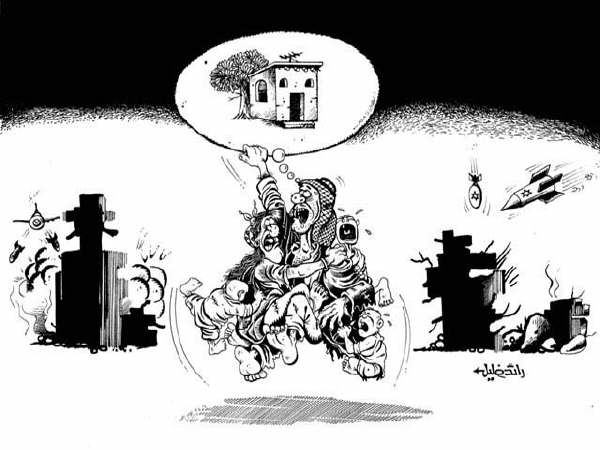
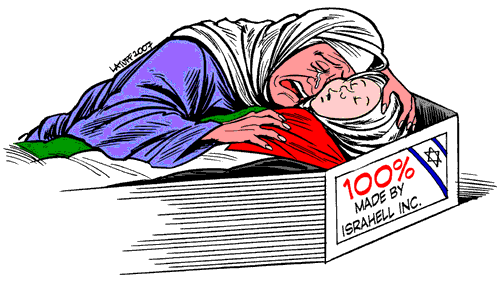


 Posts
Posts


