Alnakba English P1:
"aljazeerachannel | October 12, 2010
Alnakba English P1
- Sent using Google Toolbar"
Palestine Video - A Palestine Vlog
Showing posts with label Al Nakba [Catastrophe]. Show all posts
Showing posts with label Al Nakba [Catastrophe]. Show all posts
Tuesday, October 12, 2010


Tuesday, April 28, 2009
Palestinians in Gaza mark 61 years of Al-Nakba
Gazans mark 61st anniversary of Israeli occupation:
"Palestinians in Gaza mark 61 years of Al-Nakba, 'catastrophe'"
Palestine Video - A Palestine Vlog
"Palestinians in Gaza mark 61 years of Al-Nakba, 'catastrophe'"
Palestine Video - A Palestine Vlog
Tuesday, April 14, 2009
Interview: Naeim Giladi - Author of the Jews of Iraq 11-07-94
Naeim Giladi - 11-07-94 Original air date:
"Naeim Giladi (Hebrew: נעים גלעדי) (born 1929, Iraq, as Naeim Khalaschi) is an Anti-Zionist, and author of an autobiographical article and historical analysis entitled The Jews of Iraq.[1] The article later formed the basis for his originally self-published book Ben Gurion's Scandals: How the Haganah and the Mossad Eliminated Jews.
Giladi was born in 1929 to an Iraqi Jewish family and later lived in Israel and the United States.[2] Giladi describes his family as, 'a large and important' family named 'Haroon' who had settled in Iraq after the Babylonian exile. According to Giladi his family had owned, 50,000 acres (200 km²) devoted to rice, dates and Arab horses. They were later involved in gold purchase and purification, and were therefore given the name, 'Khalaschi', meaning 'Makers of Pure' by the Turks who occupied Iraq at the time.[1]
He states that he joined the underground Zionist movement at age 14 without his parent's knowledge and was involved in underground activities. He was arrested and jailed by the Iraqi government at the age of 17 in 1947.[1] During his two years in the prison of Abu Ghraib, he was expecting to be sentenced to death for smuggling Iraqi Jews out of the country to Iran, where they were then taken to Israel. He managed to escape from prison and travel to Israel, arriving in May 1950.
While living in Israel, his views of Zionism changed. He writes that, he "was disillusioned personally, disillusioned at the institutionalized racism, disillusioned at what I was beginning to learn about Zionism's cruelties. The principal interest Israel had in Jews from Islamic countries was as a supply of cheap labor, especially for the farm work that was beneath the urbanized Eastern European Jews. Ben Gurion needed the "Oriental" Jews to farm the thousands of acres of land left by Palestinians who were driven out by Israeli forces in 1948".[1]
I organized a demonstration in Ashkelon against Ben Gurion's racist policies and 10,000 people turned out."[1]
After serving in the Israeli Army between 1967-1970, Giladi was active in the Israeli Black Panthers movement."
The Link Archives
Title: The Jews of Iraq
Author: Naeim Giladi
April - May 1998
Volume 31, Issue 2
Download PDF
About This Issue
The Link interviewed Naeim Giladi, a Jew from Iraq, for three hours on March 16, 1998, two days prior to his 69th birthday. For nearly two other delightful hours, we were treated to a multi-course Arabic meal prepared by his wife Rachel, who is also Iraqi. “It’s our Arab culture,” he said proudly.
In our previous Link, Israeli historian Ilan Pappe looked at the hundreds of thousands of indigenous Palestinians whose lives were uprooted to make room for foreigners who would come to populate confiscated land. Most were Ashkenazi Jews from Eastern Europe. But over half a million other Jews came from Islamic lands. Zionist propagandists claim that Israel “rescued” these Jews from their anti-Jewish, Muslim neighbors. One of those “rescued” Jews—Naeim Giladi—knows otherwise.
In his book, Ben Gurion’s Scandals: How the Haganah & the Mossad Eliminated Jews, Giladi discusses the crimes committed by Zionists in their frenzy to import raw Jewish labor. Newly-vacated farmlands had to be plowed to provide food for the immigrants and the military ranks had to be filled with conscripts to defend the stolen lands. Mr. Giladi couldn’t get his book published in Israel, and even in the U.S. he discovered he could do so only if he used his own money. His book is listed in our catalog on pages 13-15.
The Giladis, now U.S. citizens, live in New York City. By choice, they no longer hold Israeli citizenship. “I am Iraqi,” he told us, “born in Iraq, my culture still Iraqi Arabic, my religion Jewish, my citizenship American.”-—John F. Mahoney, Executive Director, April 1998
Contents
The Jews of Iraq, by Naeim Giladi
In Memoriam: Marshall Wiley and Joseph L. Ryan, by John F. Mahoney
THE JEWS OF IRAQ
By Naeim Giladi
I write this article for the same reason I wrote my book: to tell the American people, and especially American Jews, that Jews from Islamic lands did not emigrate willingly to Israel; that, to force them to leave, Jews killed Jews; and that, to buy time to confiscate ever more Arab lands, Jews on numerous occasions rejected genuine peace initiatives from their Arab neighbors. I write about what the first prime minister of Israel called "cruel Zionism." I write about it because I was part of it.
My Story
Of course I thought I knew it all back then. I was young, idealistic, and more than willing to put my life at risk for my convictions. It was 1947 and I wasn't quite 18 when the Iraqi authorities caught me for smuggling young Iraqi Jews like myself out of Iraq, into Iran, and then on to the Promised Land of the soon-to-be established Israel.
I was an Iraqi Jew in the Zionist underground. My Iraqi jailers did everything they could to extract the names of my co-conspirators. Fifty years later, pain still throbs in my right toe-a reminder of the day my captors used pliers to remove my toenails. On another occasion, they hauled me to the flat roof of the prison, stripped me bare on a frigid January day, then threw a bucket of cold water over me. I was left there, chained to the railing, for hours. But I never once considered giving them the information they wanted. I was a true believer.
My preoccupation during what I refer to as my "two years in hell" was with survival and escape. I had no interest then in the broad sweep of Jewish history in Iraq even though my family had been part of it right from the beginning. We were originally Haroons, a large and important family of the "Babylonian Diaspora." My ancestors had settled in Iraq more than 2,600 years ago-600 years before Christianity, and 1,200 years before Islam. I am descended from Jews who built the tomb of Yehezkel, a Jewish prophet of pre-biblical times. My town, where I was born in 1929, is Hillah, not far from the ancient site of Babylon.
The original Jews found Babylon, with its nourishing Tigris and Euphrates rivers, to be truly a land of milk, honey, abundance-and opportunity. Although Jews, like other minorities in what became Iraq, experienced periods of oppression and discrimination depending on the rulers of the period, their general trajectory over two and one-half millennia was upward. Under the late Ottoman rule, for example, Jewish social and religious institutions, schools, and medical facilities flourished without outside interference, and Jews were prominent in government and business.
As I sat there in my cell, unaware that a death sentence soon would be handed down against me, I could not have recounted any personal grievances that my family members would have lodged against the government or the Muslim majority. Our family had been treated well and had prospered, first as farmers with some 50,000 acres devoted to rice, dates and Arab horses. Then, with the Ottomans, we bought and purified gold that was shipped to Istanbul and turned into coinage. The Turks were responsible in fact for changing our name to reflect our occupation-we became Khalaschi, meaning "Makers of Pure."
I did not volunteer the information to my father that I had joined the Zionist underground. He found out several months before I was arrested when he saw me writing Hebrew and using words and expressions unfamiliar to him. He was even more surprised to learn that, yes, I had decided I would soon move to Israel myself. He was scornful. "You'll come back with your tail between your legs," he predicted.
About 125,000 Jews left Iraq for Israel in the late 1940s and into 1952, most because they had been lied to and put into a panic by what I came to learn were Zionist bombs. But my mother and father were among the 6,000 who did not go to Israel. Although physically I never did return to Iraq-that bridge had been burned in any event-my heart has made the journey there many, many times. My father had it right.
I was imprisoned at the military camp of Abu-Greib, about 7 miles from Baghdad. When the military court handed down my sentence of death by hanging, I had nothing to lose by attempting the escape I had been planning for many months.
It was a strange recipe for an escape: a dab of butter, an orange peel, and some army clothing that I had asked a friend to buy for me at a flea market. I deliberately ate as much bread as I could to put on fat in anticipation of the day I became 18, when they could formally charge me with a crime and attach the 50-pound ball and chain that was standard prisoner issue.
Later, after my leg had been shackled, I went on a starvation diet that often left me weak-kneed. The pat of butter was to lubricate my leg in preparation for extricating it from the metal band. The orange peel I surreptitiously stuck into the lock on the night of my planned escape, having studied how it could be placed in such a way as to keep the lock from closing.
As the jailers turned to go after locking up, I put on the old army issue that was indistinguishable from what they were wearing-a long, green coat and a stocking cap that I pulled down over much of my face (it was winter). Then I just quietly opened the door and joined the departing group of soldiers as they strode down the hall and outside, and I offered a "good night" to the shift guard as I left. A friend with a car was waiting to speed me away.
Later I made my way to the new state of Israel, arriving in May, 1950. My passport had my name in Arabic and English, but the English couldn't capture the "kh" sound, so it was rendered simply as Klaski. At the border, the immigration people applied the English version, which had an Eastern European, Ashkenazi ring to it. In one way, this "mistake" was my key to discovering very soon just how the Israeli caste system worked.
They asked me where I wanted to go and what I wanted to do. I was the son of a farmer; I knew all the problems of the farm, so I volunteered to go to Dafnah, a farming kibbutz in the high Galilee. I only lasted a few weeks. The new immigrants were given the worst of everything. The food was the same, but that was the only thing that everyone had in common. For the immigrants, bad cigarettes, even bad toothpaste. Everything. I left.
Then, through the Jewish Agency, I was advised to go to al-Majdal (later renamed Ashkelon), an Arab town about 9 miles from Gaza, very close to the Mediterranean. The Israeli government planned to turn it into a farmers' city, so my farm background would be an asset there.
When I reported to the Labor Office in al-Majdal, they saw that I could read and write Arabic and Hebrew and they said that I could find a good-paying job with the Military Governor's office. The Arabs were under the authority of these Israeli Military Governors. A clerk handed me a bunch of forms in Arabic and Hebrew. Now it dawned on me. Before Israel could establish its farmers' city, it had to rid al-Majdal of its indigenous Palestinians. The forms were petitions to the United Nations Inspectors asking for transfer out of Israel to Gaza, which was under Egyptian control.
I read over the petition. In signing, the Palestinian would be saying that he was of sound mind and body and was making the request for transfer free of pressure or duress. Of course, there was no way that they would leave without being pressured to do so. These families had been there hundreds of years, as farmers, primitive artisans, weavers. The Military Governor prohibited them from pursuing their livelihoods, just penned them up until they lost hope of resuming their normal lives. That's when they signed to leave.
I was there and heard their grief. "Our hearts are in pain when we look at the orange trees that we planted with our own hands. Please let us go, let us give water to those trees. God will not be pleased with us if we leave His trees untended." I asked the Military Governor to give them relief, but he said, "No, we want them to leave."
I could no longer be part of this oppression and I left. Those Palestinians who didn't sign up for transfers were taken by force-just put in trucks and dumped in Gaza. About four thousand people were driven from al-Majdal in one way or another. The few who remained were collaborators with the Israeli authorities.
Subsequently, I wrote letters trying to get a government job elsewhere and I got many immediate responses asking me to come for an interview. Then they would discover that my face didn't match my Polish/Ashkenazi name. They would ask if I spoke Yiddish or Polish, and when I said I didn't, they would ask where I came by a Polish name. Desperate for a good job, I would usually say that I thought my great-grandfather was from Poland. I was advised time and again that "we'll give you a call."
Eventually, three to four years after coming to Israel, I changed my name to Giladi, which is close to the code name, Gilad, that I had in the Zionist underground. Klaski wasn't doing me any good anyway, and my Eastern friends were always chiding me about the name they knew didn't go with my origins as an Iraqi Jew.
I was disillusioned at what I found in the Promised Land, disillusioned personally, disillusioned at the institutionalized racism, disillusioned at what I was beginning to learn about Zionism's cruelties. The principal interest Israel had in Jews from Islamic countries was as a supply of cheap labor, especially for the farm work that was beneath the urbanized Eastern European Jews. Ben Gurion needed the "Oriental" Jews to farm the thousands of acres of land left by Palestinians who were driven out by Israeli forces in 1948.
And I began to find out about the barbaric methods used to rid the fledgling state of as many Palestinians as possible. The world recoils today at the thought of bacteriological warfare, but Israel was probably the first to actually use it in the Middle East. In the 1948 war, Jewish forces would empty Arab villages of their populations, often by threats, sometimes by just gunning down a half-dozen unarmed Arabs as examples to the rest. To make sure the Arabs couldn't return to make a fresh life for themselves in these villages, the Israelis put typhus and dysentery bacteria into the water wells.
Uri Mileshtin, an official historian for the Israeli Defense Force, has written and spoken about the use of bacteriological agents. According to Mileshtin, Moshe Dayan, a division commander at the time, gave orders in 1948 to remove Arabs from their villages, bulldoze their homes, and render water wells unusable with typhus and dysentery bacteria.
Acre was so situated that it could practically defend itself with one big gun, so the Haganah put bacteria into the spring that fed the town. The spring was called Capri and it ran from the north near a kibbutz. The Haganah put typhus bacteria into the water going to Acre, the people got sick, and the Jewish forces occupied Acre. This worked so well that they sent a Haganah division dressed as Arabs into Gaza, where there were Egyptian forces, and the Egyptians caught them putting two cans of bacteria, typhus and dysentery, into the water supply in wanton disregard of the civilian population. "In war, there is no sentiment," one of the captured Haganah men was quoted as saying.
My activism in Israel began shortly after I received a letter from the Socialist/Zionist Party asking me to help with their Arabic newspaper. When I showed up at their offices at Central House in Tel Aviv, I asked around to see just where I should report. I showed the letter to a couple of people there and, without even looking at it, they would motion me away with the words, "Room No. 8." When I saw that they weren't even reading the letter, I inquired of several others. But the response was the same, "Room No. 8," with not a glance at the paper I put in front of them.
So I went to Room 8 and saw that it was the Department of Jews from Islamic Countries. I was disgusted and angry. Either I am a member of the party or I'm not. Do I have a different ideology or different politics because I am an Arab Jew? It's segregation, I thought, just like a Negroes' Department. I turned around and walked out. That was the start of my open protests. That same year I organized a demonstration in Ashkelon against Ben Gurion's racist policies and 10,000 people turned out.
There wasn't much opportunity for those of us who were second class citizens to do much about it when Israel was on a war footing with outside enemies. After the 1967 war, I was in the Army myself and served in the Sinai when there was continued fighting along the Suez Canal. But the cease-fire with Egypt in 1970 gave us our opening. We took to the streets and organized politically to demand equal rights. If it's our country, if we were expected to risk our lives in a border war, then we expected equal treatment.
We mounted the struggle so tenaciously and received so much publicity that the Israeli government tried to discredit our movement by calling us "Israel's Black Panthers." They were thinking in racist terms, really, in assuming the Israeli public would reject an organization whose ideology was being compared to that of radical blacks in the United States. But we saw that what we were doing was no different than what blacks in the United States were fighting against-segregation, discrimination, unequal treatment. Rather than reject the label, we adopted it proudly. I had posters of Martin Luther King, Malcolm X, Nelson Mandela and other civil rights activists plastered all over my office.
With the Israeli invasion of Lebanon and the Israeli-condoned Sabra and Shatilla massacres, I had had enough of Israel. I became a United States citizen and made certain to revoke my Israeli citizenship. I could never have written and published my book in Israel, not with the censorship they would impose.
Even in America, I had great difficulty finding a publisher because many are subject to pressures of one kind or another from Israel and its friends. I ended up paying $60,000 from my own pocket to publish Ben Gurion's Scandals: How the Haganah & the Mossad Eliminated Jews, virtually the entire proceeds from having sold my house in Israel.
I still was afraid that the printer would back out or that legal proceedings would be initiated to stop its publication, like the Israeli government did in an attempt to prevent former Mossad case officer Victor Ostrovsky from publishing his first book. Ben Gurion's Scandals had to be translated into English from two languages. I wrote in Hebrew when I was in Israel and hoped to publish the book there, and I wrote in Arabic when I was completing the book after coming to the U.S. But I was so worried that something would stop publication that I told the printer not to wait for the translations to be thoroughly checked and proofread. Now I realize that the publicity of a lawsuit would just have created a controversial interest in the book.
I am using bank vault storage for the valuable documents that back up what I have written. These documents, including some that I illegally copied from the archives at Yad Vashem, confirm what I saw myself, what I was told by other witnesses, and what reputable historians and others have written concerning the Zionist bombings in Iraq, Arab peace overtures that were rebuffed, and incidents of violence and death inflicted by Jews on Jews in the cause of creating Israel.
The Riots of 1941
If, as I have said, my family in Iraq was not persecuted personally and I knew no deprivation as a member of the Jewish minority, what led me to the steps of the gallows as a member of the Zionist underground? To answer that question, it is necessary to establish the context of the massacre that occurred in Baghdad on June 1, 1941, when several hundred Iraqi Jews were killed in riots involving junior officers of the Iraqi army. I was 12 years of age and many of those killed were my friends. I was angry, and very confused.
What I didn't know at the time was that the riots most likely were stirred up by the British, in collusion with a pro-British Iraqi leadership.
With the breakup of the Ottoman Empire following WW I, Iraq came under British "tutelage." Amir Faisal, son of Sharif Hussein who had led the Arab Revolt against the Ottoman sultan, was brought in from Mecca by the British to become King of Iraq in 1921. Many Jews were appointed to key administrative posts, including that of economics minister. Britain retained final authority over domestic and external affairs. Britain's pro-Zionist attitude in Palestine, however, triggered a growing anti-Zionist backlash in Iraq, as it did in all Arab countries. Writing at the end of 1934, Sir Francis Humphreys, Britain's Ambassador in Baghdad, noted that, while before WW I Iraqi Jews had enjoyed a more favorable position than any other minority in the country, since then "Zionism has sown dissension between Jews and Arabs, and a bitterness has grown up between the two peoples which did not previously exist."
King Faisal died in 1933. He was succeeded by his son Ghazi, who died in a motor car accident in 1939. The crown then passed to Ghazi's 4-year-old son, Faisal II, whose uncle, Abd al-Ilah, was named regent. Abd al-Ilah selected Nouri el-Said as prime minister. El-Said supported the British and, as hatred of the British grew, he was forced from office in March 1940 by four senior army officers who advocated Iraq's independence from Britain. Calling themselves the Golden Square, the officers compelled the regent to name as prime minister Rashid Ali al-Kilani, leader of the National Brotherhood party.
The time was 1940 and Britain was reeling from a strong German offensive. Al-Kilani and the Golden Square saw this as their opportunity to rid themselves of the British once and for all. Cautiously they began to negotiate for German support, which led the pro-British regent Abd al-Ilah to dismiss al-Kilani in January 1941. By April, however, the Golden Square officers had reinstated the prime minister.
This provoked the British to send a military force into Basra on April 12, 1941. Basra, Iraq's second largest city, had a Jewish population of 30,000. Most of these Jews made their livings from import/export, money changing, retailing, as workers in the airports, railways, and ports, or as senior government employees.
On the same day, April 12, supporters of the pro-British regent notified the Jewish leaders that the regent wanted to meet with them. As was their custom, the leaders brought flowers for the regent. Contrary to custom, however, the cars that drove them to the meeting place dropped them off at the site where the British soldiers were concentrated.
Photographs of the Jews appeared in the following day's newspapers with the banner "Basra Jews Receive British Troops with Flowers." That same day, April 13, groups of angry Arab youths set about to take revenge against the Jews. Several Muslim notables in Basra heard of the plan and calmed things down. Later, it was learned that the regent was not in Basra at all and that the matter was a provocation by his pro-British supporters to bring about an ethnic war in order to give the British army a pretext to intervene.
The British continued to land more forces in and around Basra. On May 7, 1941, their Gurkha unit, composed of Indian soldiers from that ethnic group, occupied Basra's el-Oshar quarter, a neighborhood with a large Jewish population. The soldiers, led by British officers, began looting. Many shops in the commercial district were plundered. Private homes were broken into. Cases of attempted rape were reported. Local residents, Jews and Muslims, responded with pistols and old rifles, but their bullets were no match for the soldiers' Tommy Guns.
Afterwards, it was learned that the soldiers acted with the acquiescence, if not the blessing, of their British commanders. (It should be remembered that the Indian soldiers, especially those of the Gurkha unit, were known for their discipline, and it is highly unlikely they would have acted so riotously without orders.) The British goal clearly was to create chaos and to blacken the image of the pro-nationalist regime in Baghdad, thereby giving the British forces reason to proceed to the capital and to overthrow the al-Kilani government.
Baghdad fell on May 30. Al-Kilani fled to Iran, along with the Golden Square officers. Radio stations run by the British reported that Regent Abd al-Ilah would be returning to the city and that thousands of Jews and others were planning to welcome him. What inflamed young Iraqis against the Jews most, however, was the radio announcer Yunas Bahri on the German station "Berlin," who reported in Arabic that Jews from Palestine were fighting alongside the British against Iraqi soldiers near the city of Faluja. The report was false.
On Sunday, June 1, unarmed fighting broke out in Baghdad between Jews who were still celebrating their Shabuoth holiday and young Iraqis who thought the Jews were celebrating the return of the pro-British regent. That evening, a group of Iraqis stopped a bus, removed the Jewish passengers, murdered one and fatally wounded a second.
About 8:30 the following morning, some 30 individuals in military and police uniforms opened fire along el-Amin street, a small downtown street whose jewelry, tailor and grocery shops were Jewish-owned. By 11 a.m., mobs of Iraqis with knives, switchblades and clubs were attacking Jewish homes in the area.
The riots continued throughout Monday, June 2. During this time, many Muslims rose to defend their Jewish neighbors, while some Jews successfully defended themselves. There were 124 killed and 400 injured, according to a report written by a Jewish Agency messenger who was in Iraq at the time. Other estimates, possibly less reliable, put the death toll higher, as many as 500, with from 650 to 2,000 injured. From 500 to 1,300 stores and more than 1,000 homes and apartments were looted.
Who was behind the rioting in the Jewish quarter?
Yosef Meir, one of the most prominent activists in the Zionist underground movement in Iraq, known then as Yehoshafat, claims it was the British. Meir, who now works for the Israeli Defense Ministry, argues that, in order to make it appear that the regent was returning as the savior who would reestablish law and order, the British stirred up the riots against the most vulnerable and visible segment in the city, the Jews. And, not surprisingly, the riots ended as soon as the regent's loyal soldiers entered the capital.
My own investigations as a journalist lead me to believe Meir is correct. Furthermore, I think his claims should be seen as based on documents in the archives of the Israeli Defense Ministry, the agency that published his book. Yet, even before his book came out, I had independent confirmation from a man I met in Iran in the late Forties.
His name was Michael Timosian, an Iraqi Armenian. When I met him he was working as a male nurse at the Anglo-Iranian Oil Company in Abadan in the south of Iran. On June 2, 1941, however, he was working at the Baghdad hospital where many of the riot victims were brought. Most of these victims were Jews.
Timosian said he was particularly interested in two patients whose conduct did not follow local custom. One had been hit by a bullet in his shoulder, the other by a bullet in his right knee. After the doctor removed the bullets, the staff tried to change their blood-soaked cloths. But the two men fought off their efforts, pretending to be speechless, although tests showed they could hear. To pacify them, the doctor injected them with anesthetics and, as they were sleeping, Timosian changed their cloths. He discovered that one of them had around his neck an identification tag of the type used by British troops, while the other had tattoos with Indian script on his right arm along with the familiar sword of the Gurkha.
The next day when Timosian showed up for work, he was told that a British officer, his sergeant and two Indian Gurkha soldiers had come to the hospital early that morning. Staff members overheard the Gurkha soldiers talking with the wounded patients, who were not as dumb as they had pretended. The patients saluted the visitors, covered themselves with sheets and, without signing the required release forms, left the hospital with their visitors.
Today there is no doubt in my mind that the anti-Jewish riots of 1941 were orchestrated by the British for geopolitical ends. David Kimche is certainly a man who was in a position to know the truth, and he has spoken publicly about British culpability. Kimche had been with British Intelligence during WW II and with the Mossad after the war. Later he became Director General of Israel's Foreign Ministry, the position he held in 1982 when he addressed a forum at the British Institute for International Affairs in London.
In responding to hostile questions about Israel's invasion of Lebanon and the refugee camp massacres in Beirut, Kimche went on the attack, reminding the audience that there was scant concern in the British Foreign Office when British Gurkha units participated in the murder of 500 Jews in the streets of Baghdad in 1941.
The Bombings of 1950-1951
The anti-Jewish riots of 1941 did more than create a pretext for the British to enter Baghdad to reinstate the pro-British regent and his pro-British prime minister, Nouri el-Said. They also gave the Zionists in Palestine a pretext to set up a Zionist underground in Iraq, first in Baghdad, then in other cities such as Basra, Amara, Hillah, Diwaneia, Abril and Karkouk.
Following WW II, a succession of governments held brief power in Iraq. Zionist conquests in Palestine, particularly the massacre of Palestinians in the village of Deir Yassin, emboldened the anti-British movement in Iraq. When the Iraqi government signed a new treaty of friendship with London in January 1948, riots broke out all over the country. The treaty was quickly abandoned and Baghdad demanded removal of the British military mission that had run Iraq's army for 27 years.
Later in 1948, Baghdad sent an army detachment to Palestine to fight the Zionists, and when Israel declared independence in May, Iraq closed the pipeline that fed its oil to Haifa's refinery. Abd al-Ilah, however, was still regent and the British quisling, Nouri el-Said, was back as prime minister. I was in the Abu-Greib prison in 1948, where I would remain until my escape to Iran in September 1949.
Six months later-the exact date was March 19, 1950-a bomb went off at the American Cultural Center and Library in Baghdad, causing property damage and injuring a number of people. The center was a favorite meeting place for young Jews.
The first bomb thrown directly at Jews occurred on April 8, 1950, at 9:15 p.m. A car with three young passengers hurled the grenade at Baghdad's El-Dar El-Bida Café, where Jews were celebrating Passover. Four people were seriously injured. That night leaflets were distributed calling on Jews to leave Iraq immediately.
The next day, many Jews, most of them poor with nothing to lose, jammed emigration offices to renounce their citizenship and to apply for permission to leave for Israel. So many applied, in fact, that the police had to open registration offices in Jewish schools and synagogues.
On May 10, at 3 a.m., a grenade was tossed in the direction of the display window of the Jewish-owned Beit-Lawi Automobile Company, destroying part of the building. No casualties were reported.
On June 3, 1950, another grenade was tossed from a speeding car in the El-Batawin area of Baghdad where most rich Jews and middle class Iraqis lived. No one was hurt, but following the explosion Zionist activists sent telegrams to Israel requesting that the quota for immigration from Iraq be increased.
On June 5, at 2:30 a.m., a bomb exploded next to the Jewish-owned Stanley Shashua building on El-Rashid street, resulting in property damage but no casualties.
On January 14, 1951, at 7 p.m., a grenade was thrown at a group of Jews outside the Masouda Shem-Tov Synagogue. The explosive struck a high-voltage cable, electrocuting three Jews, one a young boy, Itzhak Elmacher, and wounding over 30 others. Following the attack, the exodus of Jews jumped to between 600-700 per day.
Zionist propagandists still maintain that the bombs in Iraq were set off by anti-Jewish Iraqis who wanted Jews out of their country. The terrible truth is that the grenades that killed and maimed Iraqi Jews and damaged their property were thrown by Zionist Jews.
Among the most important documents in my book, I believe, are copies of two leaflets published by the Zionist underground calling on Jews to leave Iraq. One is dated March 16, 1950, the other April 8, 1950.
The difference between these two is critical. Both indicate the date of publication, but only the April 8th leaflet notes the time of day: 4 p.m. Why the time of day? Such a specification was unprecedented. Even the investigating judge, Salaman El-Beit, found it suspicious. Did the 4 p.m. writers want an alibi for a bombing they knew would occur five hours later? If so, how did they know about the bombing? The judge concluded they knew because a connection existed between the Zionist underground and the bomb throwers.
This, too, was the conclusion of Wilbur Crane Eveland, a former senior officer in the Central Intelligence Agency (CIA), whom I had the opportunity to meet in New York in 1988. In his book, Ropes of Sand, whose publication the CIA opposed, Eveland writes:
In attempts to portray the Iraqis as anti-American and to terrorize the Jews, the Zionists planted bombs in the U.S. Information Service library and in synagogues. Soon leaflets began to appear urging Jews to flee to Israel. . . . Although the Iraqi police later provided our embassy with evidence to show that the synagogue and library bombings, as well as the anti-Jewish and anti-American leaflet campaigns, had been the work of an underground Zionist organization, most of the world believed reports that Arab terrorism had motivated the flight of the Iraqi Jews whom the Zionists had "rescued" really just in order to increase Israel's Jewish population."
Eveland doesn't detail the evidence linking the Zionists to the attacks, but in my book I do. In 1955, for example, I organized in Israel a panel of Jewish attorneys of Iraqi origin to handle claims of Iraqi Jews who still had property in Iraq. One well known attorney, who asked that I not give his name, confided in me that the laboratory tests in Iraq had confirmed that the anti-American leaflets found at the American Cultural Center bombing were typed on the same typewriter and duplicated on the same stenciling machine as the leaflets distributed by the Zionist movement just before the April 8th bombing.
Tests also showed that the type of explosive used in the Beit-Lawi attack matched traces of explosives found in the suitcase of an Iraqi Jew by the name of Yosef Basri. Basri, a lawyer, together with Shalom Salih, a shoemaker, would be put on trial for the attacks in December 1951 and executed the following month. Both men were members of Hashura, the military arm of the Zionist underground. Salih ultimately confessed that he, Basri and a third man, Yosef Habaza, carried out the attacks.
By the time of the executions in January 1952, all but 6,000 of an estimated 125,000 Iraqi Jews had fled to Israel. Moreover, the pro-British, pro-Zionist puppet el-Said saw to it that all of their possessions were frozen, including their cash assets. (There were ways of getting Iraqi dinars out, but when the immigrants went to exchange them in Israel they found that the Israeli government kept 50 percent of the value.) Even those Iraqi Jews who had not registered to emigrate, but who happened to be abroad, faced loss of their nationality if they didn't return within a specified time. An ancient, cultured, prosperous community had been uprooted and its people transplanted to a land dominated by East European Jews, whose culture was not only foreign but entirely hateful to them.
The Ultimate Criminals
Zionist Leaders:
From the start they knew that in order to establish a Jewish state they had to expel the indigenous Palestinian population to the neighboring Islamic states and import Jews from these same states.
* Theodor Herzl, the architect of Zionism, thought it could be done by social engineering. In his diary entry for 12 June 1885, he wrote that Zionist settlers would have to "spirit the penniless population across the border by procuring employment for it in the transit countries, while denying it any employment in our own country."
* Vladimir Jabotinsky, Prime Minister Netanyahu's ideological progenitor, frankly admitted that such a transfer of populations could only be brought about by force.
* David Ben Gurion, Israel's first prime minister, told a Zionist Conference in 1937 that any proposed Jewish state would have to "transfer Arab populations out of the area, if possible of their own free will, if not by coercion." After 750,000 Palestinians were uprooted and their lands confiscated in 1948-49, Ben Gurion had to look to the Islamic countries for Jews who could fill the resultant cheap labor market. "Emissaries" were smuggled into these countries to "convince" Jews to leave either by trickery or fear.
In the case of Iraq, both methods were used: uneducated Jews were told of a Messianic Israel in which the blind see, the lame walk, and onions grow as big as melons; educated Jews had bombs thrown at them.
A few years after the bombings, in the early 1950s, a book was published in Iraq, in Arabic, titled Venom of the Zionist Viper. The author was one of the Iraqi investigators of the 1950-51 bombings and, in his book, he implicates the Israelis, specifically one of the emissaries sent by Israel, Mordechai Ben-Porat. As soon as the book came out, all copies just disappeared, even from libraries. The word was that agents of the Israeli Mossad, working through the U.S. Embassy, bought up all the books and destroyed them. I tried on three different occasions to have one sent to me in Israel, but each time Israeli censors in the post office intercepted it.
British Leaders:
Britain always acted in its best colonial interests. For that reason Foreign Minister Arthur Balfour sent his famous 1917 letter to Lord Rothschild in exchange for Zionist support in WW I. During WW II the British were primarily concerned with keeping their client states in the Western camp, while Zionists were most concerned with the immigration of European Jews to Palestine, even if this meant cooperating with the Nazis. (In my book I document numerous instances of such dealings by Ben Gurion and the Zionist leadership.)
After WW II the international chessboard pitted communists against capitalists. In many countries, including the United States and Iraq, Jews represented a large part of the Communist party. In Iraq, hundreds of Jews of the working intelligentsia occupied key positions in the hierarchy of the Communist and Socialist parties. To keep their client countries in the capitalist camp, Britain had to make sure these governments had pro-British leaders. And if, as in Iraq, these leaders were overthrown, then an anti-Jewish riot or two could prove a useful pretext to invade the capital and reinstate the "right" leaders.
Moreover, if the possibility existed of removing the communist influence from Iraq by transferring the whole Jewish community to Israel, well then, why not? Particularly if the leaders of Israel and Iraq conspired in the deed.
The Iraqi Leaders:
Both the regent Abd al-Ilah and his prime minister Nouri el- Said took directions from London. Toward the end of 1948, el-Said, who had already met with Israel's Prime Minister Ben Gurion in Vienna, began discussing with his Iraqi and British associates the need for an exchange of populations. Iraq would send the Jews in military trucks to Israel via Jordan, and Iraq would take in some of the Palestinians Israel had been evicting. His proposal included mutual confiscation of property. London nixed the idea as too radical.
El-Said then went to his back-up plan and began to create the conditions that would make the lives of Iraqi Jews so miserable they would leave for Israel. Jewish government employees were fired from their jobs; Jewish merchants were denied import/export licenses; police began to arrest Jews for trivial reasons. Still the Jews did not leave in any great numbers.
In September 1949, Israel sent the spy Mordechai Ben-Porat, the one mentioned in Venom of the Zionist Viper, to Iraq. One of the first things Ben-Porat did was to approach el-Said and promise him financial incentives to have a law enacted that would lift the citizenship of Iraqi Jews.
Soon after, Zionist and Iraqi representatives began formulating a rough draft of the bill, according to the model dictated by Israel through its agents in Baghdad. The bill was passed by the Iraqi parliament in March 1950. It empowered the government to issue one-time exit visas to Jews wishing to leave the country. In March, the bombings began.
Sixteen years later, the Israeli magazine Haolam Hazeh, published by Uri Avnery, then a Knesset member, accused Ben-Porat of the Baghdad bombings. Ben-Porat, who would become a Knesset member himself, denied the charge, but never sued the magazine for libel. And Iraqi Jews in Israel still call him Morad Abu al-Knabel, Mordechai of the Bombs.
As I said, all this went well beyond the comprehension of a teenager. I knew Jews were being killed and an organization existed that could lead us to the Promised Land. So I helped in the exodus to Israel. Later, on occasions, I would bump into some of these Iraqi Jews in Israel. Not infrequently they'd express the sentiment that they could kill me for what I had done.
Opportunities for Peace
After the Israeli attack on the Jordanian village of Qibya in October, 1953, Ben Gurion went into voluntary exile at the Sedeh Boker kibbutz in the Negev. The Labor party then used to organize many buses for people to go visit him there, where they would see the former prime minister working with sheep. But that was only for show. Really he was writing his diary and continuing to be active behind the scenes. I went on such a tour.
We were told not to try to speak to Ben Gurion, but when I saw him, I asked why, since Israel is a democracy with a parliament, does it not have a constitution? Ben Gurion said, "Look, boy"-I was 24 at the time-"if we have a constitution, we have to write in it the border of our country. And this is not our border, my dear." I asked, "Then where is the border?" He said, "Wherever the Sahal will come, this is the border." Sahal is the Israeli army.
Ben Gurion told the world that Israel accepted the partition and the Arabs rejected it. Then Israel took half of the land that was promised to the Arab state. And still he was saying it was not enough. Israel needed more land. How can a country make peace with its neighbors if it wants to take their land? How can a country demand to be secure if it won't say what borders it will be satisfied with? For such a country, peace would be an inconvenience.
I know now that from the beginning many Arab leaders wanted to make peace with Israel, but Israel always refused. Ben Gurion covered this up with propaganda. He said that the Arabs wanted to drive Israel into the sea and he called Gamal Abdel Nasser the Hitler of the Middle East whose foremost intent was to destroy Israel. He wanted America and Great Britain to treat Nasser like a pariah.
In 1954, it seemed that America was getting less critical of Nasser. Then during a three-week period in July, several terrorist bombs were set off: at the United States Information Agency offices in Cairo and Alexandria, a British-owned theater, and the central post office in Cairo. An attempt to firebomb a cinema in Alexandria failed when the bomb went off in the pocket of one of the perpetrators. That led to the discovery that the terrorists were not anti-Western Egyptians, but were instead Israeli spies bent on souring the warming relationship between Egypt and the United States in what came to be known as the Lavon Affair.
Ben Gurion was still living on his kibbutz. Moshe Sharett as prime minister was in contact with Abdel Nasser through the offices of Lord Maurice Orbach of Great Britain. Sharett asked Nasser to be lenient with the captured spies, and Nasser did all that was in his power to prevent a deterioration of the situation between the two countries.
Then Ben Gurion returned as Defense Minister in February, 1955. Later that month Israeli troops attacked Egyptian military camps and Palestinian refugees in Gaza, killing 54 and injuring many more. The very night of the attack, Lord Orbach was on his way to deliver a message to Nasser, but was unable to get through because of the military action. When Orbach telephoned, Nasser's secretary told him that the attack proved that Israel did not want peace and that he was wasting his time as a mediator.
In November, Ben Gurion announced in the Knesset that he was willing to meet with Abdel Nasser anywhere and at any time for the sake of peace and understanding. The next morning the Israeli military attacked an Egyptian military camp in the Sabaha region.
Although Nasser felt pessimistic about achieving peace with Israel, he continued to send other mediators to try. One was through the American Friends Service Committee; another via the Prime Minister of Malta, Dom Minthoff; and still another through Marshall Tito of Yugoslavia.
One that looked particularly promising was through Dennis Hamilton, editor of The London Times. Nasser told Hamilton that if only he could sit and talk with Ben Gurion for two or three hours, they would be able to settle the conflict and end the state of war between the two countries. When word of this reached Ben Gurion, he arranged to meet with Hamilton. They decided to pursue the matter with the Israeli ambassador in London, Arthur Luria, as liaison. On Hamilton's third trip to Egypt, Nasser met him with the text of a Ben Gurion speech stating that Israel would not give up an inch of land and would not take back a single refugee. Hamilton knew that Ben Gurion with his mouth had undermined a peace mission and missed an opportunity to settle the Israeli-Arab conflict.
Nasser even sent his friend Ibrahim Izat of the Ruz El Yusuf weekly paper to meet with Israeli leaders in order to explore the political atmosphere and find out why the attacks were taking place if Israel really wanted peace. One of the men Izat met with was Yigal Yadin, a former Chief of Staff of the army who wrote this letter to me on 14 January 1982:
Dear Mr. Giladi:
Your letter reminded me of an event which I nearly forgot and of which I remember only a few details.
Ibrahim Izat came to me if I am not mistaken under the request of the Foreign Ministry or one of its branches; he stayed in my house and we spoke for many hours. I do not remember him saying that he came on a mission from Nasser, but I have no doubt that he let it be understood that this was with his knowledge or acquiescence....
When Nasser decided to nationalize the Suez Canal in spite of opposition from the British and the French, Radio Cairo announced in Hebrew:
If the Israeli government is not influenced by the British and the French imperialists, it will eventually result in greater understanding between the two states, and Egypt will reconsider Israel's request to have access to the Suez Canal.
Israel responded that it had no designs on Egypt, but at that very moment Israeli representatives were in France planning the three-way attack that was to take place in October, 1956.
All the while, Ben Gurion continued to talk about the Hitler of the Middle East. This brainwashing went on until late September, 1970, when Gamal Abdel Nasser passed away. Then, miracle of miracles, David Ben Gurion told the press:
A week before he died I received an envoy from Abdel Nasser who asked to meet with me urgently in order to solve the problems between Israel and the Arab world.
The public was surprised because they didn't know that Abdel Nasser had wanted this all along, but Israel sabotaged it.
Nasser was not the only Arab leader who wanted to make peace with Israel. There were many others. Brigadier General Abdel Karim Qasem, before he seized power in Iraq in July, 1958, headed an underground organization that sent a delegation to Israel to make a secret agreement. Ben Gurion refused even to see him. I learned about this when I was a journalist in Israel. But whenever I tried to publish even a small part of it, the censor would stamp it "Not Allowed."
Now, in Netanyahu, we are witnessing another attempt by an Israeli prime minister to fake an interest in making peace. Netanyahu and the Likud are setting Arafat up by demanding that he institute more and more repressive measures in the interest of Israeli "security." Sooner or later I suspect the Palestinians will have had enough of Arafat's strong-arm methods as Israel's quisling-and he'll be killed. Then the Israeli government will say, "See, we were ready to give him everything. You can't trust those Arabs-they kill each other. Now there's no one to even talk to about peace."
Conclusion
Alexis de Tocqueville once observed that it is easier for the world to accept a simple lie than a complex truth. Certainly it has been easier for the world to accept the Zionist lie that Jews were evicted from Muslim lands because of anti-Semitism, and that Israelis, never the Arabs, were the pursuers of peace. The truth is far more discerning: bigger players on the world stage were pulling the strings.
These players, I believe, should be held accountable for their crimes, particularly when they willfully terrorized, dispossessed and killed innocent people on the altar of some ideological imperative.
I believe, too, that the descendants of these leaders have a moral responsibility to compensate the victims and their descendants, and to do so not just with reparations, but by setting the historical record straight.
That is why I established a panel of inquiry in Israel to seek reparations for Iraqi Jews who had been forced to leave behind their property and possessions in Iraq. That is why I joined the Black Panthers in confronting the Israeli government with the grievances of the Jews in Israel who came from Islamic lands. And that is why I have written my book and this article: to set the historical record straight.
We Jews from Islamic lands did not leave our ancestral homes because of any natural enmity between Jews and Muslims. And we Arabs-I say Arab because that is the language my wife and I still speak at home-we Arabs on numerous occasions have sought peace with the State of the Jews. And finally, as a U.S. citizen and taxpayer, let me say that we Americans need to stop supporting racial discrimination in Israel and the cruel expropriation of lands in the West Bank, Gaza, South Lebanon and the Golan Heights.
ENDNOTES
* Mileshtin was quoted by the Israeli daily, Hadashot, in an article published August 13, 1993. The writer, Sarah Laybobis-Dar, interviewed a number of Israelis who had knowledge of the use of bacteriological weapons in the 1948 war. Mileshtin said bacteria was used to poison the wells of every village emptied of its Arab inhabitants.
* On Sept. 12, 1990, the New York State Supreme Court issued a restraining order at the request of the Israeli government to prevent publication of Ostrovsky's book, "By Way of Deception: The Making and Unmaking of a Mossad Officer." The New York State Appeals Court lifted the ban the next day.
* Marion Woolfson, "Prophets in Babylon: Jews in the Arab World," p. 129
* Yosef Meir, "Road in the Desert," Israeli Defense Ministry, p. 36.
* See my book, "Ben Gurion's Scandals," p. 105.
* Wilbur Crane Eveland, "Ropes of Sand: America's Failure in the Middle East," NY; Norton, 1980, pp. 48-49.
* T. Herzl, "The Complete Diaries," NY: Herzl Press & Thomas Yoncloff, 1960, vol. 1, p. 88.
* Report of the Congress of the World Council of Paole Zion, Zurich, July 29-August 7, 1937, pp. 73-74.
Palestine Video - A Palestine Vlog
"Naeim Giladi (Hebrew: נעים גלעדי) (born 1929, Iraq, as Naeim Khalaschi) is an Anti-Zionist, and author of an autobiographical article and historical analysis entitled The Jews of Iraq.[1] The article later formed the basis for his originally self-published book Ben Gurion's Scandals: How the Haganah and the Mossad Eliminated Jews.
Giladi was born in 1929 to an Iraqi Jewish family and later lived in Israel and the United States.[2] Giladi describes his family as, 'a large and important' family named 'Haroon' who had settled in Iraq after the Babylonian exile. According to Giladi his family had owned, 50,000 acres (200 km²) devoted to rice, dates and Arab horses. They were later involved in gold purchase and purification, and were therefore given the name, 'Khalaschi', meaning 'Makers of Pure' by the Turks who occupied Iraq at the time.[1]
He states that he joined the underground Zionist movement at age 14 without his parent's knowledge and was involved in underground activities. He was arrested and jailed by the Iraqi government at the age of 17 in 1947.[1] During his two years in the prison of Abu Ghraib, he was expecting to be sentenced to death for smuggling Iraqi Jews out of the country to Iran, where they were then taken to Israel. He managed to escape from prison and travel to Israel, arriving in May 1950.
While living in Israel, his views of Zionism changed. He writes that, he "was disillusioned personally, disillusioned at the institutionalized racism, disillusioned at what I was beginning to learn about Zionism's cruelties. The principal interest Israel had in Jews from Islamic countries was as a supply of cheap labor, especially for the farm work that was beneath the urbanized Eastern European Jews. Ben Gurion needed the "Oriental" Jews to farm the thousands of acres of land left by Palestinians who were driven out by Israeli forces in 1948".[1]
I organized a demonstration in Ashkelon against Ben Gurion's racist policies and 10,000 people turned out."[1]
After serving in the Israeli Army between 1967-1970, Giladi was active in the Israeli Black Panthers movement."
The Link Archives
Title: The Jews of Iraq
Author: Naeim Giladi
April - May 1998
Volume 31, Issue 2
Download PDF
About This Issue
The Link interviewed Naeim Giladi, a Jew from Iraq, for three hours on March 16, 1998, two days prior to his 69th birthday. For nearly two other delightful hours, we were treated to a multi-course Arabic meal prepared by his wife Rachel, who is also Iraqi. “It’s our Arab culture,” he said proudly.
In our previous Link, Israeli historian Ilan Pappe looked at the hundreds of thousands of indigenous Palestinians whose lives were uprooted to make room for foreigners who would come to populate confiscated land. Most were Ashkenazi Jews from Eastern Europe. But over half a million other Jews came from Islamic lands. Zionist propagandists claim that Israel “rescued” these Jews from their anti-Jewish, Muslim neighbors. One of those “rescued” Jews—Naeim Giladi—knows otherwise.
In his book, Ben Gurion’s Scandals: How the Haganah & the Mossad Eliminated Jews, Giladi discusses the crimes committed by Zionists in their frenzy to import raw Jewish labor. Newly-vacated farmlands had to be plowed to provide food for the immigrants and the military ranks had to be filled with conscripts to defend the stolen lands. Mr. Giladi couldn’t get his book published in Israel, and even in the U.S. he discovered he could do so only if he used his own money. His book is listed in our catalog on pages 13-15.
The Giladis, now U.S. citizens, live in New York City. By choice, they no longer hold Israeli citizenship. “I am Iraqi,” he told us, “born in Iraq, my culture still Iraqi Arabic, my religion Jewish, my citizenship American.”-—John F. Mahoney, Executive Director, April 1998
Contents
The Jews of Iraq, by Naeim Giladi
In Memoriam: Marshall Wiley and Joseph L. Ryan, by John F. Mahoney
THE JEWS OF IRAQ
By Naeim Giladi
I write this article for the same reason I wrote my book: to tell the American people, and especially American Jews, that Jews from Islamic lands did not emigrate willingly to Israel; that, to force them to leave, Jews killed Jews; and that, to buy time to confiscate ever more Arab lands, Jews on numerous occasions rejected genuine peace initiatives from their Arab neighbors. I write about what the first prime minister of Israel called "cruel Zionism." I write about it because I was part of it.
My Story
Of course I thought I knew it all back then. I was young, idealistic, and more than willing to put my life at risk for my convictions. It was 1947 and I wasn't quite 18 when the Iraqi authorities caught me for smuggling young Iraqi Jews like myself out of Iraq, into Iran, and then on to the Promised Land of the soon-to-be established Israel.
I was an Iraqi Jew in the Zionist underground. My Iraqi jailers did everything they could to extract the names of my co-conspirators. Fifty years later, pain still throbs in my right toe-a reminder of the day my captors used pliers to remove my toenails. On another occasion, they hauled me to the flat roof of the prison, stripped me bare on a frigid January day, then threw a bucket of cold water over me. I was left there, chained to the railing, for hours. But I never once considered giving them the information they wanted. I was a true believer.
My preoccupation during what I refer to as my "two years in hell" was with survival and escape. I had no interest then in the broad sweep of Jewish history in Iraq even though my family had been part of it right from the beginning. We were originally Haroons, a large and important family of the "Babylonian Diaspora." My ancestors had settled in Iraq more than 2,600 years ago-600 years before Christianity, and 1,200 years before Islam. I am descended from Jews who built the tomb of Yehezkel, a Jewish prophet of pre-biblical times. My town, where I was born in 1929, is Hillah, not far from the ancient site of Babylon.
The original Jews found Babylon, with its nourishing Tigris and Euphrates rivers, to be truly a land of milk, honey, abundance-and opportunity. Although Jews, like other minorities in what became Iraq, experienced periods of oppression and discrimination depending on the rulers of the period, their general trajectory over two and one-half millennia was upward. Under the late Ottoman rule, for example, Jewish social and religious institutions, schools, and medical facilities flourished without outside interference, and Jews were prominent in government and business.
As I sat there in my cell, unaware that a death sentence soon would be handed down against me, I could not have recounted any personal grievances that my family members would have lodged against the government or the Muslim majority. Our family had been treated well and had prospered, first as farmers with some 50,000 acres devoted to rice, dates and Arab horses. Then, with the Ottomans, we bought and purified gold that was shipped to Istanbul and turned into coinage. The Turks were responsible in fact for changing our name to reflect our occupation-we became Khalaschi, meaning "Makers of Pure."
I did not volunteer the information to my father that I had joined the Zionist underground. He found out several months before I was arrested when he saw me writing Hebrew and using words and expressions unfamiliar to him. He was even more surprised to learn that, yes, I had decided I would soon move to Israel myself. He was scornful. "You'll come back with your tail between your legs," he predicted.
About 125,000 Jews left Iraq for Israel in the late 1940s and into 1952, most because they had been lied to and put into a panic by what I came to learn were Zionist bombs. But my mother and father were among the 6,000 who did not go to Israel. Although physically I never did return to Iraq-that bridge had been burned in any event-my heart has made the journey there many, many times. My father had it right.
I was imprisoned at the military camp of Abu-Greib, about 7 miles from Baghdad. When the military court handed down my sentence of death by hanging, I had nothing to lose by attempting the escape I had been planning for many months.
It was a strange recipe for an escape: a dab of butter, an orange peel, and some army clothing that I had asked a friend to buy for me at a flea market. I deliberately ate as much bread as I could to put on fat in anticipation of the day I became 18, when they could formally charge me with a crime and attach the 50-pound ball and chain that was standard prisoner issue.
Later, after my leg had been shackled, I went on a starvation diet that often left me weak-kneed. The pat of butter was to lubricate my leg in preparation for extricating it from the metal band. The orange peel I surreptitiously stuck into the lock on the night of my planned escape, having studied how it could be placed in such a way as to keep the lock from closing.
As the jailers turned to go after locking up, I put on the old army issue that was indistinguishable from what they were wearing-a long, green coat and a stocking cap that I pulled down over much of my face (it was winter). Then I just quietly opened the door and joined the departing group of soldiers as they strode down the hall and outside, and I offered a "good night" to the shift guard as I left. A friend with a car was waiting to speed me away.
Later I made my way to the new state of Israel, arriving in May, 1950. My passport had my name in Arabic and English, but the English couldn't capture the "kh" sound, so it was rendered simply as Klaski. At the border, the immigration people applied the English version, which had an Eastern European, Ashkenazi ring to it. In one way, this "mistake" was my key to discovering very soon just how the Israeli caste system worked.
They asked me where I wanted to go and what I wanted to do. I was the son of a farmer; I knew all the problems of the farm, so I volunteered to go to Dafnah, a farming kibbutz in the high Galilee. I only lasted a few weeks. The new immigrants were given the worst of everything. The food was the same, but that was the only thing that everyone had in common. For the immigrants, bad cigarettes, even bad toothpaste. Everything. I left.
Then, through the Jewish Agency, I was advised to go to al-Majdal (later renamed Ashkelon), an Arab town about 9 miles from Gaza, very close to the Mediterranean. The Israeli government planned to turn it into a farmers' city, so my farm background would be an asset there.
When I reported to the Labor Office in al-Majdal, they saw that I could read and write Arabic and Hebrew and they said that I could find a good-paying job with the Military Governor's office. The Arabs were under the authority of these Israeli Military Governors. A clerk handed me a bunch of forms in Arabic and Hebrew. Now it dawned on me. Before Israel could establish its farmers' city, it had to rid al-Majdal of its indigenous Palestinians. The forms were petitions to the United Nations Inspectors asking for transfer out of Israel to Gaza, which was under Egyptian control.
I read over the petition. In signing, the Palestinian would be saying that he was of sound mind and body and was making the request for transfer free of pressure or duress. Of course, there was no way that they would leave without being pressured to do so. These families had been there hundreds of years, as farmers, primitive artisans, weavers. The Military Governor prohibited them from pursuing their livelihoods, just penned them up until they lost hope of resuming their normal lives. That's when they signed to leave.
I was there and heard their grief. "Our hearts are in pain when we look at the orange trees that we planted with our own hands. Please let us go, let us give water to those trees. God will not be pleased with us if we leave His trees untended." I asked the Military Governor to give them relief, but he said, "No, we want them to leave."
I could no longer be part of this oppression and I left. Those Palestinians who didn't sign up for transfers were taken by force-just put in trucks and dumped in Gaza. About four thousand people were driven from al-Majdal in one way or another. The few who remained were collaborators with the Israeli authorities.
Subsequently, I wrote letters trying to get a government job elsewhere and I got many immediate responses asking me to come for an interview. Then they would discover that my face didn't match my Polish/Ashkenazi name. They would ask if I spoke Yiddish or Polish, and when I said I didn't, they would ask where I came by a Polish name. Desperate for a good job, I would usually say that I thought my great-grandfather was from Poland. I was advised time and again that "we'll give you a call."
Eventually, three to four years after coming to Israel, I changed my name to Giladi, which is close to the code name, Gilad, that I had in the Zionist underground. Klaski wasn't doing me any good anyway, and my Eastern friends were always chiding me about the name they knew didn't go with my origins as an Iraqi Jew.
I was disillusioned at what I found in the Promised Land, disillusioned personally, disillusioned at the institutionalized racism, disillusioned at what I was beginning to learn about Zionism's cruelties. The principal interest Israel had in Jews from Islamic countries was as a supply of cheap labor, especially for the farm work that was beneath the urbanized Eastern European Jews. Ben Gurion needed the "Oriental" Jews to farm the thousands of acres of land left by Palestinians who were driven out by Israeli forces in 1948.
And I began to find out about the barbaric methods used to rid the fledgling state of as many Palestinians as possible. The world recoils today at the thought of bacteriological warfare, but Israel was probably the first to actually use it in the Middle East. In the 1948 war, Jewish forces would empty Arab villages of their populations, often by threats, sometimes by just gunning down a half-dozen unarmed Arabs as examples to the rest. To make sure the Arabs couldn't return to make a fresh life for themselves in these villages, the Israelis put typhus and dysentery bacteria into the water wells.
Uri Mileshtin, an official historian for the Israeli Defense Force, has written and spoken about the use of bacteriological agents. According to Mileshtin, Moshe Dayan, a division commander at the time, gave orders in 1948 to remove Arabs from their villages, bulldoze their homes, and render water wells unusable with typhus and dysentery bacteria.
Acre was so situated that it could practically defend itself with one big gun, so the Haganah put bacteria into the spring that fed the town. The spring was called Capri and it ran from the north near a kibbutz. The Haganah put typhus bacteria into the water going to Acre, the people got sick, and the Jewish forces occupied Acre. This worked so well that they sent a Haganah division dressed as Arabs into Gaza, where there were Egyptian forces, and the Egyptians caught them putting two cans of bacteria, typhus and dysentery, into the water supply in wanton disregard of the civilian population. "In war, there is no sentiment," one of the captured Haganah men was quoted as saying.
My activism in Israel began shortly after I received a letter from the Socialist/Zionist Party asking me to help with their Arabic newspaper. When I showed up at their offices at Central House in Tel Aviv, I asked around to see just where I should report. I showed the letter to a couple of people there and, without even looking at it, they would motion me away with the words, "Room No. 8." When I saw that they weren't even reading the letter, I inquired of several others. But the response was the same, "Room No. 8," with not a glance at the paper I put in front of them.
So I went to Room 8 and saw that it was the Department of Jews from Islamic Countries. I was disgusted and angry. Either I am a member of the party or I'm not. Do I have a different ideology or different politics because I am an Arab Jew? It's segregation, I thought, just like a Negroes' Department. I turned around and walked out. That was the start of my open protests. That same year I organized a demonstration in Ashkelon against Ben Gurion's racist policies and 10,000 people turned out.
There wasn't much opportunity for those of us who were second class citizens to do much about it when Israel was on a war footing with outside enemies. After the 1967 war, I was in the Army myself and served in the Sinai when there was continued fighting along the Suez Canal. But the cease-fire with Egypt in 1970 gave us our opening. We took to the streets and organized politically to demand equal rights. If it's our country, if we were expected to risk our lives in a border war, then we expected equal treatment.
We mounted the struggle so tenaciously and received so much publicity that the Israeli government tried to discredit our movement by calling us "Israel's Black Panthers." They were thinking in racist terms, really, in assuming the Israeli public would reject an organization whose ideology was being compared to that of radical blacks in the United States. But we saw that what we were doing was no different than what blacks in the United States were fighting against-segregation, discrimination, unequal treatment. Rather than reject the label, we adopted it proudly. I had posters of Martin Luther King, Malcolm X, Nelson Mandela and other civil rights activists plastered all over my office.
With the Israeli invasion of Lebanon and the Israeli-condoned Sabra and Shatilla massacres, I had had enough of Israel. I became a United States citizen and made certain to revoke my Israeli citizenship. I could never have written and published my book in Israel, not with the censorship they would impose.
Even in America, I had great difficulty finding a publisher because many are subject to pressures of one kind or another from Israel and its friends. I ended up paying $60,000 from my own pocket to publish Ben Gurion's Scandals: How the Haganah & the Mossad Eliminated Jews, virtually the entire proceeds from having sold my house in Israel.
I still was afraid that the printer would back out or that legal proceedings would be initiated to stop its publication, like the Israeli government did in an attempt to prevent former Mossad case officer Victor Ostrovsky from publishing his first book. Ben Gurion's Scandals had to be translated into English from two languages. I wrote in Hebrew when I was in Israel and hoped to publish the book there, and I wrote in Arabic when I was completing the book after coming to the U.S. But I was so worried that something would stop publication that I told the printer not to wait for the translations to be thoroughly checked and proofread. Now I realize that the publicity of a lawsuit would just have created a controversial interest in the book.
I am using bank vault storage for the valuable documents that back up what I have written. These documents, including some that I illegally copied from the archives at Yad Vashem, confirm what I saw myself, what I was told by other witnesses, and what reputable historians and others have written concerning the Zionist bombings in Iraq, Arab peace overtures that were rebuffed, and incidents of violence and death inflicted by Jews on Jews in the cause of creating Israel.
The Riots of 1941
If, as I have said, my family in Iraq was not persecuted personally and I knew no deprivation as a member of the Jewish minority, what led me to the steps of the gallows as a member of the Zionist underground? To answer that question, it is necessary to establish the context of the massacre that occurred in Baghdad on June 1, 1941, when several hundred Iraqi Jews were killed in riots involving junior officers of the Iraqi army. I was 12 years of age and many of those killed were my friends. I was angry, and very confused.
What I didn't know at the time was that the riots most likely were stirred up by the British, in collusion with a pro-British Iraqi leadership.
With the breakup of the Ottoman Empire following WW I, Iraq came under British "tutelage." Amir Faisal, son of Sharif Hussein who had led the Arab Revolt against the Ottoman sultan, was brought in from Mecca by the British to become King of Iraq in 1921. Many Jews were appointed to key administrative posts, including that of economics minister. Britain retained final authority over domestic and external affairs. Britain's pro-Zionist attitude in Palestine, however, triggered a growing anti-Zionist backlash in Iraq, as it did in all Arab countries. Writing at the end of 1934, Sir Francis Humphreys, Britain's Ambassador in Baghdad, noted that, while before WW I Iraqi Jews had enjoyed a more favorable position than any other minority in the country, since then "Zionism has sown dissension between Jews and Arabs, and a bitterness has grown up between the two peoples which did not previously exist."
King Faisal died in 1933. He was succeeded by his son Ghazi, who died in a motor car accident in 1939. The crown then passed to Ghazi's 4-year-old son, Faisal II, whose uncle, Abd al-Ilah, was named regent. Abd al-Ilah selected Nouri el-Said as prime minister. El-Said supported the British and, as hatred of the British grew, he was forced from office in March 1940 by four senior army officers who advocated Iraq's independence from Britain. Calling themselves the Golden Square, the officers compelled the regent to name as prime minister Rashid Ali al-Kilani, leader of the National Brotherhood party.
The time was 1940 and Britain was reeling from a strong German offensive. Al-Kilani and the Golden Square saw this as their opportunity to rid themselves of the British once and for all. Cautiously they began to negotiate for German support, which led the pro-British regent Abd al-Ilah to dismiss al-Kilani in January 1941. By April, however, the Golden Square officers had reinstated the prime minister.
This provoked the British to send a military force into Basra on April 12, 1941. Basra, Iraq's second largest city, had a Jewish population of 30,000. Most of these Jews made their livings from import/export, money changing, retailing, as workers in the airports, railways, and ports, or as senior government employees.
On the same day, April 12, supporters of the pro-British regent notified the Jewish leaders that the regent wanted to meet with them. As was their custom, the leaders brought flowers for the regent. Contrary to custom, however, the cars that drove them to the meeting place dropped them off at the site where the British soldiers were concentrated.
Photographs of the Jews appeared in the following day's newspapers with the banner "Basra Jews Receive British Troops with Flowers." That same day, April 13, groups of angry Arab youths set about to take revenge against the Jews. Several Muslim notables in Basra heard of the plan and calmed things down. Later, it was learned that the regent was not in Basra at all and that the matter was a provocation by his pro-British supporters to bring about an ethnic war in order to give the British army a pretext to intervene.
The British continued to land more forces in and around Basra. On May 7, 1941, their Gurkha unit, composed of Indian soldiers from that ethnic group, occupied Basra's el-Oshar quarter, a neighborhood with a large Jewish population. The soldiers, led by British officers, began looting. Many shops in the commercial district were plundered. Private homes were broken into. Cases of attempted rape were reported. Local residents, Jews and Muslims, responded with pistols and old rifles, but their bullets were no match for the soldiers' Tommy Guns.
Afterwards, it was learned that the soldiers acted with the acquiescence, if not the blessing, of their British commanders. (It should be remembered that the Indian soldiers, especially those of the Gurkha unit, were known for their discipline, and it is highly unlikely they would have acted so riotously without orders.) The British goal clearly was to create chaos and to blacken the image of the pro-nationalist regime in Baghdad, thereby giving the British forces reason to proceed to the capital and to overthrow the al-Kilani government.
Baghdad fell on May 30. Al-Kilani fled to Iran, along with the Golden Square officers. Radio stations run by the British reported that Regent Abd al-Ilah would be returning to the city and that thousands of Jews and others were planning to welcome him. What inflamed young Iraqis against the Jews most, however, was the radio announcer Yunas Bahri on the German station "Berlin," who reported in Arabic that Jews from Palestine were fighting alongside the British against Iraqi soldiers near the city of Faluja. The report was false.
On Sunday, June 1, unarmed fighting broke out in Baghdad between Jews who were still celebrating their Shabuoth holiday and young Iraqis who thought the Jews were celebrating the return of the pro-British regent. That evening, a group of Iraqis stopped a bus, removed the Jewish passengers, murdered one and fatally wounded a second.
About 8:30 the following morning, some 30 individuals in military and police uniforms opened fire along el-Amin street, a small downtown street whose jewelry, tailor and grocery shops were Jewish-owned. By 11 a.m., mobs of Iraqis with knives, switchblades and clubs were attacking Jewish homes in the area.
The riots continued throughout Monday, June 2. During this time, many Muslims rose to defend their Jewish neighbors, while some Jews successfully defended themselves. There were 124 killed and 400 injured, according to a report written by a Jewish Agency messenger who was in Iraq at the time. Other estimates, possibly less reliable, put the death toll higher, as many as 500, with from 650 to 2,000 injured. From 500 to 1,300 stores and more than 1,000 homes and apartments were looted.
Who was behind the rioting in the Jewish quarter?
Yosef Meir, one of the most prominent activists in the Zionist underground movement in Iraq, known then as Yehoshafat, claims it was the British. Meir, who now works for the Israeli Defense Ministry, argues that, in order to make it appear that the regent was returning as the savior who would reestablish law and order, the British stirred up the riots against the most vulnerable and visible segment in the city, the Jews. And, not surprisingly, the riots ended as soon as the regent's loyal soldiers entered the capital.
My own investigations as a journalist lead me to believe Meir is correct. Furthermore, I think his claims should be seen as based on documents in the archives of the Israeli Defense Ministry, the agency that published his book. Yet, even before his book came out, I had independent confirmation from a man I met in Iran in the late Forties.
His name was Michael Timosian, an Iraqi Armenian. When I met him he was working as a male nurse at the Anglo-Iranian Oil Company in Abadan in the south of Iran. On June 2, 1941, however, he was working at the Baghdad hospital where many of the riot victims were brought. Most of these victims were Jews.
Timosian said he was particularly interested in two patients whose conduct did not follow local custom. One had been hit by a bullet in his shoulder, the other by a bullet in his right knee. After the doctor removed the bullets, the staff tried to change their blood-soaked cloths. But the two men fought off their efforts, pretending to be speechless, although tests showed they could hear. To pacify them, the doctor injected them with anesthetics and, as they were sleeping, Timosian changed their cloths. He discovered that one of them had around his neck an identification tag of the type used by British troops, while the other had tattoos with Indian script on his right arm along with the familiar sword of the Gurkha.
The next day when Timosian showed up for work, he was told that a British officer, his sergeant and two Indian Gurkha soldiers had come to the hospital early that morning. Staff members overheard the Gurkha soldiers talking with the wounded patients, who were not as dumb as they had pretended. The patients saluted the visitors, covered themselves with sheets and, without signing the required release forms, left the hospital with their visitors.
Today there is no doubt in my mind that the anti-Jewish riots of 1941 were orchestrated by the British for geopolitical ends. David Kimche is certainly a man who was in a position to know the truth, and he has spoken publicly about British culpability. Kimche had been with British Intelligence during WW II and with the Mossad after the war. Later he became Director General of Israel's Foreign Ministry, the position he held in 1982 when he addressed a forum at the British Institute for International Affairs in London.
In responding to hostile questions about Israel's invasion of Lebanon and the refugee camp massacres in Beirut, Kimche went on the attack, reminding the audience that there was scant concern in the British Foreign Office when British Gurkha units participated in the murder of 500 Jews in the streets of Baghdad in 1941.
The Bombings of 1950-1951
The anti-Jewish riots of 1941 did more than create a pretext for the British to enter Baghdad to reinstate the pro-British regent and his pro-British prime minister, Nouri el-Said. They also gave the Zionists in Palestine a pretext to set up a Zionist underground in Iraq, first in Baghdad, then in other cities such as Basra, Amara, Hillah, Diwaneia, Abril and Karkouk.
Following WW II, a succession of governments held brief power in Iraq. Zionist conquests in Palestine, particularly the massacre of Palestinians in the village of Deir Yassin, emboldened the anti-British movement in Iraq. When the Iraqi government signed a new treaty of friendship with London in January 1948, riots broke out all over the country. The treaty was quickly abandoned and Baghdad demanded removal of the British military mission that had run Iraq's army for 27 years.
Later in 1948, Baghdad sent an army detachment to Palestine to fight the Zionists, and when Israel declared independence in May, Iraq closed the pipeline that fed its oil to Haifa's refinery. Abd al-Ilah, however, was still regent and the British quisling, Nouri el-Said, was back as prime minister. I was in the Abu-Greib prison in 1948, where I would remain until my escape to Iran in September 1949.
Six months later-the exact date was March 19, 1950-a bomb went off at the American Cultural Center and Library in Baghdad, causing property damage and injuring a number of people. The center was a favorite meeting place for young Jews.
The first bomb thrown directly at Jews occurred on April 8, 1950, at 9:15 p.m. A car with three young passengers hurled the grenade at Baghdad's El-Dar El-Bida Café, where Jews were celebrating Passover. Four people were seriously injured. That night leaflets were distributed calling on Jews to leave Iraq immediately.
The next day, many Jews, most of them poor with nothing to lose, jammed emigration offices to renounce their citizenship and to apply for permission to leave for Israel. So many applied, in fact, that the police had to open registration offices in Jewish schools and synagogues.
On May 10, at 3 a.m., a grenade was tossed in the direction of the display window of the Jewish-owned Beit-Lawi Automobile Company, destroying part of the building. No casualties were reported.
On June 3, 1950, another grenade was tossed from a speeding car in the El-Batawin area of Baghdad where most rich Jews and middle class Iraqis lived. No one was hurt, but following the explosion Zionist activists sent telegrams to Israel requesting that the quota for immigration from Iraq be increased.
On June 5, at 2:30 a.m., a bomb exploded next to the Jewish-owned Stanley Shashua building on El-Rashid street, resulting in property damage but no casualties.
On January 14, 1951, at 7 p.m., a grenade was thrown at a group of Jews outside the Masouda Shem-Tov Synagogue. The explosive struck a high-voltage cable, electrocuting three Jews, one a young boy, Itzhak Elmacher, and wounding over 30 others. Following the attack, the exodus of Jews jumped to between 600-700 per day.
Zionist propagandists still maintain that the bombs in Iraq were set off by anti-Jewish Iraqis who wanted Jews out of their country. The terrible truth is that the grenades that killed and maimed Iraqi Jews and damaged their property were thrown by Zionist Jews.
Among the most important documents in my book, I believe, are copies of two leaflets published by the Zionist underground calling on Jews to leave Iraq. One is dated March 16, 1950, the other April 8, 1950.
The difference between these two is critical. Both indicate the date of publication, but only the April 8th leaflet notes the time of day: 4 p.m. Why the time of day? Such a specification was unprecedented. Even the investigating judge, Salaman El-Beit, found it suspicious. Did the 4 p.m. writers want an alibi for a bombing they knew would occur five hours later? If so, how did they know about the bombing? The judge concluded they knew because a connection existed between the Zionist underground and the bomb throwers.
This, too, was the conclusion of Wilbur Crane Eveland, a former senior officer in the Central Intelligence Agency (CIA), whom I had the opportunity to meet in New York in 1988. In his book, Ropes of Sand, whose publication the CIA opposed, Eveland writes:
In attempts to portray the Iraqis as anti-American and to terrorize the Jews, the Zionists planted bombs in the U.S. Information Service library and in synagogues. Soon leaflets began to appear urging Jews to flee to Israel. . . . Although the Iraqi police later provided our embassy with evidence to show that the synagogue and library bombings, as well as the anti-Jewish and anti-American leaflet campaigns, had been the work of an underground Zionist organization, most of the world believed reports that Arab terrorism had motivated the flight of the Iraqi Jews whom the Zionists had "rescued" really just in order to increase Israel's Jewish population."
Eveland doesn't detail the evidence linking the Zionists to the attacks, but in my book I do. In 1955, for example, I organized in Israel a panel of Jewish attorneys of Iraqi origin to handle claims of Iraqi Jews who still had property in Iraq. One well known attorney, who asked that I not give his name, confided in me that the laboratory tests in Iraq had confirmed that the anti-American leaflets found at the American Cultural Center bombing were typed on the same typewriter and duplicated on the same stenciling machine as the leaflets distributed by the Zionist movement just before the April 8th bombing.
Tests also showed that the type of explosive used in the Beit-Lawi attack matched traces of explosives found in the suitcase of an Iraqi Jew by the name of Yosef Basri. Basri, a lawyer, together with Shalom Salih, a shoemaker, would be put on trial for the attacks in December 1951 and executed the following month. Both men were members of Hashura, the military arm of the Zionist underground. Salih ultimately confessed that he, Basri and a third man, Yosef Habaza, carried out the attacks.
By the time of the executions in January 1952, all but 6,000 of an estimated 125,000 Iraqi Jews had fled to Israel. Moreover, the pro-British, pro-Zionist puppet el-Said saw to it that all of their possessions were frozen, including their cash assets. (There were ways of getting Iraqi dinars out, but when the immigrants went to exchange them in Israel they found that the Israeli government kept 50 percent of the value.) Even those Iraqi Jews who had not registered to emigrate, but who happened to be abroad, faced loss of their nationality if they didn't return within a specified time. An ancient, cultured, prosperous community had been uprooted and its people transplanted to a land dominated by East European Jews, whose culture was not only foreign but entirely hateful to them.
The Ultimate Criminals
Zionist Leaders:
From the start they knew that in order to establish a Jewish state they had to expel the indigenous Palestinian population to the neighboring Islamic states and import Jews from these same states.
* Theodor Herzl, the architect of Zionism, thought it could be done by social engineering. In his diary entry for 12 June 1885, he wrote that Zionist settlers would have to "spirit the penniless population across the border by procuring employment for it in the transit countries, while denying it any employment in our own country."
* Vladimir Jabotinsky, Prime Minister Netanyahu's ideological progenitor, frankly admitted that such a transfer of populations could only be brought about by force.
* David Ben Gurion, Israel's first prime minister, told a Zionist Conference in 1937 that any proposed Jewish state would have to "transfer Arab populations out of the area, if possible of their own free will, if not by coercion." After 750,000 Palestinians were uprooted and their lands confiscated in 1948-49, Ben Gurion had to look to the Islamic countries for Jews who could fill the resultant cheap labor market. "Emissaries" were smuggled into these countries to "convince" Jews to leave either by trickery or fear.
In the case of Iraq, both methods were used: uneducated Jews were told of a Messianic Israel in which the blind see, the lame walk, and onions grow as big as melons; educated Jews had bombs thrown at them.
A few years after the bombings, in the early 1950s, a book was published in Iraq, in Arabic, titled Venom of the Zionist Viper. The author was one of the Iraqi investigators of the 1950-51 bombings and, in his book, he implicates the Israelis, specifically one of the emissaries sent by Israel, Mordechai Ben-Porat. As soon as the book came out, all copies just disappeared, even from libraries. The word was that agents of the Israeli Mossad, working through the U.S. Embassy, bought up all the books and destroyed them. I tried on three different occasions to have one sent to me in Israel, but each time Israeli censors in the post office intercepted it.
British Leaders:
Britain always acted in its best colonial interests. For that reason Foreign Minister Arthur Balfour sent his famous 1917 letter to Lord Rothschild in exchange for Zionist support in WW I. During WW II the British were primarily concerned with keeping their client states in the Western camp, while Zionists were most concerned with the immigration of European Jews to Palestine, even if this meant cooperating with the Nazis. (In my book I document numerous instances of such dealings by Ben Gurion and the Zionist leadership.)
After WW II the international chessboard pitted communists against capitalists. In many countries, including the United States and Iraq, Jews represented a large part of the Communist party. In Iraq, hundreds of Jews of the working intelligentsia occupied key positions in the hierarchy of the Communist and Socialist parties. To keep their client countries in the capitalist camp, Britain had to make sure these governments had pro-British leaders. And if, as in Iraq, these leaders were overthrown, then an anti-Jewish riot or two could prove a useful pretext to invade the capital and reinstate the "right" leaders.
Moreover, if the possibility existed of removing the communist influence from Iraq by transferring the whole Jewish community to Israel, well then, why not? Particularly if the leaders of Israel and Iraq conspired in the deed.
The Iraqi Leaders:
Both the regent Abd al-Ilah and his prime minister Nouri el- Said took directions from London. Toward the end of 1948, el-Said, who had already met with Israel's Prime Minister Ben Gurion in Vienna, began discussing with his Iraqi and British associates the need for an exchange of populations. Iraq would send the Jews in military trucks to Israel via Jordan, and Iraq would take in some of the Palestinians Israel had been evicting. His proposal included mutual confiscation of property. London nixed the idea as too radical.
El-Said then went to his back-up plan and began to create the conditions that would make the lives of Iraqi Jews so miserable they would leave for Israel. Jewish government employees were fired from their jobs; Jewish merchants were denied import/export licenses; police began to arrest Jews for trivial reasons. Still the Jews did not leave in any great numbers.
In September 1949, Israel sent the spy Mordechai Ben-Porat, the one mentioned in Venom of the Zionist Viper, to Iraq. One of the first things Ben-Porat did was to approach el-Said and promise him financial incentives to have a law enacted that would lift the citizenship of Iraqi Jews.
Soon after, Zionist and Iraqi representatives began formulating a rough draft of the bill, according to the model dictated by Israel through its agents in Baghdad. The bill was passed by the Iraqi parliament in March 1950. It empowered the government to issue one-time exit visas to Jews wishing to leave the country. In March, the bombings began.
Sixteen years later, the Israeli magazine Haolam Hazeh, published by Uri Avnery, then a Knesset member, accused Ben-Porat of the Baghdad bombings. Ben-Porat, who would become a Knesset member himself, denied the charge, but never sued the magazine for libel. And Iraqi Jews in Israel still call him Morad Abu al-Knabel, Mordechai of the Bombs.
As I said, all this went well beyond the comprehension of a teenager. I knew Jews were being killed and an organization existed that could lead us to the Promised Land. So I helped in the exodus to Israel. Later, on occasions, I would bump into some of these Iraqi Jews in Israel. Not infrequently they'd express the sentiment that they could kill me for what I had done.
Opportunities for Peace
After the Israeli attack on the Jordanian village of Qibya in October, 1953, Ben Gurion went into voluntary exile at the Sedeh Boker kibbutz in the Negev. The Labor party then used to organize many buses for people to go visit him there, where they would see the former prime minister working with sheep. But that was only for show. Really he was writing his diary and continuing to be active behind the scenes. I went on such a tour.
We were told not to try to speak to Ben Gurion, but when I saw him, I asked why, since Israel is a democracy with a parliament, does it not have a constitution? Ben Gurion said, "Look, boy"-I was 24 at the time-"if we have a constitution, we have to write in it the border of our country. And this is not our border, my dear." I asked, "Then where is the border?" He said, "Wherever the Sahal will come, this is the border." Sahal is the Israeli army.
Ben Gurion told the world that Israel accepted the partition and the Arabs rejected it. Then Israel took half of the land that was promised to the Arab state. And still he was saying it was not enough. Israel needed more land. How can a country make peace with its neighbors if it wants to take their land? How can a country demand to be secure if it won't say what borders it will be satisfied with? For such a country, peace would be an inconvenience.
I know now that from the beginning many Arab leaders wanted to make peace with Israel, but Israel always refused. Ben Gurion covered this up with propaganda. He said that the Arabs wanted to drive Israel into the sea and he called Gamal Abdel Nasser the Hitler of the Middle East whose foremost intent was to destroy Israel. He wanted America and Great Britain to treat Nasser like a pariah.
In 1954, it seemed that America was getting less critical of Nasser. Then during a three-week period in July, several terrorist bombs were set off: at the United States Information Agency offices in Cairo and Alexandria, a British-owned theater, and the central post office in Cairo. An attempt to firebomb a cinema in Alexandria failed when the bomb went off in the pocket of one of the perpetrators. That led to the discovery that the terrorists were not anti-Western Egyptians, but were instead Israeli spies bent on souring the warming relationship between Egypt and the United States in what came to be known as the Lavon Affair.
Ben Gurion was still living on his kibbutz. Moshe Sharett as prime minister was in contact with Abdel Nasser through the offices of Lord Maurice Orbach of Great Britain. Sharett asked Nasser to be lenient with the captured spies, and Nasser did all that was in his power to prevent a deterioration of the situation between the two countries.
Then Ben Gurion returned as Defense Minister in February, 1955. Later that month Israeli troops attacked Egyptian military camps and Palestinian refugees in Gaza, killing 54 and injuring many more. The very night of the attack, Lord Orbach was on his way to deliver a message to Nasser, but was unable to get through because of the military action. When Orbach telephoned, Nasser's secretary told him that the attack proved that Israel did not want peace and that he was wasting his time as a mediator.
In November, Ben Gurion announced in the Knesset that he was willing to meet with Abdel Nasser anywhere and at any time for the sake of peace and understanding. The next morning the Israeli military attacked an Egyptian military camp in the Sabaha region.
Although Nasser felt pessimistic about achieving peace with Israel, he continued to send other mediators to try. One was through the American Friends Service Committee; another via the Prime Minister of Malta, Dom Minthoff; and still another through Marshall Tito of Yugoslavia.
One that looked particularly promising was through Dennis Hamilton, editor of The London Times. Nasser told Hamilton that if only he could sit and talk with Ben Gurion for two or three hours, they would be able to settle the conflict and end the state of war between the two countries. When word of this reached Ben Gurion, he arranged to meet with Hamilton. They decided to pursue the matter with the Israeli ambassador in London, Arthur Luria, as liaison. On Hamilton's third trip to Egypt, Nasser met him with the text of a Ben Gurion speech stating that Israel would not give up an inch of land and would not take back a single refugee. Hamilton knew that Ben Gurion with his mouth had undermined a peace mission and missed an opportunity to settle the Israeli-Arab conflict.
Nasser even sent his friend Ibrahim Izat of the Ruz El Yusuf weekly paper to meet with Israeli leaders in order to explore the political atmosphere and find out why the attacks were taking place if Israel really wanted peace. One of the men Izat met with was Yigal Yadin, a former Chief of Staff of the army who wrote this letter to me on 14 January 1982:
Dear Mr. Giladi:
Your letter reminded me of an event which I nearly forgot and of which I remember only a few details.
Ibrahim Izat came to me if I am not mistaken under the request of the Foreign Ministry or one of its branches; he stayed in my house and we spoke for many hours. I do not remember him saying that he came on a mission from Nasser, but I have no doubt that he let it be understood that this was with his knowledge or acquiescence....
When Nasser decided to nationalize the Suez Canal in spite of opposition from the British and the French, Radio Cairo announced in Hebrew:
If the Israeli government is not influenced by the British and the French imperialists, it will eventually result in greater understanding between the two states, and Egypt will reconsider Israel's request to have access to the Suez Canal.
Israel responded that it had no designs on Egypt, but at that very moment Israeli representatives were in France planning the three-way attack that was to take place in October, 1956.
All the while, Ben Gurion continued to talk about the Hitler of the Middle East. This brainwashing went on until late September, 1970, when Gamal Abdel Nasser passed away. Then, miracle of miracles, David Ben Gurion told the press:
A week before he died I received an envoy from Abdel Nasser who asked to meet with me urgently in order to solve the problems between Israel and the Arab world.
The public was surprised because they didn't know that Abdel Nasser had wanted this all along, but Israel sabotaged it.
Nasser was not the only Arab leader who wanted to make peace with Israel. There were many others. Brigadier General Abdel Karim Qasem, before he seized power in Iraq in July, 1958, headed an underground organization that sent a delegation to Israel to make a secret agreement. Ben Gurion refused even to see him. I learned about this when I was a journalist in Israel. But whenever I tried to publish even a small part of it, the censor would stamp it "Not Allowed."
Now, in Netanyahu, we are witnessing another attempt by an Israeli prime minister to fake an interest in making peace. Netanyahu and the Likud are setting Arafat up by demanding that he institute more and more repressive measures in the interest of Israeli "security." Sooner or later I suspect the Palestinians will have had enough of Arafat's strong-arm methods as Israel's quisling-and he'll be killed. Then the Israeli government will say, "See, we were ready to give him everything. You can't trust those Arabs-they kill each other. Now there's no one to even talk to about peace."
Conclusion
Alexis de Tocqueville once observed that it is easier for the world to accept a simple lie than a complex truth. Certainly it has been easier for the world to accept the Zionist lie that Jews were evicted from Muslim lands because of anti-Semitism, and that Israelis, never the Arabs, were the pursuers of peace. The truth is far more discerning: bigger players on the world stage were pulling the strings.
These players, I believe, should be held accountable for their crimes, particularly when they willfully terrorized, dispossessed and killed innocent people on the altar of some ideological imperative.
I believe, too, that the descendants of these leaders have a moral responsibility to compensate the victims and their descendants, and to do so not just with reparations, but by setting the historical record straight.
That is why I established a panel of inquiry in Israel to seek reparations for Iraqi Jews who had been forced to leave behind their property and possessions in Iraq. That is why I joined the Black Panthers in confronting the Israeli government with the grievances of the Jews in Israel who came from Islamic lands. And that is why I have written my book and this article: to set the historical record straight.
We Jews from Islamic lands did not leave our ancestral homes because of any natural enmity between Jews and Muslims. And we Arabs-I say Arab because that is the language my wife and I still speak at home-we Arabs on numerous occasions have sought peace with the State of the Jews. And finally, as a U.S. citizen and taxpayer, let me say that we Americans need to stop supporting racial discrimination in Israel and the cruel expropriation of lands in the West Bank, Gaza, South Lebanon and the Golan Heights.
ENDNOTES
* Mileshtin was quoted by the Israeli daily, Hadashot, in an article published August 13, 1993. The writer, Sarah Laybobis-Dar, interviewed a number of Israelis who had knowledge of the use of bacteriological weapons in the 1948 war. Mileshtin said bacteria was used to poison the wells of every village emptied of its Arab inhabitants.
* On Sept. 12, 1990, the New York State Supreme Court issued a restraining order at the request of the Israeli government to prevent publication of Ostrovsky's book, "By Way of Deception: The Making and Unmaking of a Mossad Officer." The New York State Appeals Court lifted the ban the next day.
* Marion Woolfson, "Prophets in Babylon: Jews in the Arab World," p. 129
* Yosef Meir, "Road in the Desert," Israeli Defense Ministry, p. 36.
* See my book, "Ben Gurion's Scandals," p. 105.
* Wilbur Crane Eveland, "Ropes of Sand: America's Failure in the Middle East," NY; Norton, 1980, pp. 48-49.
* T. Herzl, "The Complete Diaries," NY: Herzl Press & Thomas Yoncloff, 1960, vol. 1, p. 88.
* Report of the Congress of the World Council of Paole Zion, Zurich, July 29-August 7, 1937, pp. 73-74.
Palestine Video - A Palestine Vlog
Monday, March 2, 2009
Wounds of the Heart: An Artist and Her Nation [FILM TRAILER]
Wounds of the Heart: An Artist and Her Nation [FILM TRAILER]:
"Wounds Of the Heart: An Artist and Her Nation
A Film By John Halaka
http://www.sittingcrowproductions.com/
Born and raised in the village of Tarsheha in the Galilee, Rana Bishara is a Palestinian Visual Artist whose creative practice includes sculpture, installation work and performance art. Her artwork functions simultaneously as an elegy to the Palestinian Nakba (the Arabic term for The Great Disaster that began in 1948), an unmasking of the brutality of the Israeli occupation of Palestine and a critique of the biased Western medias depiction of the Palestinians struggle against their occupiers. The objects employed in her artwork perform as surrogates for the body and spirit of Palestine and its people. Her work, in both its physical and conceptual manifestations is an expression of the inseparable blending of the personal and political experiences that define the identity of every Palestinian.
As a Palestinian citizen of Israel, Rana deeply understands how feelings of belonging and claims of ownership, irrevocably separate, yet permanently connect Arabs and Jews in their struggle for a land that is called Palestine by one group and Israel by the other. Each of the two cultures wants to hold on to every inch of land claimed by the other. The Palestinians strongly feel that they belong to the land, while the Israelis insist that the land belongs to them. Bisharas artwork is deeply embedded in and informed by the Palestinian experiences of displacement, exile and occupation and the desire of Palestinian refugees to return to the lands they were displaced from. Through her work, Rana wants to convey the wounds of the heart inflicted upon her fathers generation and subsequent generations of Palestinians. She wants to bear witness to a once multicultural Palestinian society that was destroyed in 1948 and a once thriving agricultural society that has been irrevocably changed.
2009 release by SittingCrow Productions
www.sittingcrowproductions.com
Produced, filmed, written, narrated and directed by John Halaka.
Edited by Marissa Bowman.
Music composed and performed by the Ramallah based musician Samer Totah and the Jerusalem based musician Nizar Rohana.
Running time: 53 minutes
For further information regarding the film, please contact John Halaka at sittingcrowproductions@gmail.com, or call 619.260.4107. "
Palestine Video - A Palestine Vlog
"Wounds Of the Heart: An Artist and Her Nation
A Film By John Halaka
http://www.sittingcrowproductions.com/
Born and raised in the village of Tarsheha in the Galilee, Rana Bishara is a Palestinian Visual Artist whose creative practice includes sculpture, installation work and performance art. Her artwork functions simultaneously as an elegy to the Palestinian Nakba (the Arabic term for The Great Disaster that began in 1948), an unmasking of the brutality of the Israeli occupation of Palestine and a critique of the biased Western medias depiction of the Palestinians struggle against their occupiers. The objects employed in her artwork perform as surrogates for the body and spirit of Palestine and its people. Her work, in both its physical and conceptual manifestations is an expression of the inseparable blending of the personal and political experiences that define the identity of every Palestinian.
As a Palestinian citizen of Israel, Rana deeply understands how feelings of belonging and claims of ownership, irrevocably separate, yet permanently connect Arabs and Jews in their struggle for a land that is called Palestine by one group and Israel by the other. Each of the two cultures wants to hold on to every inch of land claimed by the other. The Palestinians strongly feel that they belong to the land, while the Israelis insist that the land belongs to them. Bisharas artwork is deeply embedded in and informed by the Palestinian experiences of displacement, exile and occupation and the desire of Palestinian refugees to return to the lands they were displaced from. Through her work, Rana wants to convey the wounds of the heart inflicted upon her fathers generation and subsequent generations of Palestinians. She wants to bear witness to a once multicultural Palestinian society that was destroyed in 1948 and a once thriving agricultural society that has been irrevocably changed.
2009 release by SittingCrow Productions
www.sittingcrowproductions.com
Produced, filmed, written, narrated and directed by John Halaka.
Edited by Marissa Bowman.
Music composed and performed by the Ramallah based musician Samer Totah and the Jerusalem based musician Nizar Rohana.
Running time: 53 minutes
For further information regarding the film, please contact John Halaka at sittingcrowproductions@gmail.com, or call 619.260.4107. "
Palestine Video - A Palestine Vlog
The Presence of Absence in the Ruins of Kafr Bir'im [FILM TRAILER]
The Presence of Absence in the Ruins of Kafr Bir'im [FILM TRAILER]:
"The Presence of Absence in the Ruins of Kafr Bir’im
A film by John Halaka
http://www.sittingcrowproductions.com/
Shot on location in the ruins and cemetery of Kafr Bir’im, a Palestinian village located in the Northern Galilee, the film introduces the viewer to Mr. Ibrahim Essa, an elderly poet who survived the ethnic cleansing of his homeland in 1948. Mr. Essa’s family has lived in Kafr Bir’im for the past 700 years. Through his narrative and poetry, Ibrahim Essa recounts his experiences as a youth in the village, the hardships of a life in exile and the intense emotional, physical and historical connections to the land that he shares with the 5,000,000 Palestinians who currently live in the Palestinian diaspora. Mr. Essa employs an ancient oral tradition of poetry that, in style, is similar to what is now referred to as “Spoken Word Poetry.” This improvisational oral tradition has been around for centuries in Northern Palestine and continues to be used by farmers and villagers to express the community’s intimate relationship to the land; a yearning for past times; and their cultural, psychological and physical attachment to the ancient and modern ruins that exist throughout that region.
In his introduction to the events that resulted in the complete destruction of the village, John Halaka explains that ”The village of Kafr Bir’im was ethnically cleansed of its Palestinian inhabitants by the military forces of the newly established state of Israel in early November 1948. All of the 1050 inhabitants of Kafr Bir’im were driven from their land, and were never allowed to return to the homes and fields that they and their ancestors had inhabited and cultivated for centuries.”
The film commemorates the 60th anniversary of the ethnic cleansing of Palestine. The ethnic cleansing campaign was systematically carried out by Jewish military forces between December 1947and December 1948, resulting in the destruction of Palestinian civil and political societies, the eradication of 531 villages, and the expulsion of over 800,000 Palestinian civilians from their homes and homeland. The Palestinians refer to this great catastrophe as the “Nakba,” the Israelis celebrate it as “The War of Independence.”
The Presence of Absence in the Ruins of Kafr Bir’im presents a seldom-heard Palestinian perspective on the roots of the ongoing Palestinian/Israeli conflict.
2007 release by SittingCrow Productions.
www.sittingcrowproductions.com
Produced, filmed, written, narrated and directed by John Halaka.
Edited by Marissa Bowman.
Music composed and performed by the Ramallah based musician Mohsen Subhi
Running time: 60 minutes.
For further information regarding the film, please contact John Halaka at sittingcrowproductions@gmail.com, or call 619.260.4107."
Palestine Video - A Palestine Vlog
"The Presence of Absence in the Ruins of Kafr Bir’im
A film by John Halaka
http://www.sittingcrowproductions.com/
Shot on location in the ruins and cemetery of Kafr Bir’im, a Palestinian village located in the Northern Galilee, the film introduces the viewer to Mr. Ibrahim Essa, an elderly poet who survived the ethnic cleansing of his homeland in 1948. Mr. Essa’s family has lived in Kafr Bir’im for the past 700 years. Through his narrative and poetry, Ibrahim Essa recounts his experiences as a youth in the village, the hardships of a life in exile and the intense emotional, physical and historical connections to the land that he shares with the 5,000,000 Palestinians who currently live in the Palestinian diaspora. Mr. Essa employs an ancient oral tradition of poetry that, in style, is similar to what is now referred to as “Spoken Word Poetry.” This improvisational oral tradition has been around for centuries in Northern Palestine and continues to be used by farmers and villagers to express the community’s intimate relationship to the land; a yearning for past times; and their cultural, psychological and physical attachment to the ancient and modern ruins that exist throughout that region.
In his introduction to the events that resulted in the complete destruction of the village, John Halaka explains that ”The village of Kafr Bir’im was ethnically cleansed of its Palestinian inhabitants by the military forces of the newly established state of Israel in early November 1948. All of the 1050 inhabitants of Kafr Bir’im were driven from their land, and were never allowed to return to the homes and fields that they and their ancestors had inhabited and cultivated for centuries.”
The film commemorates the 60th anniversary of the ethnic cleansing of Palestine. The ethnic cleansing campaign was systematically carried out by Jewish military forces between December 1947and December 1948, resulting in the destruction of Palestinian civil and political societies, the eradication of 531 villages, and the expulsion of over 800,000 Palestinian civilians from their homes and homeland. The Palestinians refer to this great catastrophe as the “Nakba,” the Israelis celebrate it as “The War of Independence.”
The Presence of Absence in the Ruins of Kafr Bir’im presents a seldom-heard Palestinian perspective on the roots of the ongoing Palestinian/Israeli conflict.
2007 release by SittingCrow Productions.
www.sittingcrowproductions.com
Produced, filmed, written, narrated and directed by John Halaka.
Edited by Marissa Bowman.
Music composed and performed by the Ramallah based musician Mohsen Subhi
Running time: 60 minutes.
For further information regarding the film, please contact John Halaka at sittingcrowproductions@gmail.com, or call 619.260.4107."
Palestine Video - A Palestine Vlog
Monday, December 1, 2008
Ilan Pappe on The Nakba of Palestine
Alternate Focus #118: Ilan Pappe on Nakba of Palestine:
Alternate Focus
May 2008 AL Awda
Professor Ilan Pappe
The video above has been removed and is now republished on YouTube's AlternateFocus channel.
Ilan Pappe on "The Nakba of Palestine":
"AlternateFocus | August 19, 2010
Historian Ilan Pappe of Exeter University discusses the people and ideology behind the crimes of the war of 1948, which he describes as the ethnic cleansing of Palestine. This speech was given at the Al-Awda Convention in 2008.
Palestine Video - A Palestine Vlog
Alternate Focus
May 2008 AL Awda
Professor Ilan Pappe
The video above has been removed and is now republished on YouTube's AlternateFocus channel.
Ilan Pappe on "The Nakba of Palestine":
"AlternateFocus | August 19, 2010
Historian Ilan Pappe of Exeter University discusses the people and ideology behind the crimes of the war of 1948, which he describes as the ethnic cleansing of Palestine. This speech was given at the Al-Awda Convention in 2008.
Palestine Video - A Palestine Vlog
Sunday, September 14, 2008
Abu Mazen: don’t mess with the right of return
Abu Mazen: don’t mess with the right of return:
"By Khalid Amayreh
In recent days, the Chairman of the Palestinian Authority (PA) Mahmoud Abbas made two extremely worrying pronouncements with regard to the paramount issue of the Right of Return.
Last week, he told Al-Arabiya TV that he couldn’t demand that all Palestinian refugees be allowed to return to their homes and towns from which they were uprooted when Israel was created in Palestine more than sixty years ago.
This week, the PA President uttered even more daring remarks in an interview with the Israeli newspaper, Ha’aretz, published Sunday, 14 September.
He suggested that Israel was justified in refusing to allow the repatriation of the refugees.
“We understand that if we demand of you that all the five million refugees be allowed to return to Israel, the State of Israel would be destroyed. But we must talk about compromise and see what numbers you can accept,” Abbas was quoted as saying.
He added: “We have to talk with Israel about the number of refugees who will return to Israel. I am criticized for not demanding the return of all the five million refugees, but I say that we will demand the return of a reasonable number of refugees to Israel."
Needless to say, the loose tone of Abbas’s words seems to reflect a certain propensity on his part to effectively sacrifice and trivialize the right of return, which more or less represents the heart and soul of the Palestinian problem.
Well, I have a few words of advice for Abbas and his aides: Don’t mess with the right of return. Don’t play with fire.!
It is true that you were elected President of the PA in 2005. However, this doesn’t give you the right to compromise on the core of Palestinian cause, the inalienable right of Palestinian refugees to return to their homes and villages from which they were ethnically cleansed and subsequently dispersed to the four corners of the globe by organized Jewish terror.
Indeed, you yourself, Mr. Chairman, during your election campaign four years ago, stressed repeatedly that the only solution acceptable to the Palestinians with regard to the refugee plight would have to be based on UN resolution 194.
I am not asking you to emulate Saladin or Omar Ibn al Khattab This is obviously beyond your ability.
But the Palestinian masses do expect you to honour your undertaking and keep your word. This is certainly not beyond your ability.
Let me remind you Mr. Chairman of paragraph #11 of resolution- 194 in case you have forgotten it.
“It (the resolution) resolves that the refugees wishing to return to their homes and live at peace with their neighbours should be permitted to do so at the earliest practicable date, and that compensation should be paid for the property of those choosing not to return and for loss of or damage to property which, under principles of international law or in equity, should be made good by the Governments or authorities responsible.”
Some of your friends and advisors may have advised you to “show flexibility” in this regard, and you may have harboured a certain tendency to view the right of return as somewhat anachronistic given the existing hard political realities.
However, it is equally valid to argue that any resolution of the Palestinian-Israeli strife excluding a genuine implementation of the right of return would be disingenuous, fragile and short-lasting.
I am not indulging in sooth-saying or far-fetched prognostication. Ask the refugees themselves from Nahr al-Bared in Lebanon to al-Wihdat in Jordan to Jabalya in the Gaza Strip and al-Amaari near Ramallah, not far from your office. Ask them if they are willing to cede their right to return to their original homes and villages even in return for a Palestinian state or quasi-state, and they will communicate to you their true feelings. Don’t listen to the hangers-on around you whose main preoccupation is to make money and appear on TV screens every evening.
As a Palestinian, I was particularly disquieted by your remarks that “the return of five million Palestinians would lead to the destruction of Israel.”
Well, Mr. Abbas. Has Israel’s survival as an exclusive Jewish state become a pressing Palestinian preoccupation?
As a Palestinian leader, your main preoccupation should be first and foremost to protect and effect the right of return for these tormented Palestinians who have been suffering the agony of homelessness for more than sixty years.
Yes, sixty years of homelessness, pain and dispersion should be enough for these miserable people who had inherited misery and suffering generation after generation after generation.
Hence, ending this most obscene and sinister scandal would not be an act of charity to the Palestinians. It would rather be a belated application of relevant UN resolutions which call for the repatriation and indemnification for these refugees.
The uprooting of these innocent victims of satanic Zionism, now numbering five million human beings, was a collective act of rape and ethnic cleansing with very few parallels in history. It will remain an enduring act of rape as long as the wrongs done to the victims are not rectified and corrected.
Indeed, the bulk of the Zionist establishment doesn’t even recognize the occurrence of these crimes, and whenever a conscientious Israeli academic speaks up against these wrongs, he or she is usually vilified and threatened by a society dominated by racism and hatred.
This is why the Right of Return, at least as far as Palestinians are concerned, shouldn’t be a subject of dispute and controversy just as the rightful owner’s right to recover his stolen property from a thief is not a subject of dispute and property.
As to Zionist arguments about the need for maintaining Israel as a Jewish state, it is obvious that such arguments constitute a brazen moral insult to every human being that values justice and honesty.
First, it is well known that the term “Jewish character of Israel” is nothing short of a euphemism for the continuation of Israel’s racist policies against non-Jews. Apartheid and racism can’t be legitimate even if practitioners are Jewish. Jewish racism is no less virulent than German racism.
Second, it should be axiomatic to all that the conscience of the world is under no more legal or moral obligation to maintain Zionism in Palestine than it was to maintain apartheid in South Africa.
More to the point, one is always prompted to ask the following question with regard to this issue: Does Israel’s alleged right to religious and ethnic purity override the Palestinian refugees’ right to return to their homes and country?
Finally, it is clear that denying the Palestinian refugees their inalienable right to return to Palestine/Israel is beyond the pale of simple rectitude.
The Universal Declaration of Human Rights, adopted by the UN in 1948, states in its Article #13 that “everyone has the right to leave any country, including his own, and to return to his country.”
To reiterate, the right of return is the heart and soul of the Palestinian problem. It is actually more paramount than the issue of Palestinian statehood and even Jerusalem, despite the latter’s immense national and religious importance.
Hence, it should be amply clear that any agreement or understanding between Israel and the PA ignoring or overlooking this central issue of the right of return will be treated as null and void by the Palestinian people.
This is not only a message to the PLO leadership. It is also a message to the insolent Israeli state which might be tempted to think that the current weakness of the Palestinian position vis-à-vis Israel would prompt the Palestinians to retreat from their national constants.
defined by the Internal Revenue Service (IRS) of the United States of America. Under IRS guidelines, your donations to PRRC are tax-deductible. To donate, please go to http://www.al-awda.org/donate.html and follow the instructions.
The Video Quilt Project - Al Awda
"A project by the Al-Awda Media Center to gather and stitch together the voices of Palestinians and their supporters for the Right of Return."
"By Khalid Amayreh
In recent days, the Chairman of the Palestinian Authority (PA) Mahmoud Abbas made two extremely worrying pronouncements with regard to the paramount issue of the Right of Return.
Last week, he told Al-Arabiya TV that he couldn’t demand that all Palestinian refugees be allowed to return to their homes and towns from which they were uprooted when Israel was created in Palestine more than sixty years ago.
This week, the PA President uttered even more daring remarks in an interview with the Israeli newspaper, Ha’aretz, published Sunday, 14 September.
He suggested that Israel was justified in refusing to allow the repatriation of the refugees.
“We understand that if we demand of you that all the five million refugees be allowed to return to Israel, the State of Israel would be destroyed. But we must talk about compromise and see what numbers you can accept,” Abbas was quoted as saying.
He added: “We have to talk with Israel about the number of refugees who will return to Israel. I am criticized for not demanding the return of all the five million refugees, but I say that we will demand the return of a reasonable number of refugees to Israel."
Needless to say, the loose tone of Abbas’s words seems to reflect a certain propensity on his part to effectively sacrifice and trivialize the right of return, which more or less represents the heart and soul of the Palestinian problem.
Well, I have a few words of advice for Abbas and his aides: Don’t mess with the right of return. Don’t play with fire.!
It is true that you were elected President of the PA in 2005. However, this doesn’t give you the right to compromise on the core of Palestinian cause, the inalienable right of Palestinian refugees to return to their homes and villages from which they were ethnically cleansed and subsequently dispersed to the four corners of the globe by organized Jewish terror.
Indeed, you yourself, Mr. Chairman, during your election campaign four years ago, stressed repeatedly that the only solution acceptable to the Palestinians with regard to the refugee plight would have to be based on UN resolution 194.
I am not asking you to emulate Saladin or Omar Ibn al Khattab This is obviously beyond your ability.
But the Palestinian masses do expect you to honour your undertaking and keep your word. This is certainly not beyond your ability.
Let me remind you Mr. Chairman of paragraph #11 of resolution- 194 in case you have forgotten it.
“It (the resolution) resolves that the refugees wishing to return to their homes and live at peace with their neighbours should be permitted to do so at the earliest practicable date, and that compensation should be paid for the property of those choosing not to return and for loss of or damage to property which, under principles of international law or in equity, should be made good by the Governments or authorities responsible.”
Some of your friends and advisors may have advised you to “show flexibility” in this regard, and you may have harboured a certain tendency to view the right of return as somewhat anachronistic given the existing hard political realities.
However, it is equally valid to argue that any resolution of the Palestinian-Israeli strife excluding a genuine implementation of the right of return would be disingenuous, fragile and short-lasting.
I am not indulging in sooth-saying or far-fetched prognostication. Ask the refugees themselves from Nahr al-Bared in Lebanon to al-Wihdat in Jordan to Jabalya in the Gaza Strip and al-Amaari near Ramallah, not far from your office. Ask them if they are willing to cede their right to return to their original homes and villages even in return for a Palestinian state or quasi-state, and they will communicate to you their true feelings. Don’t listen to the hangers-on around you whose main preoccupation is to make money and appear on TV screens every evening.
As a Palestinian, I was particularly disquieted by your remarks that “the return of five million Palestinians would lead to the destruction of Israel.”
Well, Mr. Abbas. Has Israel’s survival as an exclusive Jewish state become a pressing Palestinian preoccupation?
As a Palestinian leader, your main preoccupation should be first and foremost to protect and effect the right of return for these tormented Palestinians who have been suffering the agony of homelessness for more than sixty years.
Yes, sixty years of homelessness, pain and dispersion should be enough for these miserable people who had inherited misery and suffering generation after generation after generation.
Hence, ending this most obscene and sinister scandal would not be an act of charity to the Palestinians. It would rather be a belated application of relevant UN resolutions which call for the repatriation and indemnification for these refugees.
The uprooting of these innocent victims of satanic Zionism, now numbering five million human beings, was a collective act of rape and ethnic cleansing with very few parallels in history. It will remain an enduring act of rape as long as the wrongs done to the victims are not rectified and corrected.
Indeed, the bulk of the Zionist establishment doesn’t even recognize the occurrence of these crimes, and whenever a conscientious Israeli academic speaks up against these wrongs, he or she is usually vilified and threatened by a society dominated by racism and hatred.
This is why the Right of Return, at least as far as Palestinians are concerned, shouldn’t be a subject of dispute and controversy just as the rightful owner’s right to recover his stolen property from a thief is not a subject of dispute and property.
As to Zionist arguments about the need for maintaining Israel as a Jewish state, it is obvious that such arguments constitute a brazen moral insult to every human being that values justice and honesty.
First, it is well known that the term “Jewish character of Israel” is nothing short of a euphemism for the continuation of Israel’s racist policies against non-Jews. Apartheid and racism can’t be legitimate even if practitioners are Jewish. Jewish racism is no less virulent than German racism.
Second, it should be axiomatic to all that the conscience of the world is under no more legal or moral obligation to maintain Zionism in Palestine than it was to maintain apartheid in South Africa.
More to the point, one is always prompted to ask the following question with regard to this issue: Does Israel’s alleged right to religious and ethnic purity override the Palestinian refugees’ right to return to their homes and country?
Finally, it is clear that denying the Palestinian refugees their inalienable right to return to Palestine/Israel is beyond the pale of simple rectitude.
The Universal Declaration of Human Rights, adopted by the UN in 1948, states in its Article #13 that “everyone has the right to leave any country, including his own, and to return to his country.”
To reiterate, the right of return is the heart and soul of the Palestinian problem. It is actually more paramount than the issue of Palestinian statehood and even Jerusalem, despite the latter’s immense national and religious importance.
Hence, it should be amply clear that any agreement or understanding between Israel and the PA ignoring or overlooking this central issue of the right of return will be treated as null and void by the Palestinian people.
This is not only a message to the PLO leadership. It is also a message to the insolent Israeli state which might be tempted to think that the current weakness of the Palestinian position vis-à-vis Israel would prompt the Palestinians to retreat from their national constants.
*********
ACTION ALERT
For Immediate Release
September 14, 2008
URGENT ACTION: DEFEND THE RIGHT TO RETURN!
According to several recent reports of an interview with the Ha'aretz newspaper (http://www.haaretz.com/hasen/spages/1020471.html), Palestinian Authority (PA) President Mahmoud Abbas is quoted as indicating that he is willing to negotiate away the rights of millions of Palestinian refugees to return to their homes and lands of origin. This outrageous statement, which has not been denied to date, comes on the heels of US Secretary of State Condoleeza Rice's latest visit and attempt to squeeze a 'peace agreement' from both the PA and 'Israel'.
ACTION REQUESTED
In keeping with the brief scenario outlined in the 6th issue of Until Return http://www.al-awda.org/until-return/danger.html, Al-Awda, The Palestine Right to Return Coalition, is calling on all its members, supporters, and all people of conscience to respond to the current increased
attempts to 'negotiate' away the inalienable right of Palestinians to return to their homes and lands of origin.
Please write to President Mahmoud Abbas c/o of the PLO Office in Washington, D.C. and The Permanent Observer Mission of Palestine to the United Nations.
TALKING POINTS
*President Mahmud Abbas' statement as reported in the Ha'aretz interview is at complete variance with the Palestinian people's inalienable, natural, legal, historical, individual and collective right to return to their homes and lands of origin, as enshrined in the Universal Declaration of Human Rights, International Law and UN Resolutions 194 and 3236.
*According to international law, no agreement, negotiations or parties which purport to trade away the right to return or any other inalienable rights can have any legal basis and cannot bind or compel the Palestinian people to end the struggle for the fulfillment of their rights.
*Any attempt to abrogate the rights of Palestinian refugees would set a disastrous precedent in international human rights law. It would provide a clear signal that any invaders who expel civilians from their homes, steal their property, and prevent them from returning for long enough can expect to have their illegal territorial conquests blessed with international legitimacy.
*Implementation of the right to return as spelled out in UN resolutions is the core to a just resolution of the Palestinian-Israeli conflict.
* Mr. Mahmoud Abbas should resign as president of the PA and chairman of the PLO forthwith. His statement as reported in the Ha'aretz, and which he has not denied to date, is outrageous and disregards the rights of 7.2 million Palestinians living in forced exile.
Send Letters to:
*PA President Mahmoud Abbas
c/o PLO Office in Washington, D.C.
1320 18th Street, NW, Suite 200
Washington, DC 20036
Email: Plomission1@aol.com
Email: Palmission@aol.com
Tel: (202) 974 6360
Fax: (202) 974 6278
Permanent Observer Mission of Palestine to the United Nations
115 East 65th Street
New York, NY 10021
Email: palestine@un.int
Tel: (212) 288-8500
Fax: (212) 517-2377
Please cc your correspondence to: alerts@al-awda.org
Executive Committee
Al-Awda, The Palestine Right to Return Coalition
PO Box 131352
Carlsbad, CA 92013, USA
E-mail: info@al-awda.org
WWW: http://www.al-awda.org
Tel: 760-918-9441
Fax: 360-933-3568
defined by the Internal Revenue Service (IRS) of the United States of America. Under IRS guidelines, your donations to PRRC are tax-deductible. To donate, please go to http://www.al-awda.org/donate.html and follow the instructions.
The Video Quilt Project - Al Awda
"A project by the Al-Awda Media Center to gather and stitch together the voices of Palestinians and their supporters for the Right of Return."
Sunday, July 20, 2008
Ilan Pappé Speaks on Anniversary of al Nakba
Ilan Pappé Speaks on Anniversary of al Nakba:
"On the 19th of June 1967- that is about 9 days after the West Bank and the Gaza Strip came under Israeli control- the Israeli Government made its first and most important decision about the future of the West Bank and Gaza Strip..."
Manchester, England. 6th June 2008. Israeli historian Ilan Pappé speaks at a rally sponsored by the Palestine Solidarity Campaign on the anniversary of al Nakba (the catastrophe). The catastrophe was the ethnic cleansing of Palestinians carried out by the Zionists to establish the state of Isreal in 1948. Pappé exposed the suppressed history of this episode in his book The Ethnic Cleansing of Palestine.
Pappé was formerly an academic at Haifa University. He now teaches at Exeter University in England."
"On the 19th of June 1967- that is about 9 days after the West Bank and the Gaza Strip came under Israeli control- the Israeli Government made its first and most important decision about the future of the West Bank and Gaza Strip..."
Manchester, England. 6th June 2008. Israeli historian Ilan Pappé speaks at a rally sponsored by the Palestine Solidarity Campaign on the anniversary of al Nakba (the catastrophe). The catastrophe was the ethnic cleansing of Palestinians carried out by the Zionists to establish the state of Isreal in 1948. Pappé exposed the suppressed history of this episode in his book The Ethnic Cleansing of Palestine.
Pappé was formerly an academic at Haifa University. He now teaches at Exeter University in England."
Alan Hart Speaks on 60th Anniversary of al Nakba
Alan Hart Speaks on 60th Anniversary of al Nakba:
"Manchester, England. 6th June 2008. Alan Hart, writer and former BBC/ITN broadcaster, speaks at a rally on the 60th anniversary of al Nakba (the catastrophe). The catastrophe was the ethnic cleansing of Palestinians by Zionists (with the connivance of Britain) in 1948 to make way for the Israeli state."
"Manchester, England. 6th June 2008. Alan Hart, writer and former BBC/ITN broadcaster, speaks at a rally on the 60th anniversary of al Nakba (the catastrophe). The catastrophe was the ethnic cleansing of Palestinians by Zionists (with the connivance of Britain) in 1948 to make way for the Israeli state."
Monday, July 7, 2008
Right of Return
Right of Return:
"Following the recognition of the State of Israel in 1948, Jewish militias quickly defeated the Arab armies that stood in their way as thousands of Palestinians fled their villages, or were forcibly removed by the advancing Israelis. In some villages, the inhabitants were rounded up and executed, and as word of these massacres spread, many more began to leave in panic. Others simply left, believing that they would return to their homes when the fighting was over. For Israelis, 1948 was a triumph in their quest for a safe haven from centuries of persecution, culminating in the Holocaust. But for the Palestinians they displaced, this event is known as 'al Nakba', or the Catastrophe."
"Following the recognition of the State of Israel in 1948, Jewish militias quickly defeated the Arab armies that stood in their way as thousands of Palestinians fled their villages, or were forcibly removed by the advancing Israelis. In some villages, the inhabitants were rounded up and executed, and as word of these massacres spread, many more began to leave in panic. Others simply left, believing that they would return to their homes when the fighting was over. For Israelis, 1948 was a triumph in their quest for a safe haven from centuries of persecution, culminating in the Holocaust. But for the Palestinians they displaced, this event is known as 'al Nakba', or the Catastrophe."
Wednesday, June 25, 2008
Muhammad Jaradat & Eitan Bronstein: 1948 and the Right of Return
Muhammad Jaradat & Eitan Bronstein: 1948 and the Right of Return:
"Eitan Bronstein of the Jewish Israeli group, Zochrot, and Muhammad Jaradat of the Badil Resource Center for Palestinian Residency and Refugees' Rights, present 'Acknowledging the Past; Imagining the Future: Israelis and Palestinians on 1948 and the Right of Return.'"
"Eitan Bronstein of the Jewish Israeli group, Zochrot, and Muhammad Jaradat of the Badil Resource Center for Palestinian Residency and Refugees' Rights, present 'Acknowledging the Past; Imagining the Future: Israelis and Palestinians on 1948 and the Right of Return.'"
George Bisharat - Ending the Palestinian Nakba
George Bisharat - Ending the Palestinian Nakba:
"Dr. George Bisharat, University of California Hastings College of Law Professor and former legal consultant to the Palestinian Authority, calls for one secular democratic state for Palestinian Arabs and Israeli Jews as a durable solution to the Israel-Palestine conflict. Dr. Bisharat offers his legal perspective on how Israel may continue to be a home for the Jewish people when the Palestinian right of return is implemented. The lecture was part of a half-day program sponsored by Americans United for Palestinian Human Rights of Portland, Oregon, to commemorate the Palestinian dispossession and expulsion from what became Israel in 1948."
"Dr. George Bisharat, University of California Hastings College of Law Professor and former legal consultant to the Palestinian Authority, calls for one secular democratic state for Palestinian Arabs and Israeli Jews as a durable solution to the Israel-Palestine conflict. Dr. Bisharat offers his legal perspective on how Israel may continue to be a home for the Jewish people when the Palestinian right of return is implemented. The lecture was part of a half-day program sponsored by Americans United for Palestinian Human Rights of Portland, Oregon, to commemorate the Palestinian dispossession and expulsion from what became Israel in 1948."
Monday, June 9, 2008
Labor for Palestine-NYCLAW Opposes Racist State of Israel
Labor for Palestine-NYCLAW Opposes Racist State of Israel:
"NYC Labor Against War (NYCLAW) protests AFSCME-DC 37 celebration of 60 years of Israeli apartheid in Palestine. Workers stand in solidarity with the victims of oppression. Cut off support for the State of Israel."
Palestine Video - A Palestine Vlog
"NYC Labor Against War (NYCLAW) protests AFSCME-DC 37 celebration of 60 years of Israeli apartheid in Palestine. Workers stand in solidarity with the victims of oppression. Cut off support for the State of Israel."
Palestine Video - A Palestine Vlog
Sunday, May 25, 2008
The Continuing Catastrophe - 24 May 08 - (4 Parts)
The Continuing Catastrophe - 24 May 08 - Part 1:
"To conclude Al Jazeera's special coverage of the 60th anniversary of the creation of Israel - an event known to Palestinians as 'al Nakba' (the catastrophe) - senior political analyst Marwan Bishara hosts a debate examining why the events of 1948 still have wide-ranging political ramifications today."
Part 1
Part 2
Part 3
Part 4
Palestine Video - A Palestine Vlog
"To conclude Al Jazeera's special coverage of the 60th anniversary of the creation of Israel - an event known to Palestinians as 'al Nakba' (the catastrophe) - senior political analyst Marwan Bishara hosts a debate examining why the events of 1948 still have wide-ranging political ramifications today."
Part 1
Part 2
Part 3
Part 4
Palestine Video - A Palestine Vlog
Monday, May 19, 2008
MIR: Al Jazeera on Israel's 60th Anniversary
MIR: Al Jazeera on Israel's 60th Anniversary:
"Al Jazeera's program, 'The Listening Post,' examines the media coverage during Israel's 60th anniversary. From Israeli media to Arab media and beyond, the world viewed Israel's anniversary from multiple lenses. But which networks focused on the Palestinian Nakba or Catastrophe? Richard Gizbert from 'The Listening Post' has these answers."
Palestine Video - A Palestine Vlog
"Al Jazeera's program, 'The Listening Post,' examines the media coverage during Israel's 60th anniversary. From Israeli media to Arab media and beyond, the world viewed Israel's anniversary from multiple lenses. But which networks focused on the Palestinian Nakba or Catastrophe? Richard Gizbert from 'The Listening Post' has these answers."
Palestine Video - A Palestine Vlog
Wednesday, May 14, 2008
Palestine Street - The Lost Bride - 14 May 08
Palestine Street - The Lost Bride - 14 May 08 - Part 1:
"In a special two-part series Al Jazeera relives the tragic narrative of the Palestinian Nakba (catastrophe) through the stories of one street in the city of Jaffa."
part 2
part 3
part 4
"In a special two-part series Al Jazeera relives the tragic narrative of the Palestinian Nakba (catastrophe) through the stories of one street in the city of Jaffa."
part 2
part 3
part 4
Monday, May 12, 2008
60 years of displacement, 60th anniversary of Nakba
YouTube - 60 years of displacement, 60th anniversary of Nakba: "After 60 years of displacement, the Palestinian refugees are still denied the right of retune to their homes.
The impoverished Gaza strip is home to 1.5 million Palestinians most of them refugees.
100's of 1000's of these people live in miserable conditions in 8 over-crowded refugee camps"
Palestine Video - A Palestine Vlog
The impoverished Gaza strip is home to 1.5 million Palestinians most of them refugees.
100's of 1000's of these people live in miserable conditions in 8 over-crowded refugee camps"
Palestine Video - A Palestine Vlog
Thursday, May 8, 2008
After 60 years of displacement,Palestinians hope return home
After 60 years of displacement,Palestinians hope return home:
"in the memory of 60 years of Palestinian Nakba, Palestinian refugees remain the world's largest refugee community and the Palestinian people are still dispossessed of their right to return home"
Palestine Video - A Palestine Vlog
"in the memory of 60 years of Palestinian Nakba, Palestinian refugees remain the world's largest refugee community and the Palestinian people are still dispossessed of their right to return home"
Palestine Video - A Palestine Vlog
Monday, July 30, 2007
"Al Nakba"--The Palestinian Catastrophe of 1948
"Al Nakba"--The Palestinian Catastrophe of 1948:
"The Palestinian Exile, also known as Al Nakba (Arabic for 'The Catastrophe'), refers to the ethnic cleansing of native Palestinian peoples ... all » during the 1948 Arab-Israeli war.
From December 1947 until November 1948, Zionist forces (namely the Irgun, Lehi, Haganah terrorist gangs) expelled approximately 750, 000 indigenous Palestinians--almost 2/3 of the population--from their homes.
Hundreds of Palestinians were also murdered for refusing to leave their homes. The most notable massacre is the Deir Yassin Massacre, in which an estimated 120 Palestinian civilians were brutally murdered by an Irgun-Lehi force. Other massacres include the ones at Sahila (70-80 killed), Lod (250 killed), and Abu Shusha (70 killed). About 40 other massacres were carried out by Zionist forces in just the summer of 1948.
Not only did Zionist forces conduct massacres of Palestinian civilians, rape occured as well. According to Israeli historian Benny Morris, 'In Acre four soldiers raped a girl and murdered her and her father. In Jaffa, soldiers of the Kiryati Brigade raped one girl and tried to rape several more. At Hunin, which is in the Galilee, two girls were raped and then murdered. There were one or two cases of rape at Tantura, south of Haifa. There was one case of rape at Qula, in the center of the country. At the village of Abu Shusha, near Kibbutz Gezer [in the Ramle area] there were four female prisoners, one of whom was raped a number of times. And there were other cases. Usually more than one soldier was involved. Usually there were one or two Palestinian girls. In a large proportion of the cases the event ended with murder. Because neither the victims nor the rapists liked to report these events, we have to assume that the dozen cases of rape that were reported, which I found, are not the whole story. They are just the tip of the iceberg."
During Al Nakba, Palestinians were murdered, raped, and ethnically cleansed from their villages. According to Israeli historian, Ilan Pappe, "In a matter of seven months, 531 villages were destroyed and 11 urban neighborhoods emptied."
Palestinians were forced into were forced out of Palestine and into neighboring countries (i.e. Lebanon, Syria, and Jordan), where they lived in refugee camps. Many were also sent to camps in West Bank and Gaza Strip.
Most Palestinian towns were demolished and taken by the newly established Israeli government to make room for new Jewish immigrants. Old Palestinian infrastructures, as well as many ruins dating back from the Canaanites, Romans, Greeks, Crusaders, Arabs, and Ottoman Turks were completely destroyed. This signified the end of historical Palestine and the birth of modern-day Israel.
Al Nakba marked the beginning of the Palestinian refugee crisis. Al Nakba destroyed a thriving and diverse Palestinian society and scattered them into diaspora. According to the UNRWA, the number of registered Palestinian refugees today is approximately 4.5 million. These refugees are dispersed throughout the world, many of which are still living in poverty-stricken refugee camps. Today, the situation keeps worsening and thousands die from malnutrition, contaminated water, or scarce medical supply.
Israel has since refused to allow Palestinian refugees to return to their homes, and has refused to pay them compensation as required by UN Resolution 194, which was passed on December 11, 1948.
Historically, the Israeli government, Israeli schools, and Israeli historians have denied that Al Nakba has occured. However, The New Historians, a loosely-defined group of Israeli historians, have recently published information recognizing the Al Nakba tragedy and controversial views of matters concerning Israel, particularly events concerning its birth in 1948. Much of their material comes from recently declassified Israeli government papers. Leading scholars in this school include Benny Morris, Ilan Pappe, Avi Shlaim, and Tom Segev. Many of their conclusions have been attacked by other scholars and Israeli historians, who continue deny Al Nakba even occurred."
Palestine Video - A Palestine Vlog
"The Palestinian Exile, also known as Al Nakba (Arabic for 'The Catastrophe'), refers to the ethnic cleansing of native Palestinian peoples ... all » during the 1948 Arab-Israeli war.
From December 1947 until November 1948, Zionist forces (namely the Irgun, Lehi, Haganah terrorist gangs) expelled approximately 750, 000 indigenous Palestinians--almost 2/3 of the population--from their homes.
Hundreds of Palestinians were also murdered for refusing to leave their homes. The most notable massacre is the Deir Yassin Massacre, in which an estimated 120 Palestinian civilians were brutally murdered by an Irgun-Lehi force. Other massacres include the ones at Sahila (70-80 killed), Lod (250 killed), and Abu Shusha (70 killed). About 40 other massacres were carried out by Zionist forces in just the summer of 1948.
Not only did Zionist forces conduct massacres of Palestinian civilians, rape occured as well. According to Israeli historian Benny Morris, 'In Acre four soldiers raped a girl and murdered her and her father. In Jaffa, soldiers of the Kiryati Brigade raped one girl and tried to rape several more. At Hunin, which is in the Galilee, two girls were raped and then murdered. There were one or two cases of rape at Tantura, south of Haifa. There was one case of rape at Qula, in the center of the country. At the village of Abu Shusha, near Kibbutz Gezer [in the Ramle area] there were four female prisoners, one of whom was raped a number of times. And there were other cases. Usually more than one soldier was involved. Usually there were one or two Palestinian girls. In a large proportion of the cases the event ended with murder. Because neither the victims nor the rapists liked to report these events, we have to assume that the dozen cases of rape that were reported, which I found, are not the whole story. They are just the tip of the iceberg."
During Al Nakba, Palestinians were murdered, raped, and ethnically cleansed from their villages. According to Israeli historian, Ilan Pappe, "In a matter of seven months, 531 villages were destroyed and 11 urban neighborhoods emptied."
Palestinians were forced into were forced out of Palestine and into neighboring countries (i.e. Lebanon, Syria, and Jordan), where they lived in refugee camps. Many were also sent to camps in West Bank and Gaza Strip.
Most Palestinian towns were demolished and taken by the newly established Israeli government to make room for new Jewish immigrants. Old Palestinian infrastructures, as well as many ruins dating back from the Canaanites, Romans, Greeks, Crusaders, Arabs, and Ottoman Turks were completely destroyed. This signified the end of historical Palestine and the birth of modern-day Israel.
Al Nakba marked the beginning of the Palestinian refugee crisis. Al Nakba destroyed a thriving and diverse Palestinian society and scattered them into diaspora. According to the UNRWA, the number of registered Palestinian refugees today is approximately 4.5 million. These refugees are dispersed throughout the world, many of which are still living in poverty-stricken refugee camps. Today, the situation keeps worsening and thousands die from malnutrition, contaminated water, or scarce medical supply.
Israel has since refused to allow Palestinian refugees to return to their homes, and has refused to pay them compensation as required by UN Resolution 194, which was passed on December 11, 1948.
Historically, the Israeli government, Israeli schools, and Israeli historians have denied that Al Nakba has occured. However, The New Historians, a loosely-defined group of Israeli historians, have recently published information recognizing the Al Nakba tragedy and controversial views of matters concerning Israel, particularly events concerning its birth in 1948. Much of their material comes from recently declassified Israeli government papers. Leading scholars in this school include Benny Morris, Ilan Pappe, Avi Shlaim, and Tom Segev. Many of their conclusions have been attacked by other scholars and Israeli historians, who continue deny Al Nakba even occurred."
Palestine Video - A Palestine Vlog
Subscribe to:
Comments (Atom)
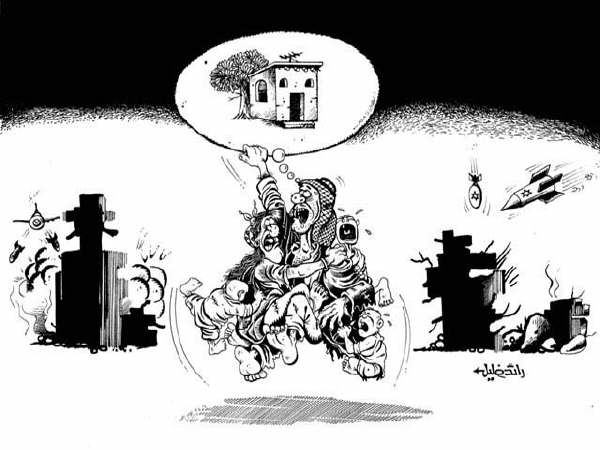
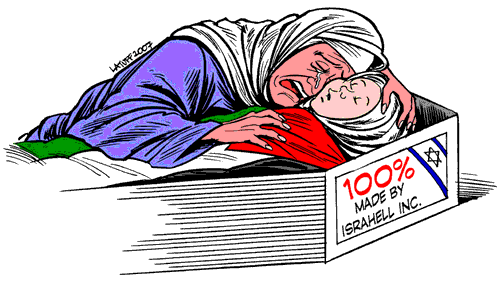


 Posts
Posts


